Archive for the ‘Movies’ Category
My Review of John Dies at the End is Now Up
Monday, February 25th, 2013The Trailer for John Dies at the End
Sunday, February 24th, 2013I’m going to have a review of John Dies at the End up over at Locus Online tomorrow. In the meantime, here’s the trailer:
The movie is based on David Wong’s novel of the same name, the protagonist of which is named David Wong. A sequel, This Book Is Full of Spiders: Seriously, Dude, Don’t Touch It, is now out, and even has its own trailer:
The movie is only showing in a few theaters nationwide (including the Alamo Drafthouse Slaughter Lane in Austin), but it’s also available for video download through Amazon and elsewhere.
Movie Review: The Love God?
Thursday, February 14th, 2013The Love God?
Director Nat Hiken
Writer Nat Hiken
Starring Don Knotts, Anne Francis, Edmond O’Brien, James Gregory, Herb Voland, Maureen Arthur, Maggie Mancuso and B.S. Pully
The concept of The Love God? is as amusing as it is absurd: Don Knotts not only as an unwilling Hugh Heffner, but also as an unaware object of unbridled feminine lust. (If Don Knotts as sex symbol seems beyond the realm of possibility, consider that in 1969, his separated at birth twin was precisely that.) Knotts plays his usual nervous-nebbish-with-a-heart-of-gold character, and the movie plays out very similar to his more famous works, save for the suggestive nature of the material. And it is only suggestive; it’s about the cleanest film you could ever make about a dirty magazine.
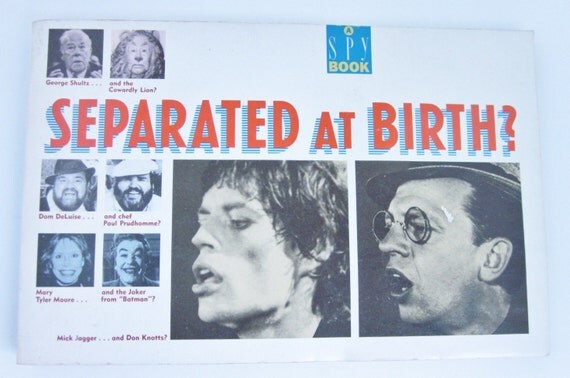
Part of the charm of the film is how it’s both strangely out of time and exactly of it’s time. You couldn’t have made a family movie about a dirty magazine too much earlier than 1969 because it would have been too risque to get greenlight by Hollywood. And you couldn’t have gotten it made too much latter, because the Sexual Revolution quickly become so sacred that no one in Hollywood would have been willing to make such ruthless fun of it, or have an ending that rejected it for the wholesome joys of marriage. One of the film’s funniest running gags is the “hip” fashion atrocities they foist onto our blithe protagonist, which obviously couldn’t have come from any era but the late 1960s. By contrast, the “swinging” signature song “Mr. Peacock” would have been considered too old-fashioned for the 1950s, much less the era of Jimi Hendrix and The Rolling Stones. Also, the characters are mostly stock types that could have appeared in most of Knotts’ other films. For a film that came out the same year as Midnight Cowboy and Easy Rider, it has all the edge of a bowling ball.
The movie starts in court (with a technically interesting multi-camera, multiple-window view of the scene along with the credits, and possibly the first use of it on film), with an oddly sentimental pornographer Osborn Tremaine (his wife is the proud covergirl of all his issues) getting a slap on the wrist from the judge on obscenity charges, only to have his precious 4th-class mailing yanked moments later. Shortly thereafter he’s driving through the sticks when he discovers that Abner Peacock’s (Knott) namesake bird-lover magazine The Peacock is on the verge of liquidation. Tremaine quickly rescues the magazine (and its fourth-class mailing permit) and sends Abner off on wild bird chase to South America. When he gets back, he discovers that Tremaine has remade the The Peacock into a porno mag, and Abner (still listed as the publisher) is under indictment as public enemy number one.
Abandoned by all but his innocent sweetheart Rose Ellen (Maggie Mancuso, playing wholesome, loyal, and very dim), Abner is about to put his head in a noose (literally; a pretty dark touch for a Knotts film) when two ACLU types show up at his door promising to pay for his defense and hire the best attorney money can buy to support free speech.
At the obscenity trial, the Attorney General (Herb Voland) condemns Abner with delicious gusto:
I have another duty, a higher duty to perform. And that is to protect you, your children, the very morality of our nation, from the smut and moral corruption spewed forth like garbage from the lecherous, vile, lewd and licentious mind of this filthy, little degenerate! Look at his face. It is the face of a smut monger. Look at his body: thin, wasted away by the dissipation and debauchery of a life of unspeakable orgies and depravity!…He says he’s innocent. And he does look innocent…until you look into his eyes. They’re the eyes of a man obsessed by sex, eyes that mock our sacred institutions; “bedroom eyes,” they called them in a bygone day. They’re the eyes of a man whose lust knows no bounds, who lives but for corrupting others to a life of carnal pleasures and lewd designs. A man whose erotic desires and libertine practices are used to titillate the unsuspecting, who regards women as his playthings and would stoop to any depths to satisfy his pornographic tastes. The Marquis de Sade would have regarded Abner Peacock as a peer in his search for lechery. We can have a clean America, but only when we remove this sex-ridden smut peddler from the society he is bent upon destroying.
Then his own attorney, played by James Gregory (Angela Lansbury’s husband/patsy in The Manchurian Candidate and Barney Miller‘s inspector Lugar, along with a hundred other supporting roles) gets up and, ahem, defends him:
Your Honor, ladies and gentlemen, I have sat here and heard my client, Abner Peacock, called “a filthy, obscene degenerate; a sex-ridden, lascivious defiler of virtue whose lust knows no bounds, whose publications have plumbed the depths of degradation, and are a reflection of his own sex-obsessed mind.” We’re not going to argue about that. We can see that Abner Peacock is everything the Attorney General has told you he is. It is the unsavory creatures like Abner Peacock who test the strength of our Constitution, which, like our Rock of Gibraltar, has withstood challenge after challenge in protecting our freedom of the press through the years. Now, ladies and gentlemen, are we to stand idly by and allow the first crack to be made in this rock because of this dirty little pornographer? This is a dirty case and a dirty little man. It is with disgust to the point of nausea that I find myself sitting next to this filthy little degenerate! But when I see this filthy degenerate’s Constitutional rights being threatened, then I must take this filthy little degenerate into my arms, clasp him to my breast and fight for this filthy little degenerate’s Constitutional rights and liberty with my very life!
You just don’t see enough people called “filthy little degenerates” these days.
Naturally Abner is acquitted.
With all the publicity, Tremaine knows he has a goldmine on his hands, but can’t raise the money to do the huge print run required to capitalize on it. This necessitates a visit to mobster “Icepick Charlie,” who’s mad for sophistication and self improvement (he has a tutor in to teach a new word every day). Charlie not only wants to underwrite the most sophisticated dirty mag in existence, he thinks he should be the publisher. He hires up-and-coming powerhouse journalist Lisa LaMonica (Anne Francis, still incredibly hot 13 years after Forbidden Planet) to edit The Peacock. She agrees, but on one condition: Abner has to stay on as figurehead, since the trial has made him the lust object of the nation’s id.
Abner just wants to clear his name, and assert that he’s just a clean, wholesome guy, but everyone from his lawyers to the magazine backers insist he must stay on for the sake free speech, and set him up in a penthouse (outfitted in the finest Late Bordello Red Velvet fashion) with french maids and his own “Peacock Pets.” Despite his wholesome nature, Abner (like all Knotts characters) isn’t exactly the the strongest-willed of men, and soon finds that a guy could really get used to the Hef lifestyle…
One of the high points for modern viewers of the film is the stunning array of “hip” outfits Peacock sports. Like this:
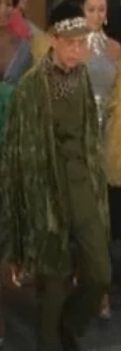
Or this:
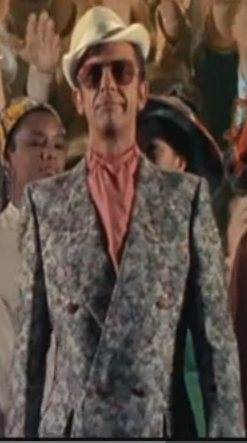
Or even this:
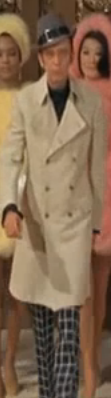
And this is so far over the top, it’s almost awesome:

The running joke, of course, is that Abner, far from being a filthy degenerate, is still pure as the driven snow, and spends his spare time teaching his Pets bird calls. Despite the supposedly risque nature of the material, The Love God? plays out like Knotts other star vehicles from the period: nebbish elevated through fluke to exalted status, fall flat on his face, suffers abject humiliation, is abandoned by his friends, triumphs through combination of honesty, good-natured perseverance and a bit of luck, and gets the girl in the end. It works well not only because Knotts was a master of the type (as his five Emmys for Barney Fife attest), but because no matter how grandiose his pretensions or painful his embarrassment at falling woefully short of them, he never loses the audience’s sympathy. Orwell famously noted that “any life when viewed from the inside is simply a series of defeats,” and Knotts’ characters not only garner more than their fair share, but also stand in for our own. The gulf between his character’s self-image and reality may be vaster than our own, but we’ve all suffered social faux pauxs. We’re willing to enjoy his abject humiliations because we know, in the end, he’ll overcome them; pathos rather than bathos.
Also, like Knotts’ other starring vehicles of the period, The Love God? is pretty funny. Lisa falls for Abner despite the obvious absurdity (“He’s a big square! (pause) Just like the one my mother married.”), and Icepick Charlie falls for her, setting up one of the stranger love triangles in cinema history (or love quadrilateral, counting Rose Ellen). There are pieces that don’t quite work (the birdcall song refrain bit falls a bit flat), but most do. Like many of Knotts’ other films (or a Shakespeare comedy) it ends with a wedding.
In this clip, British comedian Stephen Fry observes that American comedians like to be the triumphant trickster, while British comedians like to play the mournful failure.
And, as a broad generalization, fair enough. But this quick and dirty bifurcation ignores not only the many straight man/fall guy comedic pairings on both sides of the Atlantic (Laurel and Hardy, Abbott and Costello, Cook and Moore), it ignores Knotts’ entire career as the quintessential victim.
The movie was written and directed by longtime TV writer Nat Hiken, who died before his debut film was released. That’s a shame, as it’s really well-written, smoothly executed comedy of much the same pace and style of other comedic films of the era (How to Succeed in Business Without Really Trying comes to mind).
I missed the chance to see Joe Bob Briggs introduce a showing of The Love God? at the Alamo Downtown, mainly because it’s a hassle to get downtown by 7 PM these days.
You can get The Love God? as part of the Don Knotts Reluctant Hero 4-pack, which also includes The Ghost & Mr. Chicken, The Reluctant Astronaut and The Shakiest Gun In The West. That’s a lot of Knotts for your buck…
Dwight and I saw this at the same time, and he has a review up as well.
Big Ass Spider
Wednesday, February 13th, 2013Here’s a trailer for the forthcoming film Big Ass Spider:
It’s every bit as good as you would expect a trailer for a film called Big Ass Spider to be.
I’m pretty sure the intro at the beginning of the clip was timed just right to make the bikini volleyball scene show up as the default YouTube image…
“Movie 43 is the Citizen Kane of awful.”
Monday, January 28th, 2013So sayeth Roger Ebert about the latest movie from Peter Farrelly. When Ebert says a movie is worse than Freddy Got Fingered, you know that all lower bounds of the barrel have been breached.
More nuggets:
Farrelly was going for a 21st century version of “The Groove Tube” and “Kentucky Fried Movie,” two very funny, very raunchy and very influential sketch-comedy flicks of the mid-1970s.
The only thing “Movie 43” has in common with those movies is it’s in color.
Also:
Academy Award winner Halle Berry no longer can cite “Catwoman” as the low point of her career.
Ebert gave it Zero Stars. Yet, for some reason, his readers have given it four. Go figure.
Movie Review: Django Unchained
Monday, January 21st, 2013Django Unchained
Directed by Quentin Tarantino
Written by Quentin Tarantino
Starring Jamie Foxx, Christoph Waltz, Leonardo DiCaprio, Kerry Washington, Samuel L. Jackson, Walton Goggins, Dennis Christopher, James Remar, David Steen, Laura Cayouette, Don Johnson, Ato Essandoh
Django Unchained may not be Quentin Tarantino’s best film, but does seem to be the film that comes closest to fulfilling his vision for what he wanted it to be. He wanted to make a big-budget, hyper-violent, A-list, American spaghetti western antebellum slave revenge thriller. Django Unchained is such a perfect realization of that goal that I doubt anyone will ever attempt to do the exact same thing ever again.
Also, it’s a film that admirably self-selects its audience. If you think you’ll like it, you’ll probably really, really like it. If you think you’ll hate it, you’ll probably really, really hate it. It’s not a film for the faint of heart, or those with a low threshold for movie brutality.
If you’ve seen the trailer, then you know the basic setup: German bounty hunter Dr. King Schultz (Christoph Waltz) frees slave Django (Jamie Foxx) to help him track down three brothers he can identify, then makes him his partner in the bounty hunting business. A bit later, they go to rescue Django’s wife (Kerry Washington) from the clutches of Mississippi plantation owner Calvin Candie (Leonardo DeCaprio). Stylish gunplay and general brutality ensues.
Like all Tarantino’s movies, there are postmodern nods and namechecks to previous films, including recycling the theme music from 1966’s Django for the opening titles. Unlike his previous films, Tarantino has done a better job sanding off the rough edges and toning down his showier stylistic flourishes. They’re still here, but seem like a more natural fit for the material, be it a slow motion montage as a procession rides past, or solarized flashbacks to Django’s slave past. Likewise, the digressions seem more organic to the film (a scene of proto-Klansmen bitching about the poor quality of eyeholes in their hoods is funny enough that you’re willing to overlook its shaggy nature).
The script is clever and fairly taut for its 165 minute running time, and it doesn’t have the dead spots of (for example) Inglorious Basterds. There are two or three plot twists, some more improbable than others. Django’s wife is named Broomhilda and speaks German (because her original owner was German), which not only makes Waltz perfect for the role Tarantino obviously wrote for him, but actually provides three or four handy plot points in a nice, tidy package. They have a clever plan to rescue Broomhilda. It comes really, really close to succeeding.
Acting ranges from the solid, to really good, to downright excellent. Bruce Dern and Don Johnson are just fine in supporting roles. Jammie Foxx is fine in what amounts to a Shaft Kicks Dixie’s Ass role, though suffers in comparison to Clint Eastwood’s Man With No Name. Waltz is very effective in his hand-crafted role of a learned, articulate man who hates slavery and kills people for money, though it’s less of a revelation than his Oscar-winning turn as Hans Landa. Samuel L. Jackson finally gets to play a villain worthy of his simmering rage.
But for me the best performance is the movie is DiCaprio’s Candie, a plantation owner whose southern hospitality doesn’t prevent him letting a runaway slave get ripped apart by dogs, and his fury at finding himself being played is something to behold. The trailer suggested he might be playing it to broad and jokey, but his actual performance is very nuanced. DiCaprio has steadily improved as an actor, and of what I’ve seen him in, this is easily his best work.
Of course, some of the usual suspects have gotten their knickers in a twist over an American spaghetti western depicting the evils of slavery. What do they want, to soft peddle the crimes of slavery instead? And those criticizing the film for being brutal and violent: Have you not seen a Tarantino film before? It’s like someone complaining that the Seventh Season of South Park is full of potentially offensive humor. Really? You don’t say?
As previously noted, those with a low threshold for bloodshed and brutality should stay far, far away. As Dwight noted after we left the theater, “I hope they gave the squib guy a bonus.” But if you like Tarantino, here he’s pretty much at the top of his game.
And if I had known that the action figures would be discontinued, I would have picked some up.
I Have No Idea What Upstream Color is About
Thursday, January 17th, 2013So Shane Carruth, the director of Primer (which you should all see immediately if you haven’t already) has a new film coming out called Upstream Color. Here’s the description from the IMDB:
A man and woman are drawn together, entangled in the life cycle of an ageless organism. Identity becomes an illusion as they struggle to assemble the loose fragments of wrecked lives.
From that description, I have no idea what it’s about. There’s an official site that’s equally non-informative. (And the film doesn’t seem to be coming to Austin soon.) There’s no source credit for H.P. Lovecraft, so presumably it isn’t the “The Colour Out of Space.”
There’s a trailer out:
The other two teaser trailers are equally mystifying:
After watching all of them, I still have no idea what Upstream Color about.
Rare Exports: A Weird Christmas Horror Movie
Monday, December 24th, 2012In his tomb in upthrust Lapland
Dead Kris Kringle lies dreaming
If you’re looking for a weird Christmas horror movie, you could do a lot worse than the Finnish movie Rare Exports. The son of a reindeer herder/butcher finds out that a team just over the border in Russia are drilling into a mountain they believe to be a tomb.
It quickly becomes apparent that the tomb is that of Santa Claus. And the real Santa Claus is not the jolly fellow of Coke commercials, but a fearsome punisher of the wicked that looks a lot more like Krampus:

What makes the film work is its cold, gritty, unsentimental realism. It really does look like it was filmed in a tiny village in Ass End of Nowhere, Finland. Save an unconvincing CGI helicopter at the end, and the strange coda that gives the film its name, I thought everything about the movie worked pretty well. Of recent Scandinavian horror films, I thought this worked better than Dead Snow, but not as good as Let the Right One In.
Worth viewing, and available on Netflix.
I was going to do a longer review, but I’m running out of Christmas.
Galadriel As You’ve Never Seen Her Him Before
Wednesday, December 19th, 2012
Earlier this year, science fiction writer and North Carolina State University professor John Kessel declared that “I know the world does not care, but nobody could pay me enough money to go see The Hobbit. Well, maybe someone could, but nobody is going to.”
The Internet knows how to respond to such statements.

Soon a fundraiser for the SFWA Emergency Medical fund was launched, with various levels of funding support:
$250 — Prof. Kessel goes to see The Hobbit (the upcoming Peter Jackson version, in a movie theater before the end of the year, no cop-out home screenings of the Bass-Rankin animated classic)
$750 — Prof. Kessel will either before or after the film eat Denny’s The Hobbit-themed Ring Burger
$1000 — Prof. Kessel will dress as Gandalf when watching the film
$2500 — Prof. Kessel will dress as Galadriel when watching the film
And the result?
Well, feast your eyes:
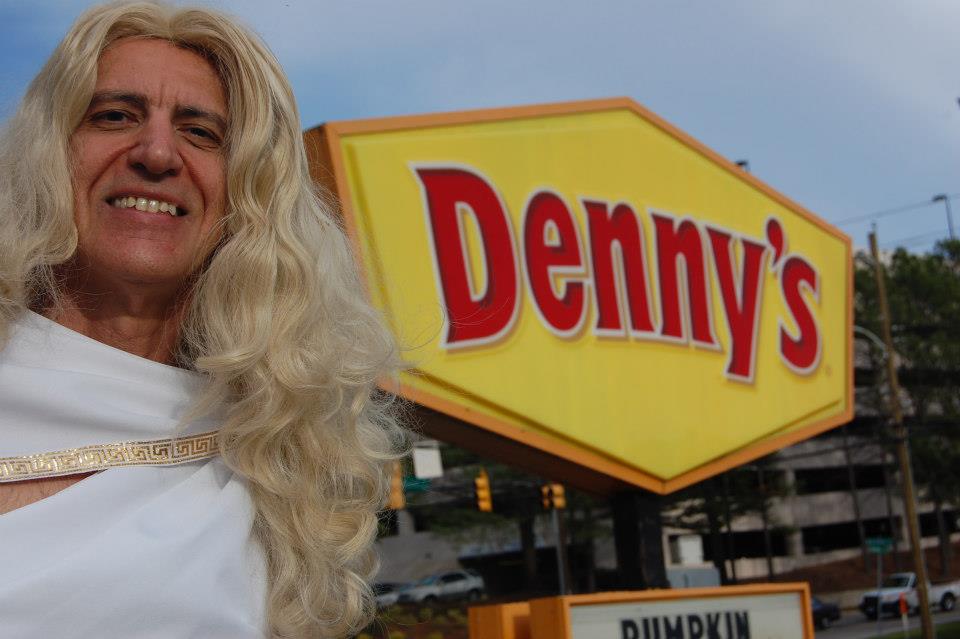
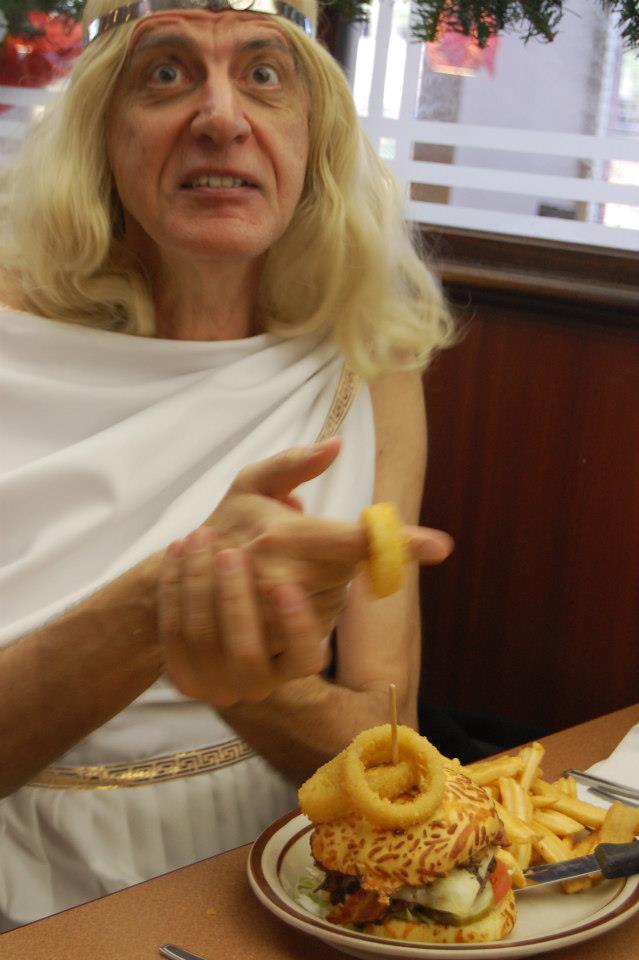
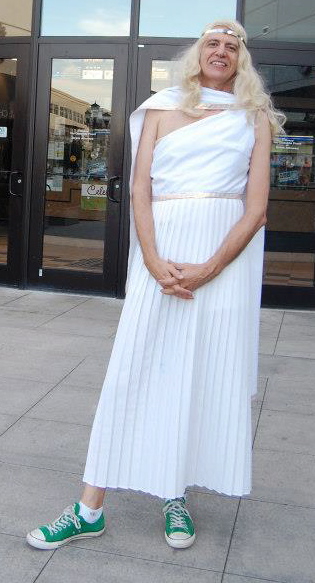
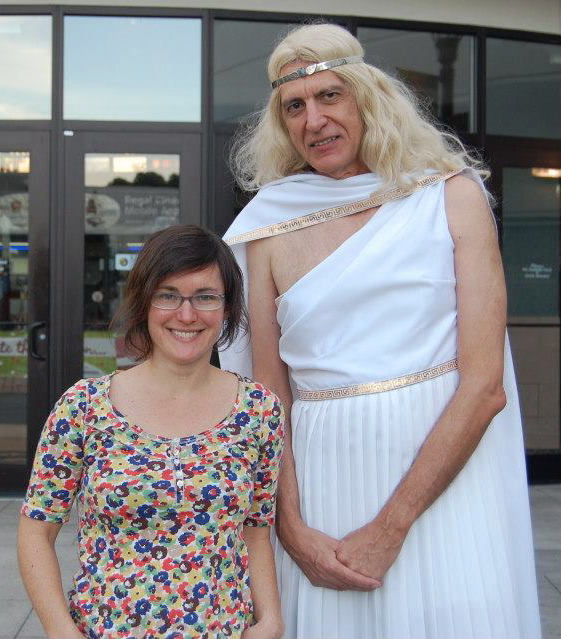
The last picture is with John’s “Hobbit escort” Kate Maddalena, who took these pictures.
Click any picture to embiggen and more fully display all of John Kessel as Galadriel’s, um, glory.
If you’re impressed by this outstanding display of selflessness (or else you have a fetish for really tall, butch trannies), you too can donate to the SFWA Medical Fund.
You might also pick up one of John’s swell books, like Good News From Outer Space, Corrupting Dr. Nice, or his short story collection The Pure Product.
(And thanks to John and Kate Maddalena for permission to use these photos.)
Howard Waldrop and I Review The Hobbit
Monday, December 17th, 2012I liked it more than Howard did.