Dick was already a major science fiction writer before he died, but since his death he has come to loom over popular culture in a way that other near contemporary SF writers of similar stature (say, Roger Zelazny, Samuel R. Delany, Harlan Ellison, and John Brunner) have not. Dick’s themes of paranoia and unreality continue to resonate in a world where almost every human action is permanently recorded, an where so many of us live lives half in a world of unreality (said a man typing in his blog).
Dick’s prose may often have been workman-like, but his vision and voice were unique, and his sheer productivity was staggering not only for its quality, but also it quantity. Between 1961 and 1966, Dick wrote:
That’s in order of composition. Some of those are minor works, and many were only published later or after his death, but five or six are considered classics. Had an otherwise unknown SF writer written just one Dr. Bloodmoney or Ubik, they would still be remembered today as the one-hit wonder of a minor classic. To think that Dick cranked them out in six years (and was just as productive writing short stories earlier in his career) is pretty mind-boggling.
I recently read Clans of the Alphane Moon on the way back from Stavanger, and I hope to have a review up in the not so distant future.
(Also, I have a few Dick firsts and paperback reprints available through Lame Excuse Books.)
It’s not a particularly good version, but I’m sure they’ll have time to improve before the final enslavement of humanity. Now you’ll have to excuse me, I have to write a quadrotor heist novel…
First up, from the world of auctioning, comes the offering of the exceedingly rare issue of June 1926 Zeppelin Stories pulp containing Gil Brewer’s “The Gorilla of the Gas Bags,” a holy grail for gorilla and zeppelin fans everywhere.
This issue formerly belonged to SF writer and pulp collector Frank M. Robinson. Bidding is currently up to $2,000, which does rather take it out of the impulse purchase range for me. Assuming, of course, that Rick Klaw, Jess Nevins and Mark Finn didn’t all chip in together to purchase it. But really, it’s a comparative bargain right now, since one just sold for $6,572.50…
Second, as seen on Fark, a giant mechanical gorilla was found abandoned in Witchford, Cambridgeshire, UK.
This piece has a lot going for it, even beyond the alteration, though I could do without the bit of black metal growling in the middle. Solines evidently hails from Denmark.
It reminds me a bit of the half of System of a Downs’ “Toxicity” that didn’t suck.
Although I usually let Dwight cover the catastrophic failure front, my visit to the Norwegian Petroleum Museum made me want to discuss something that wasn’t covered there (only mentioned in passing): the Piper Alpha disaster. Piper Alpha was not only the worst disaster to occur in the North Sea oil fields, it’s the worst oil-related disaster ever, with 167 men killed, and is an important lesson in cascading failure.
Also, it blew up real good:
That’s what happens when you start pumping 15-30 tons of natural gas into an existing fire every second.
Because the rig was completely destroyed, and most of the personnel on it killed, exactly how the disaster actually unfolded is unknown, but the official report reconstructs events.
Piper Alpha was originally an offshore oil rig that was converted to natural gas production. On July 6, 1988, technicians took one of two gas condensate pumps offline for routine safety valve maintenance, but weren’t able to complete repairs before a shift change, and thus left a temporary plate in place. Though they had filed paperwork to this effect, the information was not communicated properly to the next shift, and when the other pump failed, the crew activated the pump being repaired. This resulted in a high pressure gas leak when the temporary plate failed, and shortly thereafter by an ignition and explosion.
Though the rig had firewalls, because it was a former oil rig they were designed to contain fire, not explosions. Fire and smoke blocked access from the rig accommodations area to the lifeboats. The switch for the automated firefighting system was below deck and not activated, and the two crewman sent off to activate it were never seen again. The fire got so bad the control room was abandoned and no evacuation announcement was made over the rig’s loudspeakers. The fire would have gone out after the rig’s emergency shutdown switch was activated, except for the fact that Piper Alpha was being fed oil from two other nearby rigs. Worse still, Piper Alpha was still being fed pressured natural gas from two 24 to 36 inch pipes, which melted and burst in the fire, resulting in the huge fireball in the video above. (The gas feeds from the connected rigs hadn’t been shut off, but even if they had been, the lines were so pressurized that it would have taken hours for them to bleed off.) The explosion was so powerful it killed five rescued rig workers and two crewmen on the rescue ship, and guaranteed the complete destruction of Piper Alpha.
Time between the pump being switched on and the giant fireball: 25 minutes.
Only 59 rig workers survived.
Lots of factors contributed to Piper Alpha’s demise: multiple elements of poor design, an inadequate retrofit, inadequate lockout/tagout procedures, and insufficient safety and emergency training procedures. Together they resulted in a devastating series of cascading failures, creating a disaster far more deadly than any single one of them could have produced.
Piper Alpha changed numerous design and safety practices in the oil industry, ensuring that the series of failures that destroyed Piper Alpha can’t reoccur. But offshore oil rigs still remain one of the most dangerous and demanding working environments in the industrial world.
Wandering around Stavanger, I took pictures of some the statues, none of which were impressive. “Expressionless men in hats staring off into the distance” seemed to be the dominant motif.
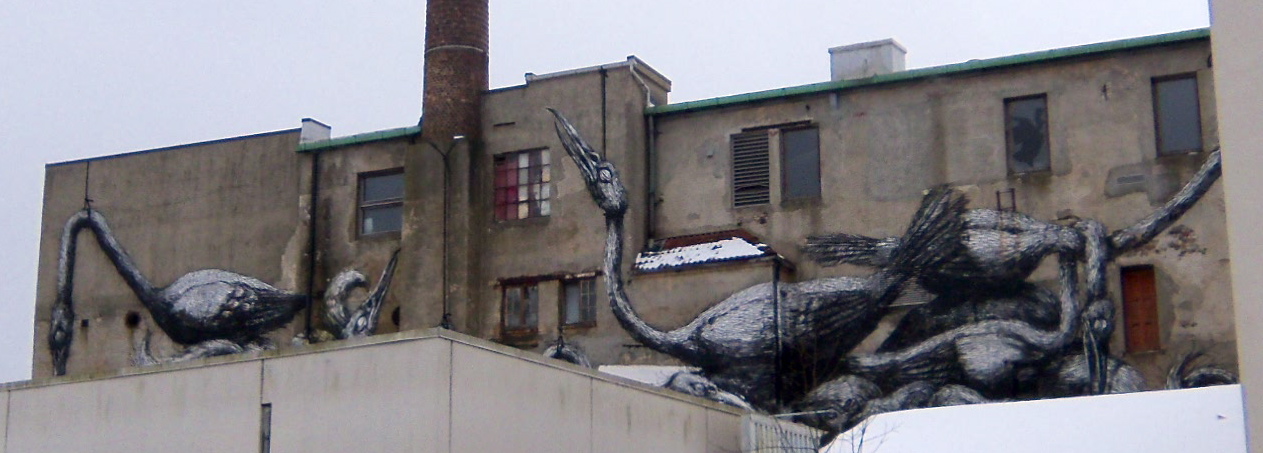
Indeed, the only art that really knocked me out while I was this weird mural of herons on the back of a (for lack of a better word) tenement building there:
Turns out it was done by a Belgian street artist named ROA from something called the “NUART Landmark Series.” ROA seems to have done lots of cool, freaky animal murals in other cities, but very few people will ever see the one in Stavanger…
I don’t know the actual address of where this building is. To see it, walk down along the road on the south-east shoreline from the Oil Museum, then jog north on Verven (I think) where there are a bunch of apartment buildings in the shadow of the Stavanger Bridge until you come to a circular pond/park/dog park right beneath the bridge, then look back toward the center of the city.
I just got back from spending two weeks in Stavanger, Norway.
A. Rhetorical Device: What made you decide to vacation there?
It wasn’t a vacation, it was a business trip. Nobody goes to Stavanger on vacation. It’s essentially the Norwegian equivalent of a New England fishing village that suddenly had an oil boom, thanks to the North Sea. People go there because they work for a company in the oil business, which is why I was there.
A. Rhetorical Device: Are you saying it’s a hellhole?
Not at all. The center of town is general clean, attractive and picturesque, pretty much everyone speaks English as a second language, and the hotels have all the modern amenities.
A. Rhetorical Device: So what’s the problem?
Unless you like pub crawling (I don’t), there’s nothing to do there. You can see pretty much everything downtown in an afternoon, including the Norwegian Petroleum Museum (more about which later), and I wasn’t pining to see the fjords. Beyond that it’s business parks and suburbs, and the sun was rising when I went to work, and setting when I went home. There were maybe three days that weren’t rainy, snowy or overcast. Plus everything is twice as expensive (at least) as it is in the U.S. My hotel hamburger clocked in at $30.
A. Rhetorical Device: So why are you bringing this up?
I’m glad you asked, Mr. Rhetorical Device! Things are going to be a bit slow while I wait for my mind to catch up to my body, so expect several Stavanger-related posts while I get back up to speed.
A. Rhetorical Device: Wait, you don’t mean—
Yes. Vacation pictures, starting with this broad pond in the center of the old part of he city. Click to embiggen.