By serendipitous chance, I have stumbled across the most delicious potato chips I’ve ever tasted.
You’re probably thinking “Oh, they’re probably truffle-flavored French potato chips you found at Central Market, and they’re $20 a bag.”
No. I found them at a convenience store in a combination Chevron/ McDonald’s in Cedar Creek on Highway 71 between Bastrop and Austin, they’re roasted garlic flavor, and they’re 79¢ a bag. And they’re made, of all places, in Detroit.
Behold Uncle Ray’s Roasted Garlic Potato Chips:
They taste like a really good slice of garlic bread, except saltier and crisper.
I don’t often eat potato chips (for all the obvious reasons), but if Central Market did have these, I’d definitely stock up for my next party…
I’ve seen some other videos of lanterns be floated over Poland as part of their midsummer festival, but I thought this was just too cool looking not to post.
Here’s a Top 100 List broken out by sub-genre. Unfortunately, in addition to expanding the list to include things like Westerns, it also lets some dubious crap in. (Constantine and Rendition? Really?) And Ronin is a great car chase surrounded by a pretty mediocre thriller.
The impression I always had is that all of Lovecraft’s works that weren’t already in the public domain passed into in 2007, 70 years after Lovecraft’s death, under the terms of the Berne convention. But the story of who owned what before that point is quite tangled indeed…
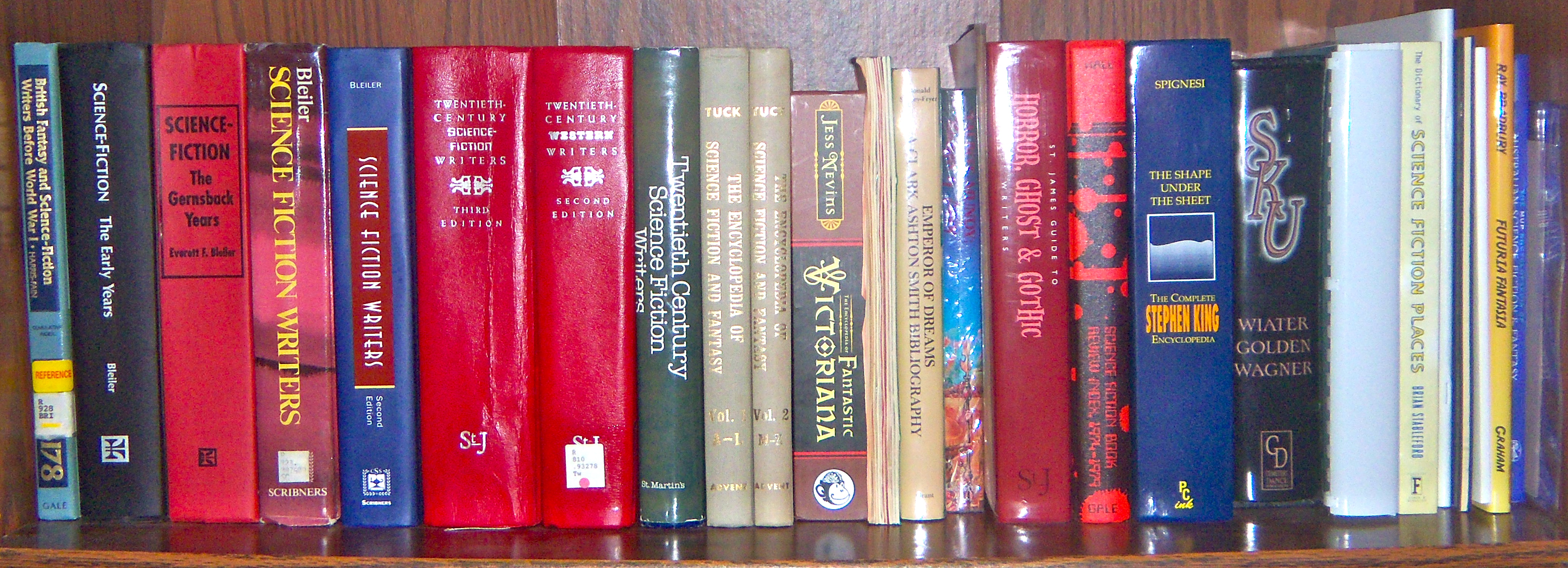
And here’s the second part of my series on my reference library. The last installment dealt with the books I reach for most often. The reference works listed in this post share only size, being too big for most of my other shelves, which is why they’re filed here. Some of these (the Nevins, the first two Bleilers) get a lot of use, while others almost never get taken down (things that have been superseded by both the Internet and the two Clute encyclopedias).
(Click to embiggen.)
I’m not going to do a full run-down of publication dates, etc. for everything, but here’s a general overview of what’s here:
Harris-Fain, Darren, editor. British Fantasy and Science-Fiction Writers before World War I (Gale Dictionary of Literary Biography Volume 178). Eclectic selection, but a very solid work for the writers (about half the volume) who aren’t well-covered in other references.
Vinson, James and D.L. Kirkpatrick, editors. Twentieth Century Western Writers. It was cheap. Like, $2 at a library sale cheap…
Tuck, Doanld H. The Encyclopedia of Science Fiction and Fantasy. Two volumes. Another book set superseded by the two Clute Encyclopedias.
Nevins, Jess. The Encyclopedia of Fantastic Victoriana. MonkeyBrain Books, 2005. Extremely useful work, but not quite worth the $2,000 some people are asking for online…
Bell, Joseph. Les Bibliotheques Howard Phillips Lovecraft (Volumes 1-8). Soft Books, 1984-1987. Weird, eight volume, stapled paper-wrappers collection of various H. P. Lovecraft-related bibliographic tidbits. Huge overlap with the Joshi bibliography and the catalog of the Grill-Berkin collection (both of which I have), but some odd and interesting information for the Lovecraft fanatic (of which there are many). I will probably do a separate post on my collection of Lovecraft reference works sometime in the indeterminate future…
Sidney-Fryer, Donald. Emperor of Dreams: A Clark Ashton Smith Bibliography. Donald M. Grant, 1979. If this isn’t the most irritatingly organized single-author bibliography of all time, it’s not for want of trying…
Day, Bradford M. Materials Toward a Bibliography of the Works of Talbot Mundy. Science-Fiction & Fantasy Publications, 1955. My copy was beat to hell when I got it, and it was regarded as not entirely accurate even when it was produced. A historical curiosity only.
Pringle, David. St. James Guide to Horror, Ghost and Gothic Writers. St. James Press, 1998. A lot less superseded than the SF & Fantasy works, but unless it’s something quite modern, I’ll generally reach for Bleiler’s The Guide to Supernatural Fiction instead.
Hall, Hal. Science Fiction Book Review Index, 1974-1979. Gale, 1981. If you need it (and you know who you are), you need it.
Spignesi,Stephen J. Shape Under the Sheet: The Complete Stephen King Encyclopedia. Popular Culture Ink., 1991. A mixture of the really useful and the completely worthless.
Wiater, Stanley, Christopher Golden and Hank Wagner. The Stephen King Universe: A Guide to the Worlds of Stephen King. Cemetery Dance, 2001. Signed, slipcased edition. I don’t have too many King reference works, but I’ve got these two. (Plus Hank use to do a lot of reviews for me back in the Nova Express days.)
Turner, George R. (Bruce Gillespie, editor) SF Commentary 76: The Unrelenting Gaze: George Turner Non-Fiction: A Selection. A hefty selection of commentary, reviews, etc. from the dean of Australian SF writers. The full text is available online.
Wright, H. Stephen. Philip K. Dick: A Secondary Bibliography, 1960-1983. Just what it says. Bound pages. Not a particularly common work. Like Lovecraft, I plan on doing a future post on my Philip K. Dick reference works.
Shoaf, Eric C. Collecting William S. Burroughs in Print: A Checklist. Ratishna Books, 2000. Bought this off eBay back around 2001, and was initially disappointed that it was just bound pages, but this is actually a really solid bibliography. For example, there’s an in-depth history of the Grove Press publication of Naked Lunch.
Bradbury, Ray. Futuria Fantasia. Graham, 2007. Hardback reproduction of four issues of an early fanzine Bradbury published. I’m guessing the green ink is designed to matched the original look of the fanzine, but man, it’s really hard on the eyes…
Science Fiction Bibliography, Volume 1, Number 1 (and only). Science Fiction Syndicate, 1935. A curiosity, being the first published science fiction bibliography on record (and published here in Austin, no less). Mainly reviews fanzine and magazines you’ve never heard of, condemning some as complete worthless. No author listed, but it was apparently a D. R. Welch, the first used SF book dealer in Austin. Picked up for $35 back when Currey was asking $100 for it. Mainly useful as something to pull out for guests and go “Look! The first published SF bibliography!” and watch them nod indulgently.
In the 1980s, two of my favorite albums were soundtracks David Byrne did as odd side projects: Music from The Knee Plays, Byrne’s linking music for the never-staged 9 1/2 hour Robert Wilson avant-garde musical spectacle the CIVIL warS: a tree is best measured when it is down, which was also supposed to have music by Philip Glass and Gavin Bryers. (The Glass music was eventually released, and which I also recommend; as far as I know the Bryers pieces haven’t been), and Sounds From True Stories, the soundtrack of incidental music from his quirky film True Stories, which shares some themes with the Talking Heads album of the same name.
And then both of them went out of print and, for the longest time, never came out on CD. This was deeply frustrating, because my old record player finally gave up the ghost, and besides The Forest and “Hanging Upside Down,” those two albums contain Byrne’s best solo work.
Finally, a few years ago, Knee Plays came out, and is well worth picking up for tracks like “Winter” and “In the Future.” (I saw The Dirty Dozen Brass Band perform live accompaniment to a sort of mime show at the Bass Concert Hall way back in the dim mists of time.)
But I still wait in vain for Sounds From True Stories to be released on CD or MP3.
Fortunately, someone has put up all the tracks on YouTube (complete with LP pops and hisses). So here are all the tracks in order. Consider this a chance to enjoy a great, lost David Byrne album (and provide a kick in the butt for Byrne and whoever owns the Sire back catalog to stop dicking around and release it to CD or iTunes).
The album contains a wild variety of styles, with Country and Western, Lounge Jazz and Tejano among them. if you don’t want to listen to all of them, try “Dinner Music,” “Mall Muzak,” and “Glass Operator.”
January 2017 Update: The previous source of these has been kicked off YouTube, so I went out and found what replacements I could:
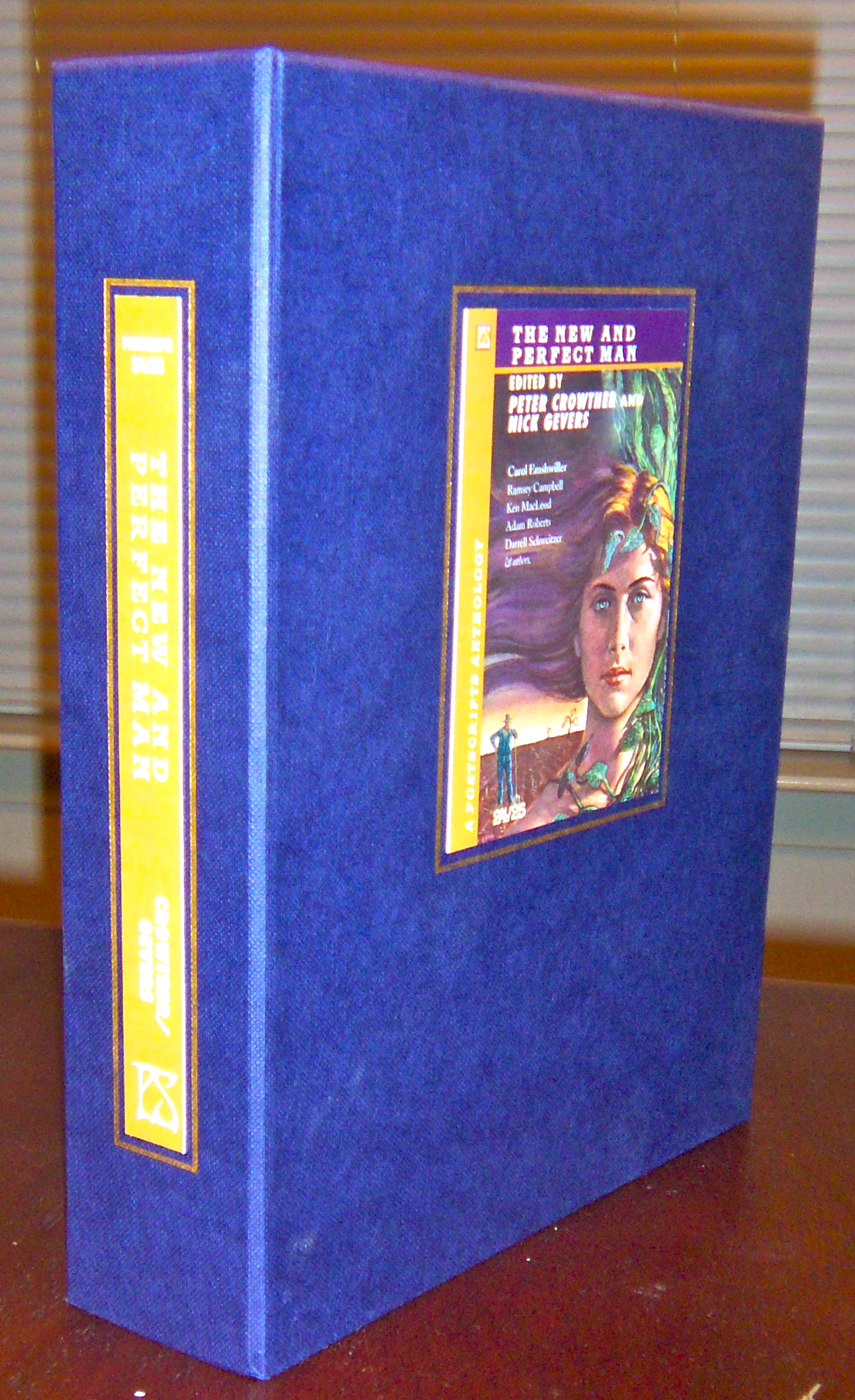
Here’s the traycase the signed, limited edition comes in:
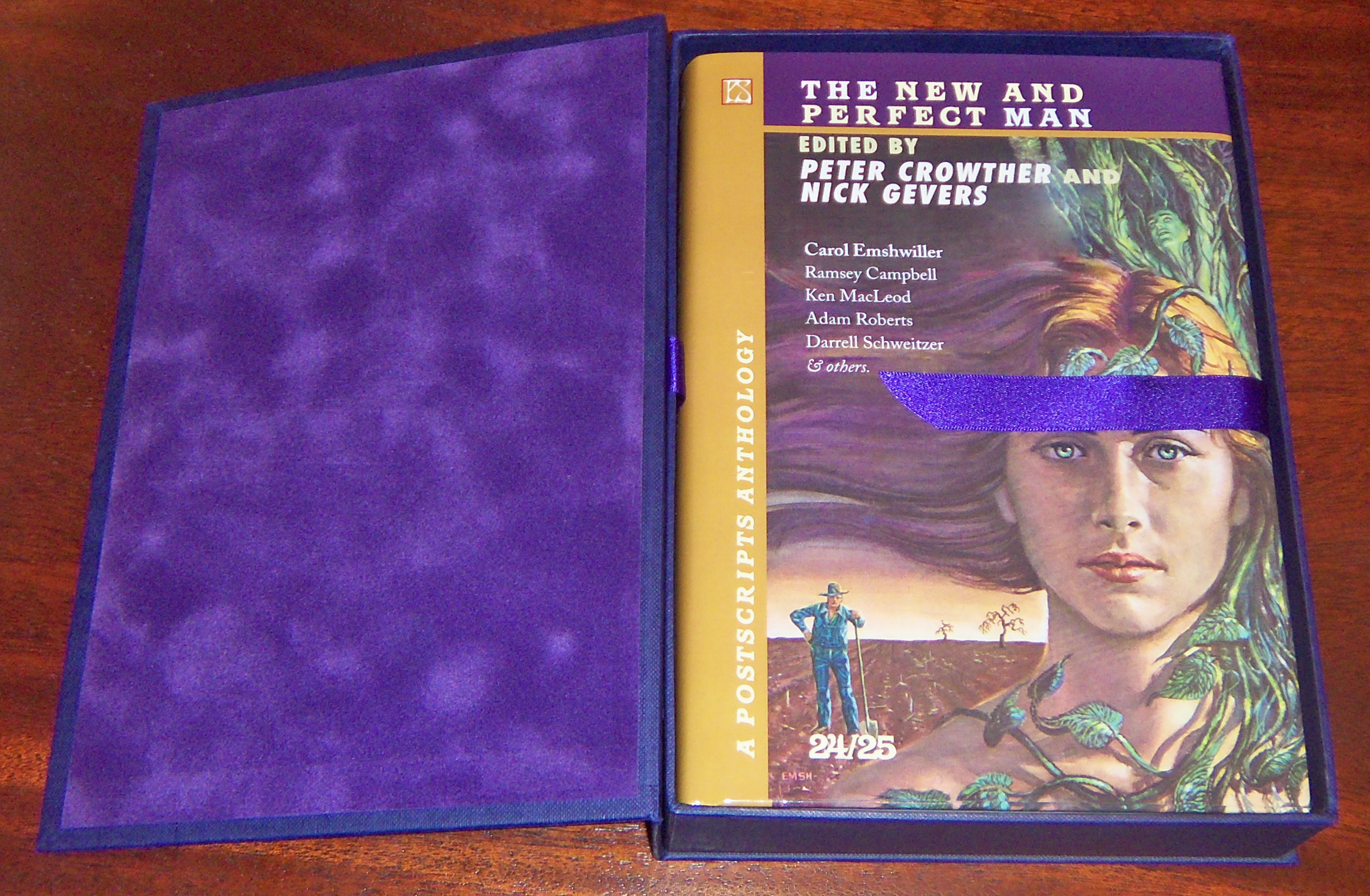
And here’s the book itself nestled snugly inside that traycase:
It was actually an unusually long journey for the anthology to be published, as one of the sets of signature sheets got lost in transit, which set back the publication timeline considerably.
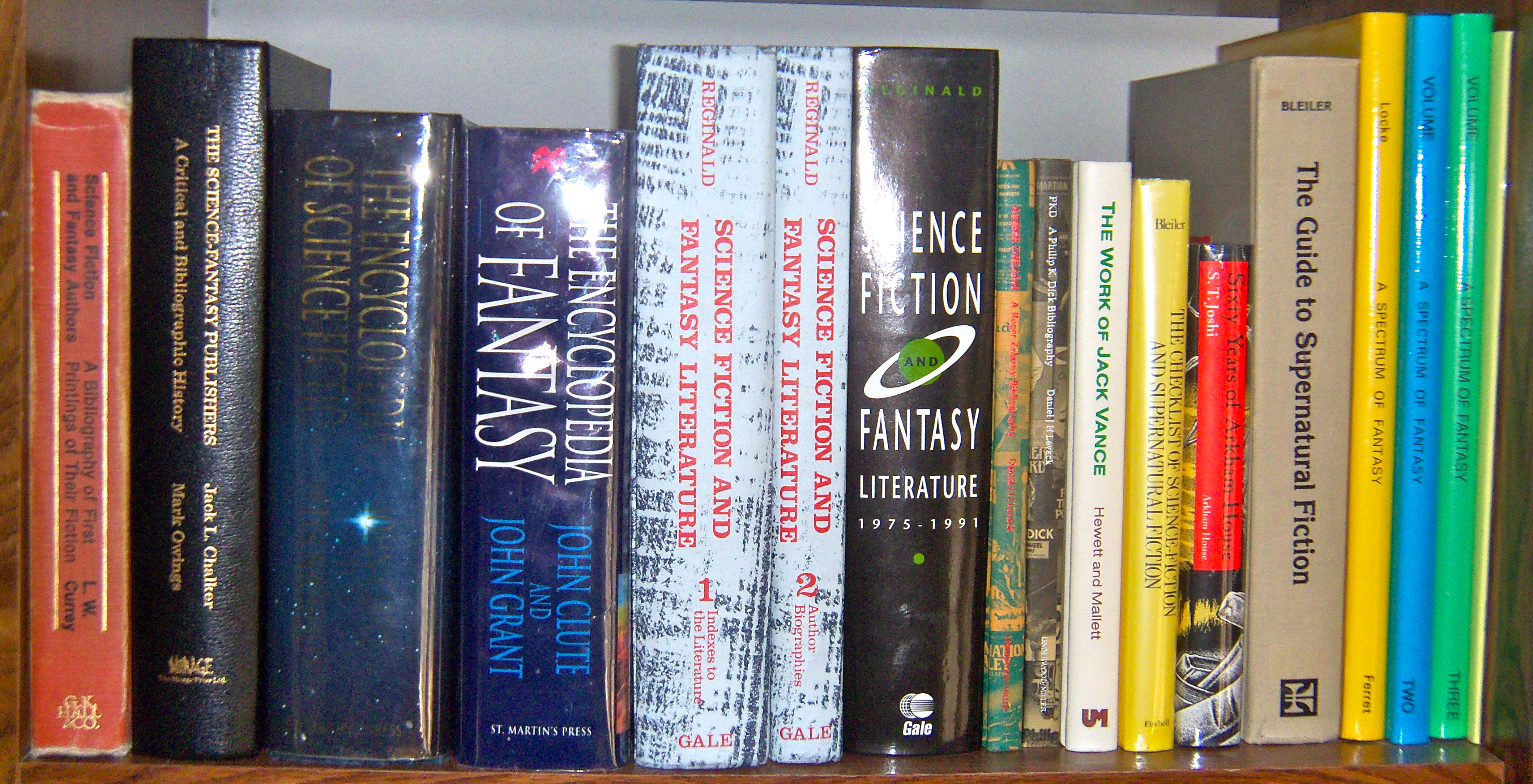
I haven’t posted much the last week because I’ve been busy doing this and that, and one of the things I’ve been busy with is a long-overdue cleanup of my office, including doing something about those Nova Express review copies cluttering it up. Now that I’ve finally finished moving books around, and gotten a new camera (a Kodak Slice) to replace the one that died, I thought I would put up some long-overdue pictures of the books in my office, starting with the reference shelf right next to my computer, which contains the reference works I tend to reach for most often.
(Click to embiggen.)
Going left to right (left being the side closest to the computer, and thus the books I reach for most often) are:
Chalker, Jack & Owings, Mark. The Science Fantasy Publishers: A Critical and Bibliographic History. Mirage Press, 1991 (“Third Edition Revised and Enlarged”). If you’re a serious SF collector, you need this. The problem is, you can’t trust it. No other reference work offers the wealth and scope of knowledge of SF small press publishers that this one does. There’s a lot of good information in here. The print edition shown above had major errors and omissions, and a very odd organizational structure, not to mention several sneers and the constant sound of ax-grinding for SF figures the authors disagree with; the CD-ROM version is more accurate, but no longer up to date as both Chalker and Owings have died. What this book is best for is the chatty, informative histories of the various publishing houses listed here. (If nothing else, I can unstintingly recommend this book for anyone thinking of starting up their own small press, as it provides numerous examples of what not to do.) It’s also quite useful for uncovering titles and publishers you might not have known existed before. In summary: A valuable tool for those who possess enough experience in the field to know which parts to take with a grain of salt.
Clute, John, & Nichols, Peter. The Encyclopedia of Science Fiction. St. Martins, 1993 (first U.S. edition, offset from the same plates as the Orbit (UK) first). An absolutely essential general reference work.
Clute, John, & Grant, John. The Encyclopedia of Fantasy. St. Martins, 1997 (first U.S. edition). Slightly more scattershot than the above, but still an essential guide.
Levack, Daniel. Amber Dreams: A Roger Zelazny Bibliography. Underwood Miller, 1983. The first of the single-author bibliographies.
Levack, Daniel. PKD: A Philip K. Dick Bibliography. Underwood Miller, 1981. I have a copy of the trade paperback edition for sale over on the Lame Excuse Books page.
Hewett, Jerry. The Work of Jack Vance: An Annotated Bibliography & Guide. Borgo Press/Underwood Miller, 1994. I know Jerry pretty well, and not only has he signed my copy, he crossed out “Borgo” and wrote in “Bozo” on the title page. I think he had some problems dealing with them…
Bleiler, Everett F. The Checklist of Science-Fiction and Supernatural Fiction. Firebell, 1978. Slightly updated edition of Bleiler’s classic Checklist of Fantastic Fiction (which I have on another shelf), and an absolutely essential reference work for older SF/F/H books.
Joshi, S. T. Sixty Years of Arkham House. Arkham House, 1999. Not 100% accurate, but essential none the less.
Bleiler, Everett. The Guide to Supernatural Fiction. Kent State University Press, 1993. Very good, and very solid, as a general reference work, but not really concerned with first edition points.
Locke, George. Spectrum of Fantasy I-III. Ferret Fantasy, 1980-2002. Perhaps the only SF dealer as knowledgeable as Currey. These are Locke’s descriptions of his own personal library of fantastic fiction. Quite enjoyable works, and George is a nice guy.
One guideline I’d offer aspiring SF/F/H book collectors is: Don’t skimp on the reference works. Some of these books can be expensive, but all it takes is one real find (or one expensive dud avoided) for a good reference work to pay for itself.
More pictures of my reference library when I have the time…
At the center of every solar system, perhaps, there’s not a benevolent disc that paints the world with light and heat, but a raging devil shouting its hate wordlessly across the void….Every civilization that has ever, and will ever, exist in this galaxy or the millions of galaxies in the heavens, revolves around a suicide bomber.
I just thought that was a nifty turn of phrase and, being in a part of Texas suffering from one of the worst droughts ever, it struck a certain chord…