I’m not a huge Orson Scott Card fan. I thought Ender’s Game was an effective Heinlein juvenile homage, but little more. (I also thought Speaker for the Dead was actually a better, more ambitious novel.) I also thought that Seventh Son and Red Prophet were good alternate history fantasies, and “Hatrack River” (which forms the beginning of Seventh Son) was probably the best thing Card ever wrote. However, after reading Xenocide (awful) and Prentice Alvin (disappointing), I decided to stop picking up Card’s new books (the occasional Subterranean novella excepted), and haven’t regretted the decision. (Someday I may read Hart’s Hope, which some people have told me is his best.)
But after I stumbled across this at the nearest Half Price Books, I thought it was odd enough to be worth picking up, especially at 50% off $35 (marked down from $60) during the usual coupon sale.
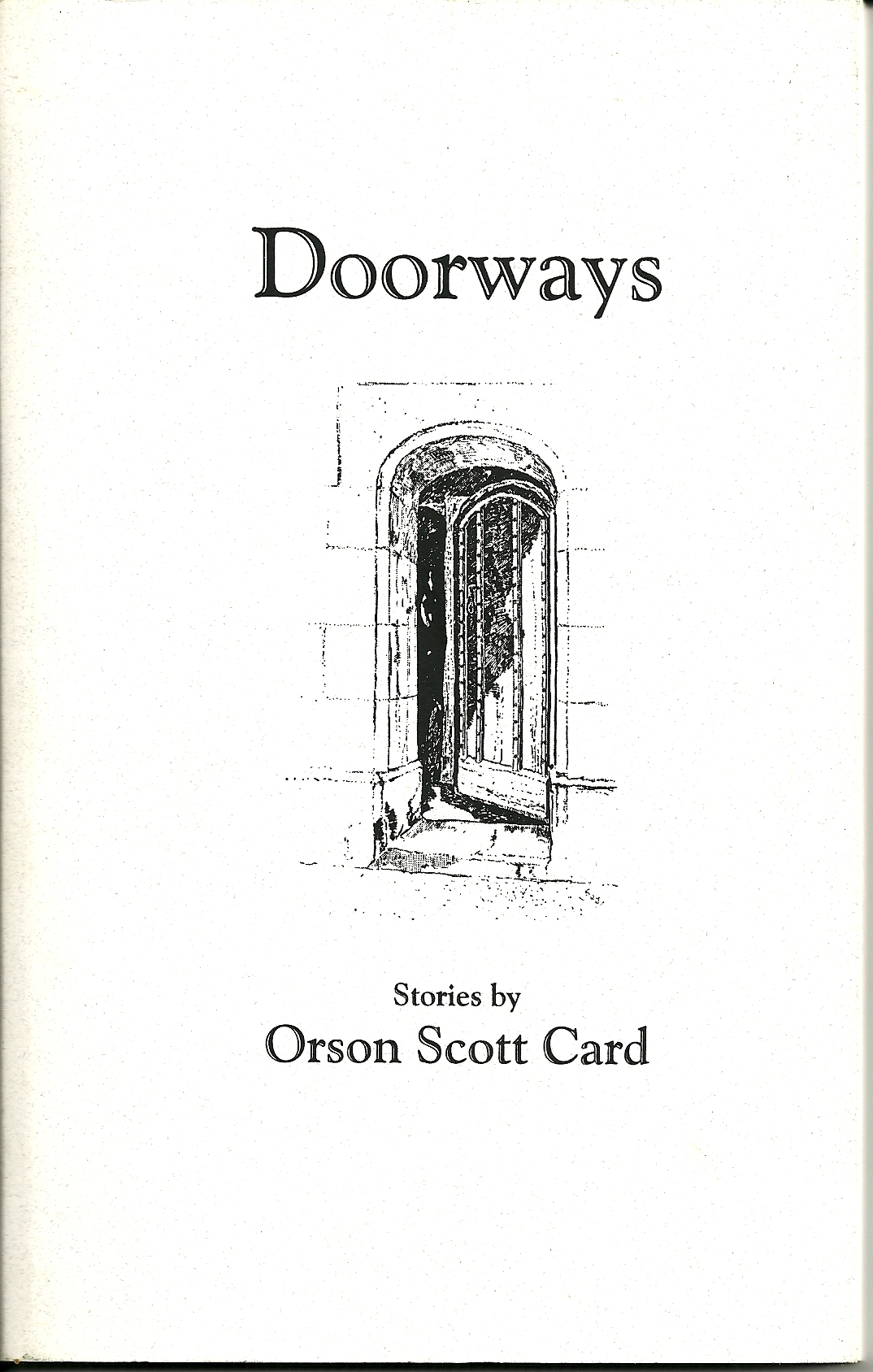
Card, Orson Scott. Doorways. No publisher listed (though I’m assuming this is Card’s own Hatrack River imprint), 2002. (Presumed) First Edition trade paperback original, perfect bound on white cardstock covers, a Fine copy, inscribed by Card: “to Sam—/Merrily…/Orson Scott Card”.
This is 98 pages long and contains two previously published novelettes along with several unpublished poems. If I had to guess, this looks like it might have been given away as some sort of promotional freebie on Card’s website.
Given how obscure this particular Card book is, here’s the complete list of contents:
“Oh Hurried Guest” (Dedication) (poem): Page 5
“Short-Lived Creatures” (poem): Page 6
“On Another Road” (poem): Page 8
“Doorways” (foreword): Page 9
“Fires” (poem): Page 12
“Angels” (novelette): Page 13
“Echo” (poem): Page 44
“Walking on Water” (poem): Page 45
“This Is the Poem I Made Then” (poem): Page 46
“Dust” (novelette): Page 47
“Public Father” (poem): Page 95
“Don’t You Remember the End of the World?” (poem): Page 96
“A Poem For Erin’s First Christmas” (poem): Page 98
1. Search for something in Google.
2. At the top of the search results page, click on “News.”
3. Instead of showing the news results on your search term, as it did every single day up until now, it blanks the search field and just show you a regular search page, rather than carrying over the term you just searched for.
Why, Google? Why you gotta play me like that?
(Note that I refrain from listing irritating Facebook changes, since those seem to occur every single day…)
I don’t tend to buy frozen pizza (for a lot of reasons), but I did recently pick up a Home Run Inn Meat Lovers Pizza at Central Market when I went there for salsa fixing. Though it does cost more than average (about $7.50), it turned out to be significantly better than your average DiGiorno’s/Red Baron/Tombstone “premium” meat pizza, with both better meat and a better crust. Anyway, if you’re near a Central Market and have a hankering for pizza, you could do worse…
Did you know that the first first filmed version of Frankenstein was not the James Whale movie, but a 1910 Edison studios film?
Though full of the hokey melodramatic tropes of early silent cinema, it actually follows the basic plot of the Mary Shelly novel more closely than the Whale movie, at least up until the happy (and vaguely slipstreamy) ending. The creation of the monster scene uses not one, but two special effects: running the film backwards and at high speed. I’m sure it blew people’s minds in 1910.
Jerry Pournelle and C. J. Cherryh have been among the first to report on the nefarious activities of Hephaestus Books, which seems to be publishing omnibus editions of hundreds or thousands of books which they haven’t bothered to obtain the rights for. I say “seems,” because a closer look shows that Hephaestus Books does seen to be ripping people off, but it’s the readers and buyers rather than the authors.
Since Jerry helped sound the alarm, let’s take this collection, titled Novels By Jerry Pournelle, including: The Legacy Of Heorot, The Mote In God’s Eye, The Gripping Hand, Footfall, Inferno (novel), Fallen Angels … Starswarm, Higher Education over at Amazon as an example. The text description reads:
Hephaestus Books represents a new publishing paradigm, allowing disparate content sources to be curated into cohesive, relevant, and informative books. To date, this content has been curated from Wikipedia articles and images under Creative Commons licensing, although as Hephaestus Books continues to increase in scope and dimension, more licensed and public domain content is being added. We believe books such as this represent a new and exciting lexicon in the sharing of human knowledge. This particular book is a collaboration focused on Novels by Jerry Pournelle.
The fact that the book length is a mere 82 pages should confirm that all the novels listed in the title are not in fact present.
So: They’re content scrapers, grabbing anything they can grab off the Internet (it looks like most of their content is scrapped off Wikipedia) and slapping it between two covers as a print-on-demand (POD) book. This is bad and dubiously legal practice, but their primary sin seems to be false advertising, since their “book” titles deceptively suggest that you’re buying an omnibus edition of fiction rather than a collection of stuff you can read for free on the Internet.
Personally, if I were in charge of Amazon or Barnes & Noble, I’d pull all the Hephaestus Books titles due to their dishonest tactics and customer dissatisfaction anyway. (I don’t think even my insane Jack Vance collector friends will be picking up this.) But from my cursory glance, it’s readers, not authors, who are the ones being ripped off.
For a while now, I’ve been posting about various Halloween horrors, real or imagined. Now I’d like to take you back to a time when the world went crazy, when paranormal phenomena entered the mainstream and the most ludicrous crap was fervently believed by otherwise normal and intelligent people.
I’m speaking of…
Having lived through the 1970s, I can assure you that it was a very strange time indeed, and not just for Nixon, Carter, disco and mood rings. It was also a golden age for paranormal crackpottery breaking into the mainstream.
Below is a roundup of all the paranormal beliefs I could remember that achieved a larger measure of widespread acceptance in the 1970s than any time before or since.
And remember: No matter how strange or bizarre some of the beliefs below, there were otherwise perfectly logical, rational people in the 1970s that believed in each of them…
Alien Abductions
Alien Abductions have been part of UFO lore for a while, and John G. Fuller’s book Interrupted Journey, about Betty and Barney Hill’s purported abduction by a flying saucer, came out in the 1960s, but the alien abduction phenomena only really took off with a TV movie based on the Hill book called The UFO Incident in 1974. (This will not be the last time that TV crops up on this list.) It’s available on YouTube, cut into non-embeddable segments, if you’re interested in viewing it. The story is told mostly through the hypnotism sessions of the Hills remembering the abduction, and James Earl Jones is very good as Barney Hill.
I can also assure you that for a 9 year old, it was terrifyingly convincing. I remember reading somewhere that the people who made The Blair Witch Project said that it was inspired by “based on real life” movies like this, because they were much more terrifying than anything you knew was fiction. I should also point out that American society as a whole was not nearly so jaded at the words “based on a true story” for a TV movie in the 1970s. Why would one of the only three broadcast networks want to lie to you?
Ah, the innocent days of youth.
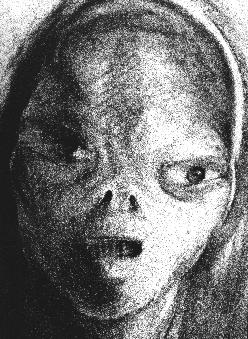
Interestingly, the pictures Betty Hill drew (or, in the case of the one below, I think had drawn based on her “recovered” memories) don’t look particularly close to your standard “alien Grays”.
The 1970s were also when painter and sculptor Budd Hopkins got interested in UFOs. Later he would start to hypnotize people complaining about “missing time,” only to discover that (surprise!) all of them were victims of alien abductions. What are the odds?
Thirteen years after The UFO Incident, Whitley Strieber would suddenly remember that someone shoved an eggbeater up his butt, and the whole new generation of alien abductions was born.
Philip Klass’ UFO Abductions: A Dangerous Game would pretty definitively demolish the whole shebang, but not before the alien abduction phenomena would claim it’s most famous victim:
Ancient Astronauts
Erich von Daniken’s book Chariots of the Gods came out in 1968, but I remember its popularity really taking off in the 1970s, especially with an NBC documentary In Search of Ancient Astronauts in 1973.
Back in the 1970s, this all seemed eerily convincing.
Von Daniken’s shtick was pretty simple: “See these cool things ancient civilizations built? It must have been aliens!” Time has not been kind to Von Daniken’s theories, as the last 40 years has seen no shortage of demonstrations of exactly how ancient men might have built things such as the Pyramids and Stonehenge, and with a good deal less manpower than previously believed:
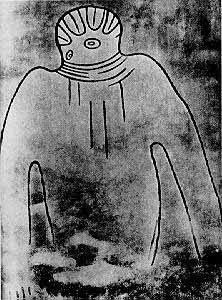
Von Daniken also scoured ancient art for figures that might be vaguely related to space travel. One-eyed guy with leaves on his head?
That’s a space helmet!
Did you know there’s a Erich von Daniken’s Center for Ancient Astronaut Research? This guy is the director:
I guess it’s easier to believe in aliens when you actually look like one…
Here’s a skeptic that traces the true lineage of von Daniken’s ideas to…H. P. Lovecraft’s Cthulhu Mythos! Which seems only fair, given the huge amount Lovecraft borrowed from various 19th century psuedoscientific beliefs like Theosophy.
Today you mainly get Ancient Astronauts mixed in with every other alien conspiracy theory floating around: Reptoids, secret alien bases, Atlantis, etc.
Speaking of Atlantis…
Atlantis Rising
I don’t actually remember this one myself, but Howard Waldrop tells me there were people in the 1970s who actually expected Atlantis to rise above the waves and usher in a new golden era thanks to the wise ancient masters who lived there. This probably had something to do with it. Naturally ancient astronauts were involved.
See? Even back in the 70s, various pseudoscientific and paranormal beliefs were already breeding with one another…
Auras
These were supposedly outline glows around people, which other people could supposedly “read” to deduce emotional states. Howard Waldrop tells me that there were even “aura fluffers” in the 1970s that would “balance” your auras using their presumably awesome psychic powers.
For a while, some people claimed that Kirlian photography (in which, if you place an image on a photographic plate and pump electricity through it, by golly, it produces a coronal image around the thing being zapped) “proved” that auras were real.
In truth, “real” auras were much more subtle things, and you had to concentrate hard to imagine see them.
I was wondering how many people still believe in auras today. Given that most hits point to either About.com pages, or pages that look like they were designed in the era of Geocities, I would say not many.
While researching auras I came across this page on “Thiaoouba Prophecy.” It’s like someone dumped every current crackpot belief in a blender, along with generous doses of Scientology and Theosophy, and set it to puree. But you know it has to be TRUTH, because it has RANDOM words in ALL CAPS!
The Bermuda Triangle
There is a region of the Atlantic ocean where thousands of planes and ships have disappeared mysteriously in fair weather. And by “thousands” I mean “15” (or possibly more, but you can’t know exactly how many unless you buy the book; how convenient). And by “fair weather” I mean “in storms and rough seas” and by “mysterious,” I mean “just about all have normal, prosaic explanations.” Namely, that anyplace on the deep ocean is a dangerous place if something goes wrong.
This is another one that got started in the late 1960s but didn’t peak until the 1970s. John Wallace Spencer’s Limbo of the Lost appeared in 1969, with Charlez Berlitz’s Bermuda Triangle and Richard Winer’s The Devil’s Triangle following a few years after.
This time there was not one, but two movies: the documentary The Devil’s Triangle in 1974 (with narration by Vincent Price and music by King Crimson!), and The Bermuda Triangle in 1978.
Biblical Millennialism
Certainly the last 2,000 years has seen no shortage of Christians predicting the end of the world. But the current round of American “The rapture’s right around the corner, better get ready” eschatology didn’t get started with Tim LaHaye’s Left Behind, but with Hal Lindsey’s The Late Great Planet Earth. Lindsey explained in some detail how the founding of Israel in 1947 set the clock ticking, drawing parallels between current events and biblical prophecy. There was even a movie narrated by no less a luminary than Orson Welles (so no, the animated Transformers movie was not the worst piece of crap he was ever involved in). However, this is one case where the book was far more influential than the movie, since the movie bombed and the book sold a zillion copies. Lindsey was confident that the whole Rapture/Apocalypse enchilada would happen in our lifetimes.
Still waiting.
And now, with the thinnest of possible justifications, here’s Orson Welles bitching about the ad copy in a frozen peas commercial.
Bigfoot
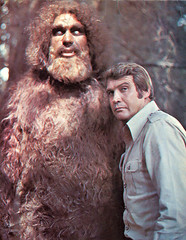
While there have been a lot of sasquatch sightings throughout history (1958 and 1967 were particularly big bigfeet years), the 1970s are when Bigfoot Mania hit its peak. Bigfoot sightings were already on the rise when, on February 1, 1976, these guys kicked it into overdrive:
After the two part Secret of Bigfoot episode of The Six Million Dollar Man (never has one TV show owed so much to a single sound effect), Bigfoot sightings soared around the country.
(I had forgotten Sandy Duncan (a very 1970s name) was in that Six Million Dollar Man episode. That, and her role in Roots, were the last non-Wheat Thins contexts I can remember her in.)
Here’s another roundup of 1970s Bigfoot Mania from a kidvid and toy perspective. Somehow I missed Bigfoot and Wildboy, though lord knows I watched plenty of other crappy (and not entirely crappy) Sid & Marty Krofft TV shows in the 1970s…
There’s still no end to people who believe in bigfoot these days, despite the fact that two of the most famous pieces of evidence for modern bigfoot, the Wallace footprints and the Patterson film have been fairly conclusively debunked. And despite a nation filled with digital cameras and video phones, videos of bigfoot have only gotten less and less convincing…
Cults
While you would be hard-pressed to find any decade of American history that was completely free of strange cults, the 1970s were something of a “Onyx Age” for weird cults, beginning with the trial of the Manson Family and ending (just about) with the mass suicide of Jim Jones’ People’s Temple in Guyana.
I smell an enduring metaphor coming on.
Jones was an ardent Communist and member of CPUSA right up until they started to dis one of his heroes: Joseph Stalin. Looking for a way to put his Marxism into action, he hit upon the bright idea of founding a religion to bring in money, and founded the People’s Temple Christian Church Full Gospel. His strong commitment to integration made him a favorite of liberals like Indianapolis’ Democratic Mayor Charles Boswell, who appointed him director of the city’s Human Rights Commission. Then he moved to California, where he discovered (to quote Wikipedia) “he was the reincarnation of Jesus of Nazareth, Mahatma Gandhi, Buddha, Vladimir Lenin, and Father Divine.” Which is a neat trick, given that Lenin, Gandhi and Father Divine were all alive at the same time, and that the lifespans of the latter two overlapped with Jones’. Strangely enough, this (and his increasing tendency to bang both male and female members of his congregation) did not seem to slow down Jones’ acceptance among the liberal establishment, since Jones moved to San Francisco, helped out the Mayoral campaign of George Moscone (who then put him in charge of the San Francisco Housing Authority), and hobnobbed with the likes of Harvey Milk (who spoke at the Temple), Angela Davis, Walter Mondale and Rosalynn Carter.
In 1970, Jones had formed a People’s Temple in Jonestown, Guyana, where he would spend increasing amounts of time. On November 18, 1978, Jones’ personal Red Brigade bodyguards ambushed and killed California Democratic congressman Leo Ryan (who was visiting to investigate reports of human rights abuses and take defectors from the People’s Temple home), along with one defector and three journalists. Jones then announced to the Temple that the Soviet Union would not be granting them asylum, and they should all commit suicide instead. Which 909 of them did. There’s an audio tape of the suicide, in which Jones’ is heard proclaiming “Stop this…hysterics. This is not the way for people who are Socialists or Communists to die. No way for us to die. We must die with some dignity…We didn’t commit suicide; we committed an act of revolutionary suicide protesting the conditions of an inhumane world.”
Certainly there were other cults active in the 1970s; Scientology, the Nation of Islam (tangentially involved in the Zebra murders), The Process Church of the Final Judgment, and possibly the shadowy Four Pi movement, were all active in the 1970s, experiencing either rapid growth or violent upheaval. But none racked up the sheer body count of the People’s Temple.
Telekinesis
In the 1970s, there were people that could bend spoons with their minds! And by people, I mean “Uri Geller,” and by “minds” I mean “fingers.”
Geller is still around, hawking stuff from his website, despite the fact that James Randi not only comprehensively debunked Geller’s fakery, but had all of Geller’s lawsuits dismissed and Geller was forced to pay the court costs.