Once again, here’s the latest Lame Excuse Books catalog just posted as a text file here. Enjoy!
Greetings, and welcome to the latest Lame Excuse Books catalog!
(Thanksgiving came too close to the end of the month to get it out in
November. And it would have gone out yesterday were it not for several
orders that came in, one quite large.)
I’ve got an eclectic mix this time around, including a new Ted Chiang
limited, a signed/limited edition of a Silverberg classic, signed
Jacquline Carey and Orson Scott Card, several signed Swanwick
chapbooks, true firsts of multiple Hugo winners, some Diana Wynne
Jones, some new Borderlands Little Books, several K. W. Jeter PBOs, a
rare Lafferty PBO, and even a couple of signed/limited Subterranean
Ex-Library copies from Austin writers.
I’ve also gone through and marked a bunch of older stock down. I’m
running out of room to store these and I’ve been without a day job for
quite a while, so I need both shelf space and money!
As usual, I typically only have 1-2 copies of even the newest books,
so if you want something you should act fast!
The URL for the main Lame Excuse Books webpage is:
https://www.lawrenceperson.com/lame.html
Here’s my giant Books Wanted list:
https://www.lawrenceperson.com/?p=17157
So if you have any of those available at attractive prices, or want to
trade them for credit against book purchases, let me know.
I’m still (occasionally) doing a Lame Excuse Books Twitter feed:
https://twitter.com/LameExcuseBooks
My books are also now listed at:
http://www.biblio.com/bookstore/lame-excuse-books-austin?aid=BSCB2577247
But buying directly from me guarantees you the best price.
Payment, Contact & Shipping Information
Email me at lawrenceperson@gmail.com. I can hold books for ten days on
email or phone requests (please leave a message on my voicemail) at
(512) 569-9036). U.S. shipping is $6.50 for the first book, and $1.00
a book thereafter.
Foreign shipping is at cost (please inquire; for most overseas
locations, Priority International starts at $47.05 now). However,
Biblio (when it’s up) has instituted an overseas consolidated shipper
whose rates are between domestic and foreign USPS rates. I’ve had
overseas customers successfully receive books, so that’s a definite
possibility if the books aren’t too heavy and you live in the UK or
Australia.
Past this week there may be a small delay due to Christmas season festivities.
Books may be returned in the same condition sent for any reason within
10 days of purchase for a full refund. I can take PayPal and credit
card payment to this email address at http://www.paypal.com. I can
also take checks. Please make checks payable to Lawrence Person. Mail
checks to:
Lawrence Person
Lame Excuse Books
P.O. Box 27231
Austin, Texas 78755
Finally, if you want me to take you off this mailing list, please let
me know. I hate spam just as much as the next person.
Now the books!
Hardbacks
LP3406. Adams, Douglas (edited by Kevin Jon Davies). 42: The Wildly
Improbable Ideas of Douglas Adams. Unbound, 2023. First edition
hardback (number line ending with 1), a Fine copy in decorated boards,
sans dust jacket, as issued. A compendium of scripts, drafts, notes,
sketches etc. from the archives of this Dr. Who and Hitchhiker’s Guide
to the Galaxy writer. I backed this on Kickstarter (which is where I
got this copy), and my name can be found on page 315. This book was
actually a #1 Sunday Times bestseller, so I imagine it’s gone through
many multiple printings. REDUCED PRICE. $49.
LP3711. Aldiss, Brian. Moreau’s Other Island. Cape, 1980. First
edition hardback, a Fine-/Fine- copy with slight bumping at head, heel
and points, signed by Aldiss, with a “With the compliments of the
publisher” slip laid in. $75.
LP3712. Asimov, Isaac. Foundation’s Edge. Doubleday, 1982. First
edition hardback, a Near Fine copy with slight creases at head and
heel and a trace of lean, in a Very Good+ dust jacket with wear at
head, heel and points, slight age darkening to white portions of rear
cover and blind-side foxing. Decent copy of Asimov’s fourth,
Hugo-winning and Nebula-nominated installment in the Foundation series
(a make-up award, as it’s not as good as the classic first three
books). A cheap first to fill that slot in your Hugo winner
collection. $15.
LP3020. Asimov, Isaac. The Foundation Trilogy (Foundation, Foundation
and Empire, and Second Foundation). Folio Society, 2012. First edition
hardbacks thus, an attractive three volume prestige edition, all Fine
copies in decorated boards, sans dust jacket, as issued, in a Fine,
decorated slipcase with a Fine Folio Society brochure laid in. One of
the Folio Society’s more attractive and desirable offerings. REDUCED
PRICE. $249.
LP3713. Baird, Wilhelmina (pseudonym for Joyce Hutchinson).
Crashcourse. Ace Books/SFBC, 1993. Book club and first hardback
edition, a Fine- copy with slight bend at head and heel in with a Near
Fine+ dust jacket with wrinkle and trace of loss and head 1/8″ closed
tear at heel, otherwise quite a nice copy, especially considering the
overwhelmingly white dust jacket. Third generation Cyberpunk novel and
the first in a trilogy. The hardback seems uncommon. $35.
LP3714. Baring-Gould, Sabine (John Maclay, editor). A Little Gray Book
of Gloom. Borderlands Press, 2025. First edition hardback, one of 350
signed numbered copies (though your number may be higher: Borderlands:
“We only print 350 copies but if anyone has matching numbers above
350, we make sure they continue to get it”), a Fine copy, sans dust
jacket, as issued. Collection of ghost stories from this extremely
prolific late 19th/early 20th century clergyman and writer who penned
the lyrics to “Onward Christian Soldiers.” Now out of stock from the
publisher. $35.
LP2516. Blaylock, James P. The Further Adventures of Langdon St.
Ives.Subterranean Press, 2016. First edition hardback, trade state,
Fine copy in a Fine dust jacket, new and unread. Omnibus edition of
four Lagdon St.Ives steampunk novellas. “The Here-and-Thereians” plus
a short coda (“Earthbound Things”) are original to this volume, so you
need this even if you have the previous Subterranean Press Langdon St.
Ives volumes. $49.
LP3715. Blaylock, James P. and Tim Powers. The Devils in the Details.
Subterranean Press, 2003. First edition hardback, #352 of 1,250
numbered copies signed by both authors, a Fine copy in a Fine,
Mylar-protected dust jacket. Long out of print, but pick it up at
cover price. $35.
LP2688. Bloch, Robert. Screams. Underwood-Miller, 1989. First edition
hardback thus, a Fine copy in a Fine- dust jacket with a 1/16″ closed
tear at head, and a 1/32″ closed tear at heel, now in dust jacket
protector, otherwise pristine, with repricing sticker on dust jacket
flap, as per Chalker/Owings. Omnibus edition of The Will To Kill,
Firebug, and The Star Stalker, being the first hardback editions of
each. Chalker/Owings (1991), page 440. REDUCED PRICE. $24.
LP1052. Cadigan, Pat. Tea from an Empty Cup. Tor, 1998. First edition
hardback, a Fine copy in a Fine dj, new and unread. Cyberpunk murder
mystery set in virtual reality. REDUCED PRICE. $7.
LP3717. Campbell, Ramsey. The Incubations. Flame Tress Press, 2024.
First edition hardback, a Fine- copy with a trace of surface wear,
sans dustjacket in shiny metallic decorated boards, as issued. “The
New Novel.” “A Special Ramsey Campbell Edition.” Done in a uniform
format with Flame Tree’s H.P. Lovecraft and M. R. James collections,
both those were sort of instant remainder things, while this is a
brand new novel, which is a bit odd. Book has prices for UK, US and
Canadian markets, so I assume there was one printing for both sides of
the Atlantic. $15.
LP3718. Caro, Robert. The Years of Lyndon Johnson: Means of Ascent.
Knopf, 1990. First edition hardback (stated), a Fine- copy with just a
trace of wear at head and heel (looks like it’s been read carefully
once) in a Fine- dust jacket with the barest bit of crimping at head
and heel, otherwise a beautiful copy. The second volume in Caro’s
massive, Award-winning LB series, this one documenting how Johnson
stole the 1948 senate election from Coke Stevens. Other volumes in the
series have won the Pulitzer Prize and the National Book Award. Yeah,
sometimes I find important non-SF firsts. $20.
LP3719. Card, Orson Scott. Prentice Alvin. Tor, 1989. First edition
hardback, a Fine- copy with slight bumping at head and heel in a Fine
Mylar-protected dust jacket, with a plate signed by Card affixed to
the half title page. Third Alvin Maker book. $15.
LP2017. Card, Orson Scott. Red Prophet. Tor, 1988. First edition
hardback, a Fine copy in a Fine, Mylar-protected dust jacket.
Inscribed by Card: “to Julia – I’ll see you inside 8-face mound-Orson
Scott Card”. Second book in the Alvin Maker series, Hugo and Nebula
finalist, and possibly the last book by Card I personally enjoyed.
$25.
LP3136. Card, Orson Scott. Seventh Son. Tor, 1987. First edition
hardback, a Fine copy in a Fine Mylar-protected dust jacket, inscribed
by Card: “to Rocco – /Don’t go near the water!/Orson Scott Card.”
First Alvin Maker alternate history fantasy. Recommended. $20.
LP3720. Carey, Jacqueline. Kushiel’s Avatar. Tor, 2003. First edition
hardback (“First Edition: April 2003” and “0 9 8 7 6 5 4 3 2 1”
numberline), a Fine- copy with spine ever so slightly concave and very
slight bump at top head/font join, in a Fine- Mylar-protected dust
jacket with the barest pinpricks of wear at points, signed by Carey;
I’m being really picky, this is just short of perfect. Third book in
the Kushiel’s series. $49.
LP3721. Carey, Jacqueline. Kushiel’s Chosen. Tor, 2002. First edition
hardback (“First Edition: April 2002” and “0 9 8 7 6 5 4 3 2 1”
numberline), a Fine- copy with slight bend at head and heel in a Fine
Mylar-protected dust jacket, signed by Carey. Second book in the
Kushiel’s series. $75.
LP3722. Carey, Jacqueline. Kushiel’s Dart. Tor, 2001. First edition
hardback, a Fine- copy with slight concavity to the spine (looks like
it was read once) and slight bend at heel in a Fine- Mylar-protected
dust jacket with the barest pinpricks of wear at points, signed by
Carey. An exceptionally nice signed copy of the first book in this
popular fantasy series. “A novel of passion, magic and betrayal,” and
reportedly quite erotic. $95.
LP3723. Carey, Jacqueline. Kushiel’s Scion. Warner Books, 2006. First
edition hardback, a Fine copy in a Fine- Mylar-protected dust jacket
with a trace of wear at top points, signed by Carey. Fourth book in
the Kushiel’s series. $30.
LP3724. Carroll, Jonathan. From the Teeth of Angels. Doubleday, 1994.
First edition hardback (Locus database says this is simultaneous with
the UK edition), a Fine- copy with a tiny bit of bend at head and heel
in a Fine- dust jacket with just a trace pof wear at head, heel and
points. Modern fantasy novel of three people interacting with literal
Death incarnate, who is, let’s say, not nearly as empathetic as Neil
Gaiman’s version. Possibly Carroll’s most acclaimed novel, and the one
that Carroll’s said that countless people dealing with the death of a
loved one have told him was very important to them. Recommended. $12.
LP3725. Chabon, Michael. The Amazing Adventures of Kavalier & Clay.
Random House, 2000. First edition hardback (“FIRST PRINTING” and “2 4
6 8 9 7 5 3″ on copyright page, which was Random House’s deeply
irritating way of indicating the true first edition at the time), a
Near Fine copy with slight bumping at head, heel, points, and just a
trace along bottom edges), in a Near Fine- dust jacket with slight
bumping at head, heel and points, with about an 1/8” wade line of
abrasion wear at top points, plus a couple of pinhead-sized light rust
colored spots to outer pageblock edge; not perfect, but overall a
pretty nice copy of Chabon’s breakthrough Pulitzer Prize-winning novel
following two cousins working in the nascent comics industry before,
during and after World War II. Highly recommended. $45.
LP1721. Chabon, Michael. The Yiddish Policemen’s Union. Harper
Collins, 2007. First edition hardback, a Fine copy in a Fine dust
jacket. Winner of the Hugo and Nebula Award. Excellent police
procedural chess murder mystery set in an alternate world where the
founding of Israel failed and Jewish refugees were resettled in a
special district in Alaska. Highly recommended. REDUCED PRICE. $15.
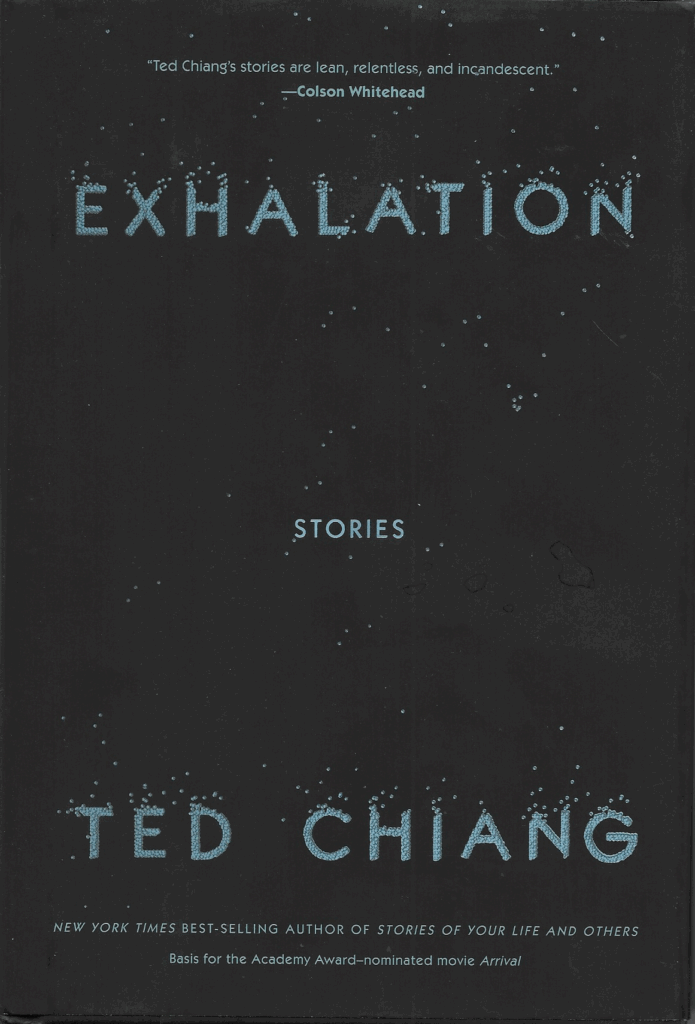
Chiang, Ted. Story of Your Life. Subterranean Press, 2025. First
edition hardback, #212 of 500 signed, numbered copies, a Fine copy in
a Fine slipcase, sans dust jacket, as issued, in publisher’s
resealable bag. Chiang’s Nebula-winning novella about attempts to
communicate with aliens who don’t perceive time as linear, and the
basis of the 2016 movie Arrival. Only have one. $175.
LP3555. Clegg, Douglas. Isis. Cemetery Dance, 2006. First edition
hardback, #378 of 600 signed numbered copies, a Fine copy in a Fine,
Mylar-protected dust jacket, additional inscribed “To Stephen-/Welcome
to Isis.” Horror novella about a woman who regularly gets possessed by
spirits before being whisked off to Hell. So not the Jihadi type of
ISIS. I have the cheapest copy online by quite a bit. $25.
LP1160. Datlow, Ellen, & Terri Windling. The Year’s Best Fantasy and
Horror: Fifteenth Annual Collection. St. Martin’s, 2002. First edition
hardback, an Ex-Library copy (see Ex-Library Note) with most of the
usual flaws (though no stamps on page block edges, no bands on dj, and
the stickers inside the dj protector can usually be peeled off,
meaning this has the potential to clean up quite nicely on the
outside). REDUCED PRICE. $3.
LP792. Denton, Brad. Lunatics. St. Martin’s Press, 1996. First edition
hardback, a Fine copy in a Fine minus dj, with slight wear at dj
corners. (Given the thinness of the St. Martin’s dust jackets of this
period, it’s usually found much more worn than this.) The humorous
story of a man in love with a naked moon goddess, and the effect it
has on his friends. Signed by Denton. REDUCED PRICE. $12.
LP1394. Dick, Philip K. I Hope I Shall Arrive Soon. Doubleday, 1985.
First edition hardback, an Ex-Library copy with all the usual flaws,
otherwise VG/NF with spine lean and wear to the bottom boards.
Posthumous short story collection. REDUCED PRICE. $3.
LP1395. Dick, Philip K. Voices from the Street. Tor, 2007. First
edition hardback, a Fine copy in a Fine dust jacket, new and unread.
Dick’s last previously unpublished novel (or at least the last for
which a manuscript is known to exist). David Hartwell told me that
it’s actually much better than itfs reputation. REDUCED PRICE. $12.
LP3199. Edmondson, G. C. T.H.E.M. Doubleday, 1974. First edition
hardback, a Near Fine- copy with remainder speckling at heel, bumping
at heel and head, and what looks to be an extremely faint triangular
sticker ghost to inside front cover near gutter, in a Near Fine dust
jacket with slight bumping at head and heel, slight dust soiling to
white rear dust jacket, and long, mild, non-breaking crease to inner
edge of front flap. Story of two earthlings signing up for duty in an
intergalactic war after first contact. “Working name of Mexican-born
US translator and author Jose Mario Garry Ordonez Edmondson y
Cotton….T.H.E.M. (1974) The acronym refers to Alien invaders known
as the Theriomorphic Hellbent Enemy Mission, who subject Earth
civilization to tough-love Uplift…fluently written…” – The
Encyclopedia of Science Fiction. REDUCED PRICE. $3.
LP1398. Fowler, Karen Joy. The Jane Austen Book Club. Putnam, 2004.
First edition hardback, a Fine copy in a Fine dj, apparently new and
unread. Hit the bestseller list and went through a zillion printings.
Pick it up at less than cover price. REDUCED PRICE. $15.
LP1123. Gentle, Mary (S. M. Stirling). Under the Penitence. PS
Publishing, 2004. First edition hardback, 1 of 300 numbered, limited
hardback copies signed by Gentle and introduction author S. M.
Stirling, Fine in Fine dj, new and unread. A novella set in the
Visigothic Carthage of Ash: A Secret History. REDUCED PRICE. $25.
LP1058. Glass, Julia. Three Junes. Pantheon, 2002. First edition
hardback (numberline goes down to I, “First Edition” statement
present) in a first state dj (no mention of Good Morning America), a
Fine-/Fine- copy with just the barest trace of bumping at head and
heel, and a phantom wrinkle to top front cover just above title. “It
won the National Book Award,” I think. “It will be worth some money
down the road,” I think. Nope. REDUCED PRICE. $4.
LP2838. Grant, Charles L. (Hank Wagner and Kathryn Ptacek, editors). A
Little Black Book of Quiet Horror. Borderlands Press, 2019. First
edition hardback, one of 500 numbered copies signed by the editors, a
Fine copy, sans dust jacket, as issued. Four stories. Now out of print
from the publisher. REDUCED PRICE. $39.
LP3726. Hartwell, David G., and Kathryn Cramer, editors (George R. R.
Martin, Gene Wolfe, Storm Constantine, Michael Swanwick, Charles de
Lint, Robert Sheckley, Don Webb, etc.). Year’s Best Fantasy.
HarperCollins Eos (SFBC), 2001. Book club and first hardback edition,
a Fine- copy with slight bend at head in a Fine- dust jacket with
slight wear at head, heel and points. The first hardback of the first
volume of this Year’s Best series. According to ISFDB: “This SFBC
edition adds two stories, by Jensen and Dowling, left out of the
paperback edition due to lack of space.” Also, they left Cramer’s name
off the front cover, which I’m sure she was thrilled about… $35.
LP3278. Hirshberg, Glen. The Book of Bunk: A Fairy Tale of the Federal
Writers’ Project. Earthling Books, 2010. First edition hardback, #64
of 400 signed, numbered copies, a Fine copy in a Fine dust jacket. Now
out of print from the publisher. REDUCED PRICE. $49.
LP3279. Hirshberg, Glen. Motherless Child. Earthling Books, 2012.
First edition hardback, #186 of 400 signed, numbered copies, a Fine
copy in a Fine dust jacket. Now out of print from the publisher.
REDUCED PRICE. $49.
LP3682. Howard, Robert E. and Richard Lupoff. The Return of
Skull-Face. FAX Collector’s Editions, 1977. First edition hardback
(Currey state B, unsigned), a Fine- copy with a tiny bit of crimping
to heel, in a Very Good dust jacket with 2″ tear to bottom front cover
and associated accordion-fold creasing, slight crimping at heel and a
trace of wear at points; tears are closed now, and could be mitigated
with a dust jacket protector. Skull Face novella begun by Howard and
completed by Lupoff. Currey, page 251. Selling it cheap. $5.
LP100. Jablokov, Alexander. A Deeper Sea. AvoNova, 1992 First Edition,
Hardback Fine-/Near Fine+, with cloth/board join rubbing, a corner
crease, slight head bumping, and some faint soiling to bottom page
blocks. REDUCED PRICE. $5.
LP3727. Jones, Diana Wynne. Aunt Maria (AKA Black Maria). Greenwillow
Books, 1991. First American edition (stated, with “10 9 8 7 6 5 4 3 2
1” numberline) and first edition under this title, a Near Fine+ copy
with bump at head and bend at heel in a Fine- dust jacket with bump at
head and slight wear to top points. “In Cranbury-on-Sea Aunt Maria
rules with a rod of sweetness far tougher than iron and deadlier than
poison.” Modern fantasy. $15.
LP3728. Jones, Diana Wynne. A Sudden Wild Magic. Morrow/AvoNova, 1992.
First edition hardback (the US edition precedes the UK edition by four
years), a Fine copy in a Fine dust jacket. A ring of witches on our
world fights a conspiracy from a parallel universe. $49.
LP3729. Jones, Diana Wynne. A Tale of Time City. Greenwillow Books,
1987. First edition (according to ISFDB, the US edition precedes the
UK edition by a month) with “First Edition 1 2 3 4 5 6 7 8 9 10″ on
copyright page, a Fine- copy with bend at heel in a Fine- dust jacket
with slight wrinkle at heel along with a very thin line of light
discoloration to same, otherwise an exceptionally nice copy. During
World War II, British children are kidnapped to a city outside time
and space. $25.
LP3730. King, Stephen. Hearts in Atlantis. Hodder & Stoughton, 1999.
First edition hardback (Collings’ Horror Plum’d has both this and the
U.S. edition coming out on the same day, September 14, 1999), a Fine-
copy with just a tiny bit of wrinkling at head and heel in a Fine,
Mylar-protected dust jacket. More an interconnected short story
collection than an actual novel. Basis of the Anthony Hopkins film of
the same name. This is the edition I own, and for some reason I
remember hearing at the time that this was the true first. And I guess
it is, by about six hours. $20.
LP37301. Kirk, Russel. A Creature of the Twilight: His Memorials (2
copies). Fleet Publishing, 1966. Both copies are first edition
hardbacks, the first copy a Near Fine hardback with slight bend at
head and heel, a moderate bump to top front point and slight bumping
to others, in a Very Good+, Mylar-protected, first state dust jacket
(with blurbs for Kirk’s other books), with 1/16″ strip of
loss/abrasion rubbing across bottom, lesser wear and rubbing at head,
shallow loss at points, slight dust staining to rear white panel, and
a few other pinpricks of wear. The second copy is a Near Fine copy
with slight bumping and 1/4” wrinkle at head, very slight bend at
heel, and a trace of bumping to points, in a Near Fine-,
Mylar-protected, second state dust jacket (with ad for the
Conservative Book Club on the rear panel), dust jacket with slight
edgewear at head and heel, slight abrasion wear to front points, but a
clean, bright white rear panel. Novel of intrigue in an imaginary
north African nation, featuring Kirk’s continuing character Manfred
Arcane, star of the underrated horror novel the Lord of the Hollow
Dark. I’m hopefully that there’s some Kirk collector out there who
would like a set featuring both first and second state dust jackets.
brown, Russell Kirk: A Bibliography, page 101 (but no mention of the
different dust jacket states, alas). Kirk, The Sword of the
Imagination, page 375. For the pair: $40.
LP1909. Kress, Nancy. Nothing Human. Golden Gryphon, 2003. First
edition hardback, a Fine copy in a Fine dust jacket, new and unread.
Novel. Seems to be the cheapest copy online. $12.
LP1275. Lansdale, Joe R. The Drive In: The Bus Tour. Subterranean
Press, 2005. First edition hardback, one of 1000 signed “trade”
hardcovers, a Fine copy in a Fine- dust jacket with a tiny little
trace of wear at heel, otherwise new and unread. The third book in the
Drive-In series. LAST COPY! $35.
LP3147. Lansdale, Joe R. The Sky Done Ripped. Subterranean Press,
2019. First edition hardback, #147 of 350 signed, numbered copies, a
Fine copy in a Fine dust jacket and a Fine slipcase. Third Ned The
Seal book, preceded by Zeppelins West and Flaming London. Alien
Invaders, the Hollow Earth, H. G. Wells, Shangri-La and the Golden
Fleece. Includes bonus sketch section not in the trade edition.
Isajanko, A063aii. REDUCED PRICE. $85.
LP3292. Lansdale, Joe R. Moon Lake. Short Scary Tales Publications
(SST), 2022. First limited edition hardback, one of 500 signed,
numbered copies, a Fine copy in a Fine dust jacket with tissue paper
seal laid in. REDUCED PRICE. $45.
LP1733. Lansdale, Joe R. Unchained and Unhinged. Subterranean Press,
2009. First edition hardback, one of 750 signed, numbered copies, a
Fine copy in a Fine dust jacket, new and unread. Short stories and
essays. 750 is a pretty low limitation for a Lansdale book. REDUCED
PRICE. $35.
LP3430. Lansdale, Joe R. and Kasey Lansdale. Terror is Our Business:
The Dana Roberts Casebook of Horrors. Short Scary Tales (SST)
Publications, 2023. First edition hardback, one of 500 signed,
numbered copies, a Fine copy in a Fine dust jacket, with tissue paper
closure sticker laid in. Now sold out from the publisher, and I appear
to be the only one with copies online. $49.
LP3731. Lansdale, Joe R., editor (George R. R. Martin, Harlan Ellison,
Thomas Ligotti, Robert Bloch, etc.). The Horror Hall of Fame: The
Stoker Winners. Cemetery Dance, 2012. First edition hardback, a Fine
copy in a Fine dust jacket, with signature plate by Lansdale laid in.
Trade edition. Just what it says, selections from Stoker Award winning
stories. Out of print, but offered at cover price. $35.
LP2940. Lansdale, Joe R. and Sam Glanzman (illustrator). Red Range.
It’s Alive Press, 2017. First edition thus, a hardback edition
collecting the individual comics (and this is the “Kickstarter
Edition”), a Fine copy in decorated black boards, sans dust jacket, as
issued, signed by Lansdale. Weird western comic featuring the Klan,
the hollow earth, and dinosaurs. Introduction by Rick Klaw and
afterword by Stephen R. Bissette. Also see Red Range: Pirates of
Fireworld on the trade paperbacks page. REDUCED PRICE. $25.
LP3732. Lee, Sharon. I Dare. Meisha Merlin, 2002. First edition
hardback (“First MM Publishing edition: February 2002” and “0 9 8 7 6
5 4 3 2 1″ numberline), a Fine copy in a Fine dust jacket, signed by
both authors. Signed firsts of Plan B can be had online, but I’m not
seeing a single one of this one. $95.
LP3733. Lethem, Jonathan, and Carter Scholz. Kafka Americana.
Subterranean Press, 1999. First edition hardback, an unnumbered copy
of 600 numbered copies signed by both authors, a Fine copy in a Fine
dust jacket. Collaborative short story collection. An early Lethem
limited from before he blew up over Motherless Brooklyn. This may be
the last Subterranean book that had the old square logo they used
before the stylized S. $49.
LP3525. (Lovecraft, H.P.) Pedersen, Nate, editor. The Dagon
Collection: An Auction Catalogue of Items Recovered in the Federal
Raid on Innsmouth, Mass. PS Publishing, 2024. First edition hardback
in decorated boards, a Fine copy in a Fine dust jacket. Anthology in
the form of a mock auction catalog of Cthulhu Mythos related items
from the Esoteric Order of Dagon, with contributions from F. Paul
Wilson, Ramsey Campbell, etc. Raised the price on this because I was
the only one with a copy online, but a few more have shown up, so
let’s drop it down again. LAST COPY! $45.
LP3734. Maberry, Jonathan. The X Files Origins: Devil’s Advocate.
Macmillan Imprint, 2017. First edition hardback, a Fine- copy with
slight bend at head and heel in a Fine- dust jacket with slight bend
at head and heel and a 1/32″ closed tear to top front edge. Dana
Scully origin novel by this Bram Stoker-winning author.. $20.
LP2946. Martin, George R. R., editor (Roger Zelazny, Pat Cadigan,
etc.). Wild Cards II: Aces High. Bantam/SFBC, 1987 (stated; actually
1988). Book club and first hardback edition, a Fine- copy with a tiny
bit of bend at head and heel in a Near Fine dust jacket with a 1 1/2″
wrinkle and a 1 1/4″ closed tear on top front cover near head and a
trace of age darkening to very top of white flaps, in Mylar protector.
Second Wild Cards shared universe superhero anthology. Reduced price.
$15.
LP3735. Martin, George R. R., editor (Ed Bryant, Melinda Snodgrass,
Lewis Shiner, etc.) Wild Cards III: Jokers Wild. Bantam/SFBC, 1987
(stated, actually 1988). Book club and first hardback edition, a Near
Fine copy with printer stamp to rear free endpaper and bend at head
and heel, in a Near Fine+ dust jacket with 1/4” tear at top front
panel and slight wear at head, heel and points. Third Wild Cards
shared universe novel. $20.
LP134. Matheson, Richard. By the Gun. Evans, 1993. First edition
hardback, Fine in a Fine dj. Gripping collection of Western stories
that show Matheson was skilled in multiple genres. Recommended.
REDUCED PRICE. $15.
LP1018. McAuley, Paul [J.]. Whole Wide World. HarperCollins/Voyager
(UK), 2001. First edition hardback, a Fine copy in a Fine- dj with a
tiny bit of crimping at head and the barest trace of edgewear,
otherwise new and apparently unread. They evidently took the J. out of
his name in hopes of fooling the computers and making this his
breakthrough mainstream technothriller. Actually looks like an SF
murder mystery. This UK edition precedes the Tor edition by a year.
REDUCED PRICE. $10.
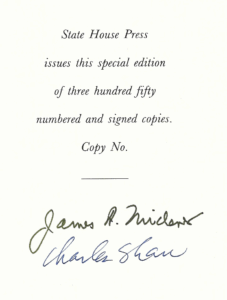
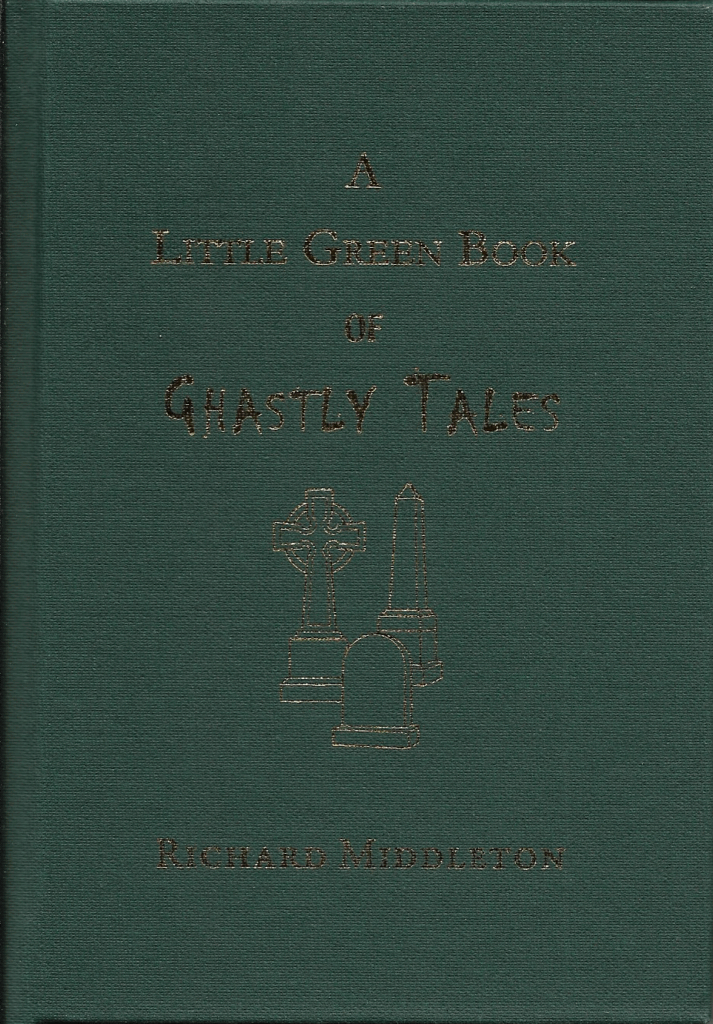
LP3736. Middleton, Richard. A Little Green Book of Ghastly Tales.
Borderlands Press, 2025. First edition hardback, one of 350 numbered
copies (though your number may be higher: Borderlands: “We only print
350 copies but if anyone has matching numbers above 350, we make sure
they continue to get it”) signed by editor Nicholas A. Psaltso, a Fine
copy, sans dust jacket, as issued. Collection from this British writer
and poet who died young, including his most famous story, “The Ghost
Ship.” $32.50.
LP3529. Mieville, China. The City & The City. Del Rey, 2009. First
U.S. edition hardback (the UK McMillan edition slightly precedes), a
Fine-/Fine copy with bumping at head and slight bumping at heel. His
Hugo, World Fantasy and Arthur C. Clarke Award winning novel of two
European city states that exist superimposed one atop the other, whose
respective residents have been trained since birth to avoid noticing
residents of the “other” city. Basis of a UK miniseries. Recommended.
REDUCED PRICE. $45.
LP3737. Mieville, China and Zak Smith (artist). The Worst Breakfast.
Black Sheep/Akashic Books, 2016. First edition illustrated children’s
book, a Near Fine copy that would be Fine save for the presence of an
electronic inventory control tag affixed to the inside of the rear
cover. A children’s book that many of Mieville’s fans may not even
have been aware of. $15.
LP2778. Moorcock, Michael. King of the City. Morrow, 2000. Second
printing of the first American hardback, a Near Fine copy with one
spot of spotting on foreedge, and slight bumping at head and heel in a
Fine- dust jacket with slight wrinkling at head. Signed by Moorcock.
Novel set in contemporary London, a sequel to Mother London.
Previously typoed this price. $10.
LP2785. Moorcock, Michael. The War Amongst the Angels. Avon, 1997.
First American hardback edition, a Fine- copy in a Fine- dust jacket
with slight bumping at heel. Signed by Moorcock. Third book in the
Blood/Second Ether trilogy. REDUCED PRICE. $25.
LP3738. Morgenstern, Erin. The Night Circus. Doubleday, 2011. First
edition hardback, a Fine-/Fine copy with slight bend at head. Very
popular dark fantasy that went through numerous printings, and a movie
based on it is currently in pre-production. $45.
LP3739. Nesbit, Edith. A Little Fuchsia Book of Fantasy. Borderlands
Press, 2025. First edition hardback, one of 350 numbered copies
(though your number may be higher: Borderlands: “We only print 350
copies but if anyone has matching numbers above 350, we make sure they
continue to get it”) signed by editor Hal Bodner, a Fine copy, sans
dust jacket, as issued. Ten stories (including retellings of Hamlet
and Macbeth) from an English author better known for children’s books.
I think this is out of print, as it’s not listed on their (new)
website. $35.
LP3740. Niffenegger, Audrey. The Time Traveler’s Wife. McAdam Cage,
2003. First edition hardback (numberline ending in 1), a Fine- copy
with slight bend at head and heel in a Near Fine+ dust jacket with
wrinkle at head, tiny bit of bend at heel, and atrace of haze rubbing
to black rear cover. Popular novel of a woman married to a man
suffering from Chrono-Displacement Disorder. Went through numerous
printings and shows up on a few modern best SF 100 lists (like NPR’s).
Niffenegger is also a big Gene Wolfe fan, which is always a plus in my
book. $18.
LP3741. Powers, Tim. Dinner at Deviant’s Palace. Charnel House, 2025.
First limited edition thus, one of 99 numbered copies, a Fine copy,
sans dust jacket, as issued, with cardstock ad for limited edition art
print of Powers’ own interpretation of Deviant’s Palace laid in.
Post-apocalyptic science fiction novel that won the Philip K. Dick
Award. Instantly sold out from the publisher. $495.
LP3743. Read, Julian. JFK’s Final Hours in Texas. Dolph Bricoe Center
of American History, 2013. First edition hardback (stated), a Fine
copy in a Fine dust jacket, inscribed by the author “To Carrie
Matales[?]/Thanks for being here./Julian Read/10/29/13.” Again,
sometimes I stumble across non SF/F/H books that might be valuable.
$35.
LP3742. Reynolds, Alastair. The Dagger in Vichy. Subterranean Press,
2025. First edition hardback, #422 of 1,000 signed, numbered copies, a
Fine copy in a Fine dust jacket, with bookmark laid in. Novella
described as a mixture of science fiction and fantasy, with perhaps a
dollop of Eldritch Horror. $40.
LP3744. Robinson, Kim Stanley. Blue Mars. Bantam Spectra, 1996. First
American hardback, a Fine copy in a Fine dust jacket. The third book
in the Mars trilogy and a Hugo winner for Best Novel. $28.
LP3745. Shiner, Lewis. Outside the Gates of Eden. Subterranean, 2019.
First edition hardback, #612 of 1,000 signed, numbered copies, an
Ex-Library copy with most of the usual flaws, otherwise a Near Fine+
copy trace of wear to boards at heel and touches of dust soiling to
page block edges, in a Fine- dust jacket with a trace of wear at
points (Austin Public Library stopped glueing their paper library name
strips to the dust jacket, so there’s at least a chance the two
exterior stickers could peel off cleanly). Sweeping novel of rock
music and the 1960s. Lew worked on this one a long time. To quote the
publisher: “I consider Lewis Shiner’s Outside the Gates of Eden to be
the best original novel SubPress will have published in our nearly
twenty-five years of existence. At 880 pages, it’s also the longest.
This is a book too important to miss.” Pick up a signed first edition
of this massive book at a bargain price. $15.
LP3746. Silverberg, Robert. Nightwings. Centipede Press, 2025. First
limited edition hardback, #329 of 500 signed, numbered copies, a Fine
copy in a Fine dust jacket, new and unread, still in shrinkwrap.
Anatomy of Wonder, 4-412 (“Lusly romantic and elegic far future
fantasy.”) Only have one. Buy it while it’s still cover price. $125.
LP3747. Spencer, William Browning. The Unorthodox Dr. Draper.
Subterranean Press, 2017. First edition hardback, #394 of 750 signed,
numbered copies, an Ex-Library copy with most of the usual flaws
(Austin Public Library stopped glueing their paper library name strips
to the dust jacket, so there’s at least a chance the two exterior
stickers could peel off cleanly), otherwise a Fine- copy with a trace
of wear at heel in a Near Fine+ copy with a feel small indentations
through the Mylar protector. Bill’s latest short story collection.
Pick up a signed first at a bargain price. $10.
LP3748. Stableford, Brian. Empire of Fear. Simon & Schuster (UK),
1988. First edition hardback in what appears to be an Australian
export edition dust jacket (lacking a price and with the UPC code
square on rear cover blank; the only two other copies of this title
with that dust jacket were both from Australia), two lines of
ownership blindstamp text to front free endpaper, and bottom front
hinge just starting, in a Fine, Mylar-protected dust jacket, signed by
Stableford. His acclaimed novel in which the world is ruled by a
vampire aristocracy. Carter, The Vampire in Literature, page 101.
Anatomy of Winder 4-434. $15.
LP3749. Sterling, Bruce. Ascendancies: The Best of Bruce Sterling.
Subterranean Press, 2007. First edition hardback, a Near Fine+ copy
with slight bumping at head and heel, with heel having suffered just a
trace of dampstain dye transfer to blind side of dust jacket (not
showing through to front), in a Near Fine dust jacket with said blind
side staining, 1/32″ nick through dj front at spine join, and a few
other rubs and points of wear; looks like a Fine copy until you look
closely. Just what it says, a best of Bruce’s short stories, including
seminal cyberpunk Shaper/Mech stories like “Swarm,” plus “Flowers of
Edo,” “Dori Bangs,” “Bicycle Repairman” and “Talamakan,” among many
others. Highly recommended. $40.
LP3750. Sterling, Bruce. Holy Fire. Bantam Books, 1986. First American
hardback edition, a Fine copy in a Fine- dust jacket with trace of
haze rubbing to black rear cover and trace of wear at points,
inscribed by Sterling: “For Clio:/Muse of
History/bruces@well.com/Bruce Sterling/The future is obsolescence in
reverse.*8-1”. One of Bruce’s best novels, and highly recommended.
$25.
LP3751. Sterling, Bruce. Islands in the Net. Arbor House, 1988. First
edition hardback, a Near Fine copy with small, two lines of ownership
blindstamp text to front free endpaper, very slight bend at head and
heel and trace of wear at points, in a Fine- dust jacket with trace of
haze rubbing and trace of wear at points, inscribed by Sterling The
work where Bruce went from pure quill cyberpunk to postcyberpunk. “For
Jack,/Bruce Sterling.” John W. Campbell Memorial Award winner and Hugo
Award nominee for Best Novel. Anatomy of Wonder 4, *4-439 (“What
stands out in Sterling’s novel [is] the extraordinarily detailed and
highly believable word he has created.” “One of the most fascinating
sociological and political SF novels in recent years.”) $49.
LP1129. Swainston, Steph. The Year of Our War. Gollancz, 2004. First
edition hardback, a Fine copy in a Fine dj, new and unread. Science
fiction. A first novel that John Clute and several others raved about,
probably the second best received first novel published in 2004 beside
Susanna Clarke’s Jonathan Strange & Mr. Norrell, and runner-up to it
for Best First Novel in the Locus poll. REDUCED PRICE. $12.
LP3752. Turtledove, Harry and Richrd Dreyfuss. The Two Gorges: A Novel
of Alternate America, 1996. Tor, 1996. First American edition
hardback, a Fine- copy with slight bend at head in a Fine- dust jacket
with slight bend at head and a trace of edgewear at heel, inscribed by
Turtledove: “3-9-96/For Tony —/No longer virtually —/Thanks for liking
my stuff —/Best —/Harry Turtledove.” An alternate history
collaboration between an Oscar Winner and a Hugo winner, in which the
North American Union is a self-governing dominion within the British
Empire until rebellion brews. $25.
LP3754. Vance, Jack. Lyonesse: The Green Pearl. Berkley Books, 1985.
First Book Club hardback (gutter code Q39 on page 406, as per Hewett),
a Near Fine+ copy with slight, lite spotting to top page block, in a
Fine, Mylar-protected dust jacket. The first non-limited edition
hardback of the second book in the Lyonesse trilogy. A nice copy.
Hewett, A73.e. $10.
LP3753. Vinge, Vernor. A Deepness in the Sky. Tor, 1999. First edition
hardback, a Fine-/Fine- copy with a trace of wear at head, heel and
points. The prequel to the Hugo winning A Fire Upon the Deep, and a
Hugo and John W. Campbell winner on its own, and a great book in its
own right. Highly recommended. $25.
LP1193. Whitbourn, John. Popes and Phantoms. Gollancz, 1993. First
edition hardback, a Fine copy in a Fine, Mylar-protected dust jacket,
apparently new and unread. Inscribed by the author: “To Pat/with best
wishes/from the author/John Whitbourn/ 06/04/96.” No U.S. edition. I
like Whitbourn, and this is the cheapest signed copy of this online.
$13.
LP3755. Willis, Connie. All Clear. Bantam Spectra, 2000. First edition
hardback, a Fine- copy with slight bend at head and heel in a Near
Fine+ dust jacket with slight wrinkling at head and a 1/4″ semi-closed
tear at rear heel join; could probably be closed with a dust jacket
protector. The second in the Hugo and Nebula winning Oxford Time
Travel two-volume novel set during Blitz-era England in World War II.
$20.
LP3756. Willis, Connie. Passage. Bantam Books, 2001. First edition
hardback, a Fine- copy with slight bend at heel and slight bumping at
points, in a Fine, Mylar-protected dust jacket, signed and dated
(“5-12-01”) by Willis. Novel about research into near-death
experiences. Hugo and Nebula finalist. $35.
LP3757. Wolfe, Gene. Castleview. Tor, 1990. First edition hardback, a
Fine- copy with small, two lines of ownership blindstamp text to front
free endpaper, in a Fine, Mylar-protected dust jacket. Novel of a town
with a phantom castle, figures from Arthurian legend, and a murder
mystery. $20.
LP3603. Yarros, Rebecca. Iron Flame. Red Tower Books, 2023. First
edition hardback (“First Edition November 2023” and a complete number
line of 10 9 8 7 6 5 4 3 2 1 on the copyright page, and black-stained
pageblock edges), a Fine copy in a Fine dust jacket. Second novel in
the Fourth Wing dragon series. REDUCED PRICE. $30
LP3758. Zelazny, Roger. Manna from Heaven. DNA Publications/Wildside
Press, 2003. Reprint hardback (blue boards rather than decorated and
$29.95 price on dust jacket UPC code), a Fine- dcopy with a trace of
wear to rear boards in a Fine dust jacket. Previously uncollected
stories, including six Amber stories. $35.
Trade Paperbacks (including chapbooks)
LP3759. (Dick, Philip K.) William, Paul. Only Apparently Real: The
World of Philip K. Dick. Arbor House, 1986. First edition trade
paperback original, a Near Fine copy with former owner’s blindstamp to
half-title page and small crease to top rear outer corner. Biography
of Dick by his close friend and literary executor. $15.
LP2124. Gunn, James. The Unpublished Gunn Part 2. Chris Drumm Books,
1996. First edition chapbook original, a Fine copy. Uncollected work
by this Nebula Grandmaster. REDUCED PRICE. $4.
LP3225. Lansdale, Joe R. Born For Trouble. Tachyon, 2022. First
edition trade paperback original, a Fine copy, new and unread, signed
by Lansdale. The latest Hap and Leonard collection. REDUCED PRICE.
$15.
LP3760. Lansdale, Joe R. (Joe Hill) The Essential Horror of Joe R.
Lansdale. Tachyon, 2025. First edition trade paperback original, a
Fine copy, signed by Lansdale. Hill provides an introduction. His
latest best-of collection. $20.
LP2573. Lansdale, Joe R. Hap and Leonard: Blood and Lemonade. Tachyon,
2017. Signed by Lansdale. First edition trade paperback original, a
Fine copy. Looks like a compilation of Hap and Leonard stories crafted
together into a mosaic novel. REDUCED PRICE. $14.
LP3612. Lansdale, Joe R. In The Mad Mountains. Tachyon, 2024. First
edition trade paperback original, a Fine copy, with signature plate
signed by Lansdale laid in. Stories inspired by H. P. Lovecraft.
REDUCED PRICE. $15.
LP2856. Lansdale, Joe R. Of Mice and Minestrone. Tachyon, 2020. First
edition trade paperback original, a Fine copy, signed by Lansdale.
“Hap and Leonard: The Early Years.” REDUCED PRICE. $14.
LP3075. Lovecraft, H.P. (S.T. Joshi and David E. Schultz, editors).
Letters to Alfred Galpin and Others. Hippocampus Press, 2020. First
edition trade paperback original thus, a Fine copy. “A new edition,
augmented here with over 200 new pages of material.” Primarily letters
Lovecraft wrote to his amateur press association correspondents.
REDUCED PRICE. $22.
LP2575. Lovecraft, H.P. (David E. Schultz and S. T. Joshi, editors).
H. P. Lovecraft: Letters to C. L. Moore and Others. Hippocampus Press,
2017. First edition trade paperback original, a Fine copy, new and
unread. The latest Hippocampus collection of Lovecraft letters, and it
should be quite interesting, as I think Lovecraft heavily influenced
Moore’s early work. REDUCED PRICE.$22.
LP3076. Lovecraft, H.P. (S.T. Joshi and David E. Schultz, editors).
Letters to E. Hoffman Price and Richard F. Searight. Hippocampus
Press, 2020. First edition trade paperback original, a Fine copy.
Hoffman was an acclaimed Weird Tales writer in his own right, and also
friends with Robert E. Howard (who is a frequent topic in these
letters). Searlight also had pieces appear in Weird Tales. REDUCED
PRICE. $22.
LP3077. Lovecraft, H.P. (S.T. Joshi and David E. Schultz, editors).
Letters to Family and Family Friends Volume 1 with Letters to Family
and Family Friends Volume 2. Hippocampus Press, 2020. First edition
trade paperback originals, both Fine copies. Over 1,000 pages of
letters, with page numbers across both volumes, plus a Glossary, an
Index, etc. REDUCED PRICE. $55.
LP3078. Lovecraft, H.P. (S.T. Joshi and David E. Schultz, editors).
Letters to Rheinhart Kleiner and Others. Hippocampus Press, 2020.
First edition trade paperback original, a Fine copy. “A new edition,
augmented here with nearly 250 new pages of material.” Letters
Lovecraft wrote to one of his oldest friends, having known Kleiner
since 1915. Other correspondence includes letters to other amateur
journalists and members of the New York City-based Kalem Club. REDUCED
PRICE. $22.
LP2658. (Lovecraft, H.P.) Ambuehl, James, editor (Richard Lupoff, Cody
Goodfellow, C.J. Henderson, etc.). Hardboiled Cthulhu. Dimensions
Books/Elder Signs Press, 2006. First edition trade paperback original,
a Fine copy. Just what it sounds like: an anthology of hardboiled
detective Cthulhu Mythos stories. REDUCED PRICE. $14.
LP2346. (Lovecraft, H.P.) Derie, Bobby. Sex and the Cthulhu Mythos.
Hippocampus Press, 2014. First edition trade paperback original, Fine.
Great Gahan Wilson cover. Non-fiction work examining sexual themes in
a wide variety of Cthulhu Mythos-related work. REDUCED PRICE. $15.
LP3761. Simmons, Dan. Hyperion. Doubleday Foundation, 1989. First
edition trade paperback original (simultaneous with the much smaller
hardback run), a Fine- copy with trace of wear to bottom front corner,
otherwise looks new and unread. Tremendous first novel in the Hyperion
Cantos, one of the very best modern Space Operas, with the absolutely
gorgeous (if slightly inaccurate) Gary Ruddell cover. Hugo Award
winner for best novel. Anatomy of Wonder, *4-419 (“Beautifully written
and have few equals for sheer, large-scale sense of wonder.) Highly
recommended. A more affordable alternative to the hardback first,
which now has a comma in the price. $95.
LP3082. Smith, Clark Ashton, and August Derleth. Eccentric,
Impractical Devils: The Letters of August Derleth and Clark Ashton
Smith. (David E. Schultz and S.T. Joshi, editors). Hippocampus Press,
2020. First edition trade paperback original, a Fine copy. Derleth, of
course, published many of Smith’s collections at Arkham House, and
both men were appearing in the pages of Weird Tales in the 1920s, but
they didn’t correspond until Lovecraft introduced them to each other
in 1930. REDUCED PRICE. $25.
LP3083. (Smith, Clark Ashton) S.T. Joshi, David E. Schultz and Scott
Conners. Clark Ashton Smith: A Comprehensive Bibliography. Hippocampus
Press, 2020. First edition trade paperback original, a Fine copy.
Much-needed comprehensive bibliography for Smith’s works, especially
since Donald Sidney-Fryer’s Emperor of Dreams is not only out of date,
but so poorly organized as to be nearly useless. REDUCED PRICE. $25.
LP3762. Swanwick, Michael. S1ngular 1nterv1ews. First edition chapbook
original, #57 of 60 signed, numbered copies, a Fine- copy with a
slight crease in the middle. A series of one question interviews with
science fiction professionals: David Hartwell (on editing Gene Wolfe’s
Book of the New Sun), Samuel R. Delaney, John Crowley, etc. Now out of
print from the publisher. $35.
LP3763. Swanwick, Michael, with Marianne Porter. Under A Harvest Moon.
Dragonstairs Press, 2025. First edition chapbook original, one of 80
copies signed by both Swanwick and Porter, a Fine copy. Now out of
print from the publisher. $35.
LP3764. Swanwick, Michael. Winter Constellations. Dragonstairs Press,
2024. First edition chapbook original, one of 118 signed, numbered
copies, of which only 32 were offered for sale, a Fine copy. “Winter
Constellations is Michael Swanwick’s musings on the night sky during
the coldest and darkest months.” $49.
LP1993. Westerfeld, Scott. Evolution’s Darling. Four Walls Eight
Windows, 1999. First edition trade paperback original (TPO), a Fine
copy, apparently new and unread. Tale of a sentient ship seeking out a
dead artist who may not be dead after all. Also has a healthy dusting
of sex. Really hard to find now that he’s a big YA author. Can’t find
another collectable first online at all. REDUCED PRICE. $49.
LP3765. (Wolfe, Gene) Borksi, Robert. Solar Labyrinth: Exploring Gene
Wolfe’s Book of the New Sun. iUniverse, 2004. Presumed trade paperback
reprint (there’s a POD bar code on the last page0, a Fine copy,
apparently new and unread. Critical companion to Gene Wolfe’s Book of
the New Sun. $25.
Paperbacks
LP219. Baker, Scott. Dhampire. Timescape, 1982. Paperback original
(PBO) first edition, F-, with light spine creasing. Vampire novel by a
writer who’s done some interesting work, including Webs and “Varicose
Worms.” REDUCED PRICE. $3.
LP220. Baker, Scott. Symbiote’s Crown. Berkeley, 1978. Paperback
original (PBO) first edition, VG+ with serious spine creasing, lean,
corner creases and wear to back cover. SF novel. REDUCED PRICE. $2.
LP812. Baker, Scott. Webs. Tor, 1989. First edition paperback original
(PBO), Fine- with thin line at head, slight crease to front bottom
corner, and faint wear along spine, otherwise looks unread. Despite a
somewhat lurid cover, this is actually a very interesting
psychological suspense novel featuring spiders growing far larger than
normal. Recommended. REDUCED PRICE. $3.
LP2233. Bujold, Lois McMaster. Barrayar. Baen, 1991. First edition
paperback original (PBO), a Fine- copy with traces of edgewear at the
corners and foxing to inside covers, otherwise tight, square and
apparently unread. Hugo Winner for Best Novel. Part of the Miles
Vorkosigan saga. Anatomy of Wonder, *4-78 (“Traditional space opera at
its very best.”) $9.
LP3766. Bujold, Lois McMaster. The Vor Game. Baen, 1990. First edition
paperback original (PBO) (“First Printing, September 1990”), a Near
Fine copy with spine just slightly concave, traces of wear at points,
trace of foxing to inside covers, and pages just slightly toned. A
nice copy. Hugo Winner for Best Novel. Part of the Miles Vorkosigan
saga. Anatomy of Wonder, 4-80. $12.
LP3767. Cherryh, C. J. Downbelow Station. DAW, 1981. First edition
paperback original (PBO) (“First Printing, February 1981/1 2 3 4 5 6 7
8 9”), a Very Good copy with spine creasing bookstore stamp and small
inked date to teaser page, small bump at heel-front join, and
edgewear. Decent copy of this Hugo-winning PBO, the first book in her
Alliance–Union/Company Wars universe (though later I think she tied
all her books into the same timeline). Anatomy of Wonder, *4-103 (“The
novel is a key work in an elaborate future history”). I remember
enjoying this a great deal in my youth. $6.
LP3768. Davidson, Avram. Strange Seas and Shores. Ace, 1981. First
paperback edition (a decade after the Doubleday hardback), a Very
Good+ copy with slight spine creasing and a few touches of edgewear,
but pages quite toned (but still readable). Short story collection.
Introduction by Ray Bradbury. One of science fiction and fantasy’s
true original short story writers. $5.
LP3769. Dick, Philip K. Radio Free Albemuth. Avon, 1987. Paperback
reprint, an Ex-Library copy mounted in plasticized boards, otherwise a
Very Good, square copy with only slight page toning. A superior novel,
I think, to VALIS, while covering much of the same themes. A solid,
durable reading copy. Wintz & Hyde, SF16.3. $5.
LP3770. Garner, Alan. The Weirdstone of Brisingamen. Ace, 1978.
Paperback reprint, a Very Good copy with phantom crease running the
length of the front cover, spine creasing, thin crease along front
cover jone and traces of wear, otherwise a tight, square copy.
Garner’s first novel, and his first Alderly novel. $5.
LP3771. Hawke, Simon. The Last Wizard. Warner Aspect, 1997. First
edition paperback original (PBO), a Fine- copy with a trace of
edgewear a few traces of surface wear. A very nice copy of what was
the last book in the Wizard of 4th Street series, but it looks like he
recently self-published a couple of trade paperbacks. $10.
LP3497. Hughart, Barry. Bridge of Birds. Del Rey, 1985. Paperback
reprint, a Fine copy. One of the great fantasy novels of the 20th
century, very funny, and a book that just keeps selling and selling
for me. World Fantasy Award winner. Highly recommended. $7.
LP3772. Jeter, K.W. Soul Eater. Tor, 1983. First edition paperback
original, a Very Good copy with non-authorial signature, date and
location to title page, spine creasing, thin crease along front spine
join, what’s either a 3, a w, or an m on the bottom page block, slight
crease to bottom front corner, and traces of general wear, still a
nice, square copy of Jeter’s first horror novel (and a very dark one
it is as well). This has gotten hard to find. $20.
LP3707. Jeter, K. W. Star Wars: The Mandalorian Armor (Book 1 of The
Bounty Hunter Wars). Bantam Spectra, 1998. First edition paperback
original, a Near Fine copy with a faint crease down the left side of
the front cover, slightly blunted corners and edgewear, otherwise
quite nice. Copies of this have gotten harder to find since The
Mandalorian TV show came out. REDUCED PRICE. $10.
LP3707. Jeter, K. W. Star Wars: Slave Ship (Book 2 of The Bounty
Hunter Wars). Bantam Spectra, 1998. First edition paperback original
(“October 1998” and “10 9 8 7 6 5 4 3 2 1” numberline), a Very Good
copy with spine creasing and lean, trace of edgewear and a trace of
foxing to inside covers. Second book in the Bounty Hunters Wars
trilogy. $10.
LP2261. Jones, Diana Wynne. Archer’s Goon. Ace, 1987. First Ace
edition, a paperback reprint, a Very Good copy with crease across
front cover, spine wrinkling, and general wear. Fantasy novel. $2.50.
LP2262. Jones, Diana Wynne. Fire and Hemlock. Berkeley, 1986.
Paperback reprint, a Very Good+ copy with spine creasing and a stamp
at heel. Fantasy novel. $2.50.
LP3773. Lafferty, R. A. Apocalypses. Pinnacle, 1977. First edition
paperback original, a Near Fine- copy with slight spine lean, small
corner crease to front corner, and edgewear. Two novellas, “Where Have
You Been, Sandaliotis?” and “The Three Armageddons of Enniscorthy
Sweeny” that have never been reprinted. One of Lafferty’s most
difficult PBOs. $30.
LP2626. Martin, George R. R., editor (Pat Cadigan, Lewis Shiner,
Walter Jon Williams, etc.) Wild Cards II: Aces High. Bantam Spectra,
1987. First edition paperback original, a Near Fine copy with small
signs of sticker pulls around UPC label on rear and some edgewear,
otherwise a nice square copy. REDUCED PRICE. $3.
LP2679. Martin, George R. R., editor (Lewis Shiner, Edward Bryant,
etc.). Wild Cards III: Jokers Wild. Bantam Spectra, 1987. First
edition paperback original, a Fine- copy with edgewear, but otherwise
new and unread. Third book in the shared-universe superhero anthology.
REDUCED PRICE. $5.
LP3644. Martin, George R. R. Wild Cards VI: Ace in the Hole. Bantam
Spectra, 1990. First edition paperback original, a Fine- copy with
just a bare trace of wear at corners. REDUCED PRICE. $5.
LP2680. Martin, George R. R. and Jon J. Miller. Wild Cards VII: Dead
Man’s Hand. Bantam Spectra, 1990. First edition paperback original, a
Fine- copy with edgewear, a couple of pinprick abrasions to rear
cover, and slight age darkening to pages, but otherwise new and
unread. Seventh book in the shared-universe superhero series, this one
a collaborative novel between Martin and Miller. REDUCED PRICE. $6.
LP2681. Martin, George R. R., editor (Lewis Shiner, Victor Milan,
etc.). Wild Cards IX: Jokertown Shuffle. Bantam Spectra, 1991. First
edition paperback original, a Near Fine copy with thin rubbing line of
white along rear join, tiny crease at top front corner, edgewear, and
the beginning of an invisible spine crease, but otherwise a nice,
square copy. The latter Wild Card PBOs have gotten quite hard to find
in just about any condition, much less as nice as this one. REDUCED
PRICE. $22
LP3491. Martin, George R. R., editor (Melinda Snodgrass). Wild Cards
Volume X: Double Solitaire. Bantam Spectra, 1992. First edition
paperback original (PBO), a Very Good+ copy with moderate spine
creasing, small crease to front bottom corner, and moderate wear at
points, otherwise a nice square copy. The first Wild Cards book
written by one author, and features a visit to Dr. Tachyon’s
homeworld. REDUCED PRICE. $8.
LP3492. Martin, George R. R., editor. Wild Cards Volume XI: Dealer’s
Choice. Bantam, 1992. First edition paperback original (PBO), a Near
Fine+ copy with a couple of abrasions to bottom front edge near heel,
a 1/8″ closed tear to top of front cover, and slight edgewear at head,
otherwise apparently new and unread. The latter Bantam Wild Card
novels are hard to find, especially in collectable condition like
this. REDUCED PRICE. $10.
LP3645. Martin, George R. R. Wild Cards XII: Turn of the Cards. Bantam
Spectra, 1993. First edition paperback original, a Very Good+ copy
with moderate spine creasing, and a 1″ long by 1/8″ high area of
partial sticker lift at the top right of the front cover that’s
visible but not awful, slight edgewear, and slight foxing to inside
covers, but otherwise nice and square; presents a bit better than this
list of flaws. The twelfth and hardest-to-find of the original Wild
Card PBOs. REDUCED PRICE. $15.
LP2006. Martin, George R. R., editor. Wild Cards New Cycle Book I:
Card Sharks. Baen, 1993. First edition paperback original (PBO), a
Fine copy, new and unread. First in the new Baen Wild Cards, which are
also not particularly easy to find. $15.
LP2266. Martin, George R. R., editor. Wild Cards: Marked Cards. Baen,
1994. First edition paperback original (PBO), a Very Good copy with
spine creasing and lean. The Baen Wild Cards books seemed to have much
smaller runs than the earlier Bantam volumes. REDUCED PRICE. $12.
LP3774. Niven, Larry. Ringworld. Ballantine Books, 1970. First edition
paperback original (“First Printing: October 1970,” as per Currey, a
Very Good- copy with 1/4″ chip to top front corner, and another 3/4″ x
1/16″ chip to middle of front cover edge, spine crease, pages brittle,
and a few pinpoint spots of soiling to page block edges, plus a few
other spots of wear. Still, the true first edition of this landmark
Hugo and Nebula winner, and the only edition in which Niven infamously
had the earth rotating the wrong way. Currey, page 387. Pringle,
Ultimate Guide to Science Fiction, page 262 (“***”). Barron, Anatomy
of Wonder 4 *4-316. Magill, Survey of Science Fiction Literature,
pages 1799-1804.$45.
LP3775. Partridge, Norman, and Martin H. Greenberg, editors (Karl
Edward Wagner, Ed Bryant, Nancy Collins, Steve Rasnic Tem, etc.) It
Came From the Drive-In. DAW, 1996. First edition paperback original ,
a Very Good copy with tape neatly applied to front and rear top
covers, a1/8″ chip at top front, and a 1/4″ closed tear with a little
brasion at top rear, touches of edgewear, and trace of foxing to
inside gutters. Original SF/horror anthology of stories inspired by
drive-in movies. $15.
LP3776. Saha, Arthur W., editor (Roger Zelazny, Gene Wolfe, Orson
Scott Card, Jane Yolen, etc.). The Year’s Best Fantasy Stories: 7.
DAW, 1981. First edition paperback original (PBO), a Very Good copy
with significant bump to bottom right front cover, also affecting
pages and extending to very minor bottom on bottom rear corner, with
slight age darkening to some white prtions of cover, slight foxing to
rear inside cover, and irrecular foxing to front inside cover where
SFBC fold out card is still present, along with second SFBC card laid
in between pages 16 and 17. Still a solid reading copy with an
uncreased spine, and SFBC inserts for the ultra-completist. The first
volume of this long-running best of anthology series edited by Saha,
who took over from Lin Carter. Also includes the only reprint of a fun
Nicholas Yermakov (AKA Simon Hawke) story “Melpomene, Calliope … and
Fred,” about a very modern muse, that I remember liking quite a bit
when I read it in F&SF. $8.
LP3777. Shepherd, Mark. Elvendude. Baen, 1994. First edition paperback
original, a Near Fine+ copy with small verticle wrinkle at head, 1/16″
rubbing at head, and slight wear at points, inscribed in pencil by the
author: “To Ron -/Rock on!/Mark/Shepherd.” Fantasy, part of the Elves
of the Road/SERRAted Edge universe. “Straight from Mercedes Lackey’s
World to Ours!” Shepherd was evidently Lackey’s personal secretary and
writing protege, and collaborated with her on a couple of novels. He
killed himself in 2011. I’m not seeing any other signed copies online.
$25.
LP3778. Sterling, Bruce. Involution Ocean. Jove, 1977. First edition
paperback original, a Very Good+ copy with moderate spine lean,
scattered light, tiny spots of staining across rear cover that look
like they may bave been ink transfer from another book, and a few
traces of wear, but this copy feels like it’s never actually been
read. Bruce’s first novel, about hunting a whale on a planet with seas
of dust, and # in the Harlen Ellison Discovery series. $8.
LP3779. Sturgeon, Theodore. Sturgeon is Alive and Well… Pocket
Books, 1978. First Pocketbooks edition (a paperback reprint), a Near
Fine- copy with a few small, minimal annotations on the table of
contents (“funny” is the longest, the letter “B” next to two, and
three page numbers circled), a thin crease running along front spine
join, thin line of staining down rear spine join, top rear tip corner
creased, and slight edgewear. Short story collection that includes the
Hugo-winning “Slow Sculpture,” “It Was Nothing—Really!” (since
perforations seem to make things stronger, scientists develop
impenetrable walls of invisible nothingness), and “Suicide,” one of my
favorite Sturgeon stories. Recommended. $5.
LP3780. Wagner, Karl Edward and David Drake. Killer. Tor, 1990. First
Tor edition (the Baen PBO precedes), a Near Fine- copy with one spine
crease, light gloss removal square from a price sticker to top right
front cover (not listing any of the actual cover illustration), and a
trace of edgewear. Novel of hunting an outer space monster in ancient
Rome. $5.