The Sentinel
Directed by Michael Winner
Written by Jeffrey Konvitz and Michael Winner (based on Konvitz’s novel)
Starring Cristina Raines, Chris Sarandon, Burgess Meredith, Arthur Kennedy, John Carradine, Ava Gardner, Deborah Raffin, Eli Wallach, Martin Balsam, José Ferrer, Sylvia Miles, Christopher Walken, Jerry Orbach, Beverly D’Angelo
Satan was big in the 1970s. He got his first big taste of mainstream movie stardom in Roman Polanski’s Rosemary’s Baby in 1968, but it was the runaway success of William Friedkin’s brilliant The Exorcist in 1973 that really kicked Old Scratch’s movie career into high gear. Richard Donner’s The Omen (1976) would continue the trend; though not in the same league as The Exorcist, it was a solid enough big-budget movie that you didn’t feel like Gregory Peck and Lee Remick were slumming.
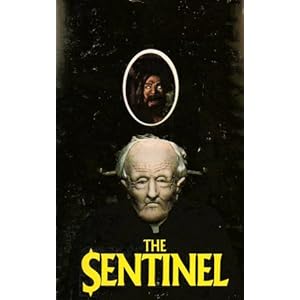
And then comes The Sentinel. I don’t remember the movie coming out, but I do remember the paperback reprint of the book staring out from every grocery store wire rack:
Even then it looked to be part of the first wave of mass market horror dreck rushed to print in the wake of the success of The Exorcist (both in print and on-screen).
So I had very low expectations for the movie adaptation when we queued it up for holiday viewing. Fortunately, it was better than I thought it would be, turning out to be only mediocre rather than utter crap. (Hurray for low expectations!) It has a few unexpected twists and a dynamite supporting cast that skims the best of three generations of Hollywood character actors. However, it’s easily the weakest of the big budget Catholic Devil films of the era, far inferior to not only The Exorcist, but also Rosemary’s Baby and The Omen.
Like The Exorcist and The Omen, the film has a cold open in a foreign clime, in this case Italy, with a mysterious conclave of Catholic officials, which ends up not telling us a damn thing.
Back in New York City, Cristina Raines (sort of a poor man’s Kate Jackson) plays Alison, a model looking for an apartment because she “needs some space” (I did say it was the 70s) from her lawyer boyfriend (a very young Chris Sarandon skillfully walking the line between sympathetic and oily). How was she to know the apartment building she choose was a Hellmouth?
Well, the fact she found a large, furnished apartment with a water view for $400 was the first hint. (Today if you advertised an NYC apartment that big at that price, you could probably get takers even if you told them it’s a Hellsmouth. “Sure, the walls drip blood. But look at all this room!”) The freaky neighbors were another, including an overly cheerful Burgess Meredith, two lesbians sharing an apartment (one of whom, a silent Beverly D’Angelo, “Jill’s off” in front of her), and the blind recluse of a priest in the top apartment. Then comes the disturbing noises and bumps above her room at night. And the strange birthday party for Meredith’s cat.
Outside her apartment things aren’t much better. Her father dies, leading to a strange flashback of her coming home in her Catholic schoolgirl uniform, him cavorting with hookers, slapping her, and then her attempting to slit her wrists, which seems a rather drastic response. (I mean, couldn’t she just start dressing in black and listening to punk rock?) She’s fainting during her modeling gigs and on some sort of drugs. (I did say it was the 70s.)
However, things take a truly weird turn when the agent that rented the apartment to her reveals that all the flats but her’s and the priest’s are vacant, taking her on a tour of cobwebbed suites she had seen occupied the day before.
At this point the movie is starting to resemble Gaslight more than your average Satanic shocker. Is she really living on a Hellmouth? Is she just seeing things? Is it the drugs? It takes a twist back to horror land when, back in her apartment (yeah, she’s a moron) she hears more groaning and bumping above her, at which point she undertakes the only course of action available to a horror movie heroine in this situation: Go up to confront it in her negligee with a flashlight and a knife. And who should be there but her dead father, who she promptly stabs before running screaming into the street and covered with blood.
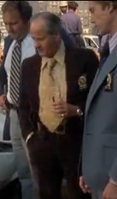
After that there’s even more weird twists, featuring two policemen (Eli Wallach, sporting the widest tie in cinema history, along with young Christopher Walken) investigating, visits to churches, lawyer boyfriend hiring a detective who disappears, a bit of written glossolalia on the part of Alison (ancient Latin, natch), and the usual plea to kept her under constant observation while he goes to Confront the Evil. You can probably figure out how well that works out.
And in case you think I was exaggerating about Eli Wallach’s tie:
It does turn back into a full-blown Hellsmouth movie about five minutes before the end, with a suitably creepy (if depressing) climax.
Here’s the trailer, which includes a goodly portion of the climax cut into little pieces, and actually makes the film seem like a bit more of a generic horror film than it actually is:
Despite the solid supporting roles, the film falls flat compared to its demonic brethren largely due to the talent on the other side of the camera. The Exorcist and Rosemary’s Baby featured great directors at or near the top of their game and solid screenplay adaptions of famous horror novels. Michael Winner, most famous for directing Death Wish (I, II and III) is not in that league. When Friedkin deployed the gore, it was all the more effective due to his naturalistic restraint earlier in the film. By contrast, Winner seems to reach for the sleaze pretty early, including possibly the last mainstream American film where lesbianism was intended to be a sign of moral turpitude rather than easy titillation. There’s plenty of female nudity, most of it deeply unerotic. The film has more gore than its predecessors (possibly a linear extrapolation per year), but not enough to satisfy a real gore hound. Otherwise the direction and cinematography are workmanlike.
The resume for writer Jeffrey Konvitz (adapting his own novel) is even thinner, with Silent Night, Bloody Night (not to be confused with the far more infamous, but no doubt equally crappy, Silent Night, Deadly Night) and Gorp being his only other screenplay credits. As a producer he did slightly better, with Spy Hard as his most notable film. The Sentinel probably comes in at the very top of his extremely limited resume.
The Exorcist had a solid grasp on Catholic doctrine, while The Omen had enough of one to make the plot go. The theology in The Sentinel seems loosely based on other films and horror novels and is never fleshed out enough to actually make sense. Also, in the film it becomes apparent that Alison has been Chosen, but the mechanism doesn’t make any sense. What if she never called back this particular apartment agent? Burgess Meredith’s role doesn’t really make sense. Is he a quirky neighbor? Satan? Something else? He seems as ill-defined as the rules under which Good opposes Evil. And pretty much every actor in it has done better work.
Still, the climax is nicely creepy. The film handles the “Is She Crazy or Is It Satan” question better than you think it would. It was pretty much the last mainstream horror film featuring Satan in the big city (it would soon go suburban and then rural, and then either disappear off the list of standard horror cliches entirely, go to indy films, or mutate into something else (the cenobites in Hellraiser do not come out of the Catholic demonic tradition), before staging a mild comeback thanks to remake fever. There’s lots scarier and more interesting horror fare available; this is mainly a curiosity for those who have already seen the other Hollywood horror films of the 1970s.
I can’t find box office records for the film, indicating it wasn’t particularly successful; it didn’t make as much money as that year’s other Satanic film Exorcist II: The Heretic, which raked in $30.7 million. (The top film that year was Star Wars, which you might have heard of.)
And it looks like someone has posted the entire movie online, if you’re really curious:
The End of the Ocean labels themselves post-rock, and some of their work is a bit noodly for my taste, but this one hits a nice melodic shoegaze sweet spot.
The only reason this isn’t perfect is that no one has the pure upper tenor Art Garfunkel has. But right now it’s only a 360 hits. By the end of the month I bet it’s over a million.
With it’s decayed council estates, menaced pensioner and eerie gang of identically-faced children, Aphex Twin’s “Come To Daddy” surely has to rank among the creepiest music videos ever made.
Next on our Halloween tour of scary and/or creepy phenomena: Mummies.
Yawn. Bad Universal monster movies. How banal.
OK. How about Japanese mummies?
Meh. Maybe worthy of a slightly-arched eyebrow.
OK. How about Japanese monks who mummified themselves while they were still alive?
!!!
I thought that would get your attention.
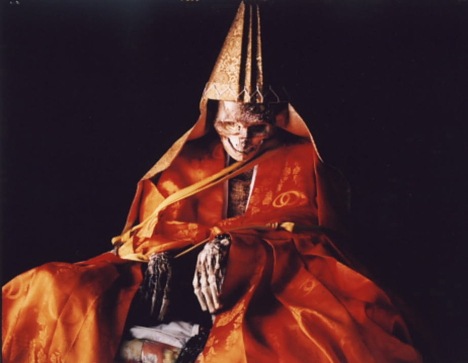
Meet the Sokushinbutsu:
Let’s go to Wikipedia, the source of all vaguely-accurate knowledge, for the grisly details of how a monk would voluntarily turn himself into a Sokushinbutsu:
For 1,000 days the priests would eat a special diet consisting only of nuts and seeds, while taking part in a regimen of rigorous physical activity that stripped them of their body fat. They then ate only bark and roots for another thousand days and began drinking a poisonous tea made from the sap of the Urushi tree, normally used to lacquer bowls.
This caused vomiting and a rapid loss of bodily fluids, and most importantly, it made the body too poisonous to be eaten by maggots. Finally, a self-mummifying monk would lock himself in a stone tomb barely larger than his body, where he would not move from the lotus position. His only connection to the outside world was an air tube and a bell. Each day he rang a bell to let those outside know that he was still alive.
When the bell stopped ringing, the tube was removed and the tomb sealed. After the tomb was sealed, the other monks in the temple would wait another 1,000 days, and open the tomb to see if the mummification was successful.
If the monk had been successfully mummified, he or she was immediately seen as a Buddha and put in the temple for viewing. Usually, though, there was just a decomposed body. Although they were not viewed as a true Buddha if they were not mummified, they were still admired and revered for their dedication and spirit.
There are reportedly some 24 “successful” examples of monks turning themselves into mummies in northern Japan, which suggests that they were probably hundreds of unsuccessful attempts. So just imagine a starving monk, entombing himself alive, wasting away toward his inevitable demise.
That would be one hell of a time to discover you have claustrophobia…
I picked up Malory’s album Outerbeats and I’m enjoying it quite a bit. It’s about halfway between ambient and shoegaze, with a tiny bit of lounge jazz thrown in every now and then. Great end-of-the-day music.
With the Halloween season upon us, I thought I’d start sharing some seasonal videos. Here’s one of an amusingly scary prank snowman, even though it won’t be cold enough for snow in Austin for a few months (if then).
Back when I edited Nova Express, I tried to pick up all the important SF reference works I could afford that I could lay my hands on. Among those were two extensive Magill’s references sets: Survey of Science Fiction Literature and Survey of Modern Fantasy Literature. Each covers hundreds of key works, alphabetized by title, providing title, author, year of publication, type (novel, etc.), time, setting, key characters, a summary of the book that touches in some measure on its major themes, and a short secondary bibliography. Several notable science fiction writers, editors and critics contributed entries, including Brian Aldiss, John Clute, David Pringle, Brian Stableford and Jack Williamson.
In some ways, the material in these books have been superseded by the aggregate knowledge contained in the Internet. But it’s still a useful reference source. If i want to know, say, what Harry E. Martinson’s Aniara is about, I can read the short entry here rather than the entire book-length poem and be reasonably sure that it’s accurate.
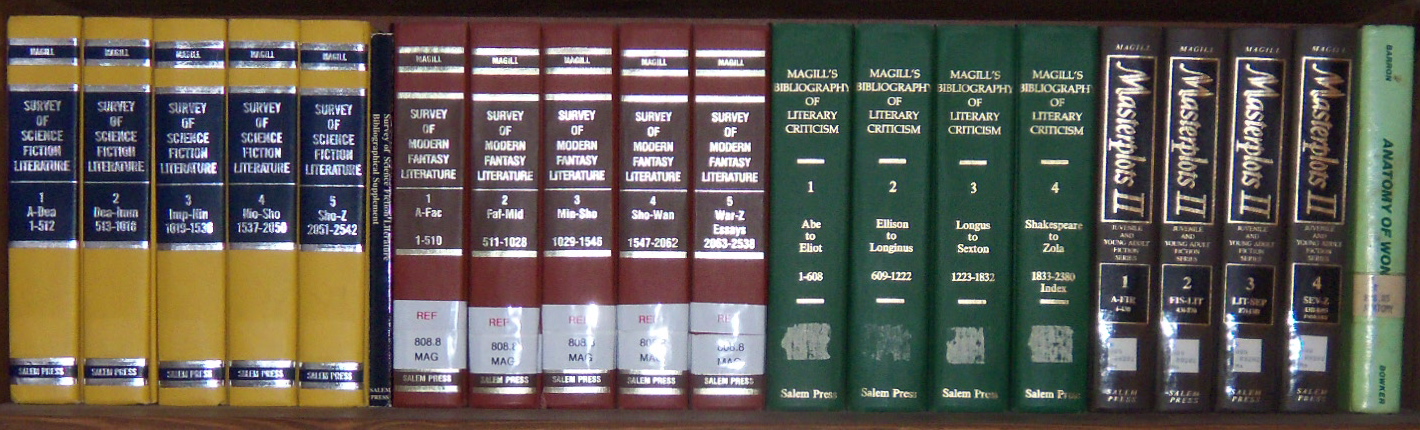
I kept my eyes out for those sets, and picked them up off eBay when affordable copies appeared. I also picked up two more Magill’s sets at a library sale dirt cheap (I think $10 for each set) and those are on the same top shelf.
Magill, Frank N., Editor (series editor). Survey of Science Fiction Literature. Salem Press, 1979. First edition hardbacks, five volume set, Ex-Library copies, otherwise VG with interior library markings, etc.
Magill, Frank N., Editor (with bibliographies compiled by Marshall b. Tymn). Survey of Science Fiction Literature Bibliographic Supplement. Salem Press, 1979. First edition trade paperback original, a Fine- copy with slight edgewear. Additional secondary bibliographic material for 295 of the entries in the five volume work. Purchased separately.
Magill, Frank N., Editor (series editor). Survey of Modern Fantasy Literature. Salem Press, 1983. First edition hardbacks, five volume set, Ex-Library copies, otherwise VG with library markings, etc.
Magill, Frank N., Editor (with Stephen L. Hanson and Patricia King Hanson, Associate Editors). Magill’s Bibliography of Literary Criticism. Salem Press, 1979. First edition hardbacks, four volume set, Ex-Library copies, otherwise VG with library markings, etc. Covers some 2,500 works, listed alphabetically by author. Very little genre coverage.
Magill, Frank N., Editor. Materplots II: Juvenile and Young Adult Fiction Series. Salem Press, 1991. First edition hardbacks, four volume set, Ex-Library copies, otherwise VG with library markings, etc. Listed alphabetically by title. Includes some genre coverage, even of books I wouldn’t associate with YA (such as Babel-17, Dreamsnake, Dune, etc.).
On the end of the row in the picture is an Ex-Library copy of the first edition of Neil Barron’s Anatomy of Wonder.
There are two other Magill SF/F reference sets I don’t own: Magill’s Guide to Science Fiction and Fantasy Literature from 1996, which culls and condenses the two five volume sets down to a single four volume set, and Classics of Science Fiction and Fantasy Literature from 2002, which condenses them down still further into a two volume set with still more additional material, including my own entry on Patrick O’Leary’s Door Number Three. I believe that Classics of Science Fiction and Fantasy Literature is the only thing I’m in for which I lack a contributor’s copy.
In Anatomy of Wonder 4, Neil Barron calls Survey of Science Fiction Literature “an essential tool, although its price will limit it to larger libraries.” Well, I guess mine qualifies…