And now I pretty much have to see Deadpool…
“Deadpool: The movie that touches you in totally inappropriate ways…”
And now I pretty much have to see Deadpool…
“Deadpool: The movie that touches you in totally inappropriate ways…”
Sometimes you stumble across something not really on your collecting radar, but if it’s cheap enough, you go “What the hell?”
Ellison, Harlan. A Boy & His Dog & “Repent, Harlequin” said the Ticktockman. Warner Audio Publishing, no date (but 1985). Presumed first edition, a pair of cassette tapes of Ellison reading his two stories, a Fine- copy with small cracks to the clear cassette tape case plastic, in blister pack. Signed by Ellison on the back of the front cover insert. Bought for $2 off eBay.

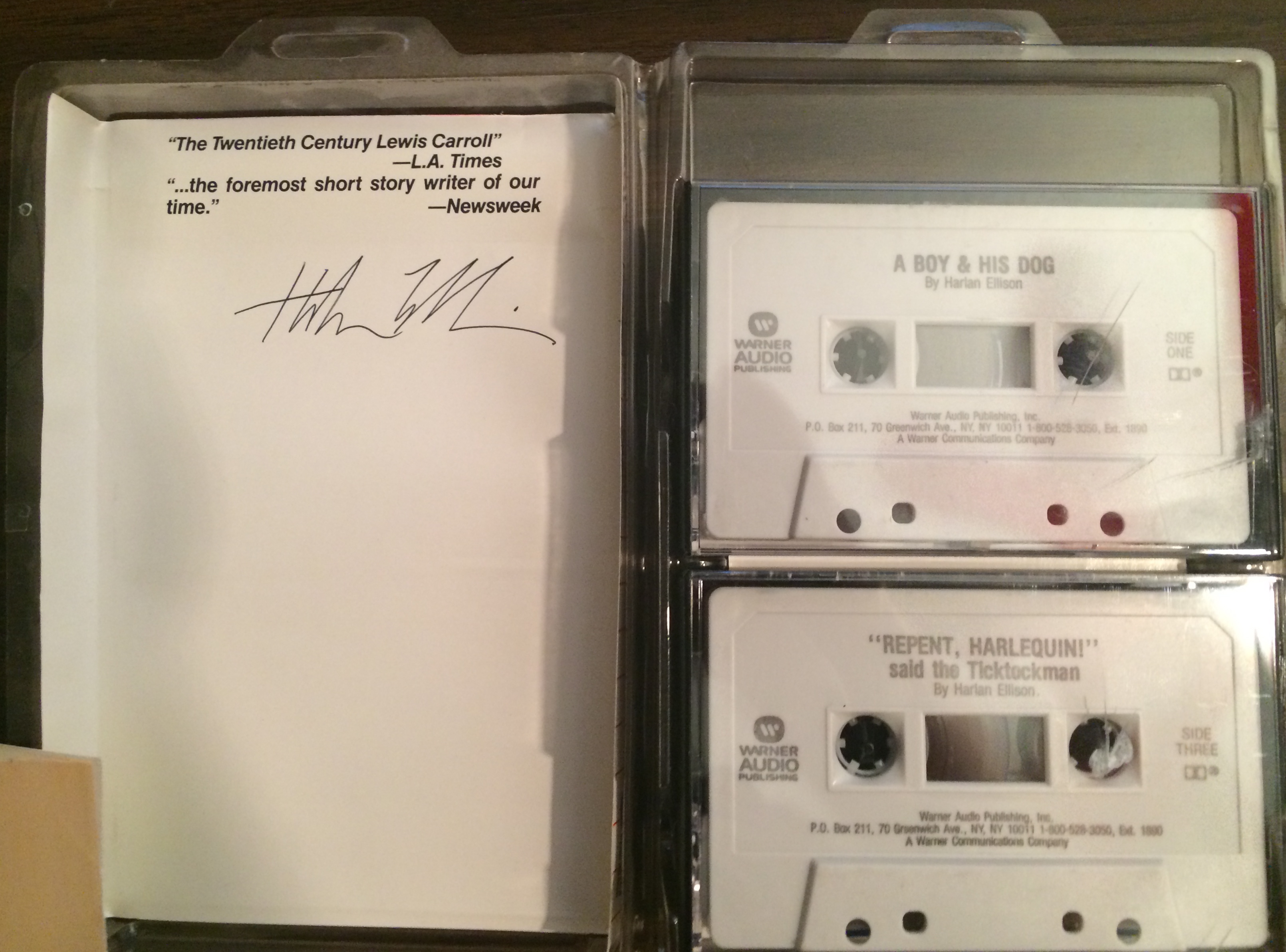
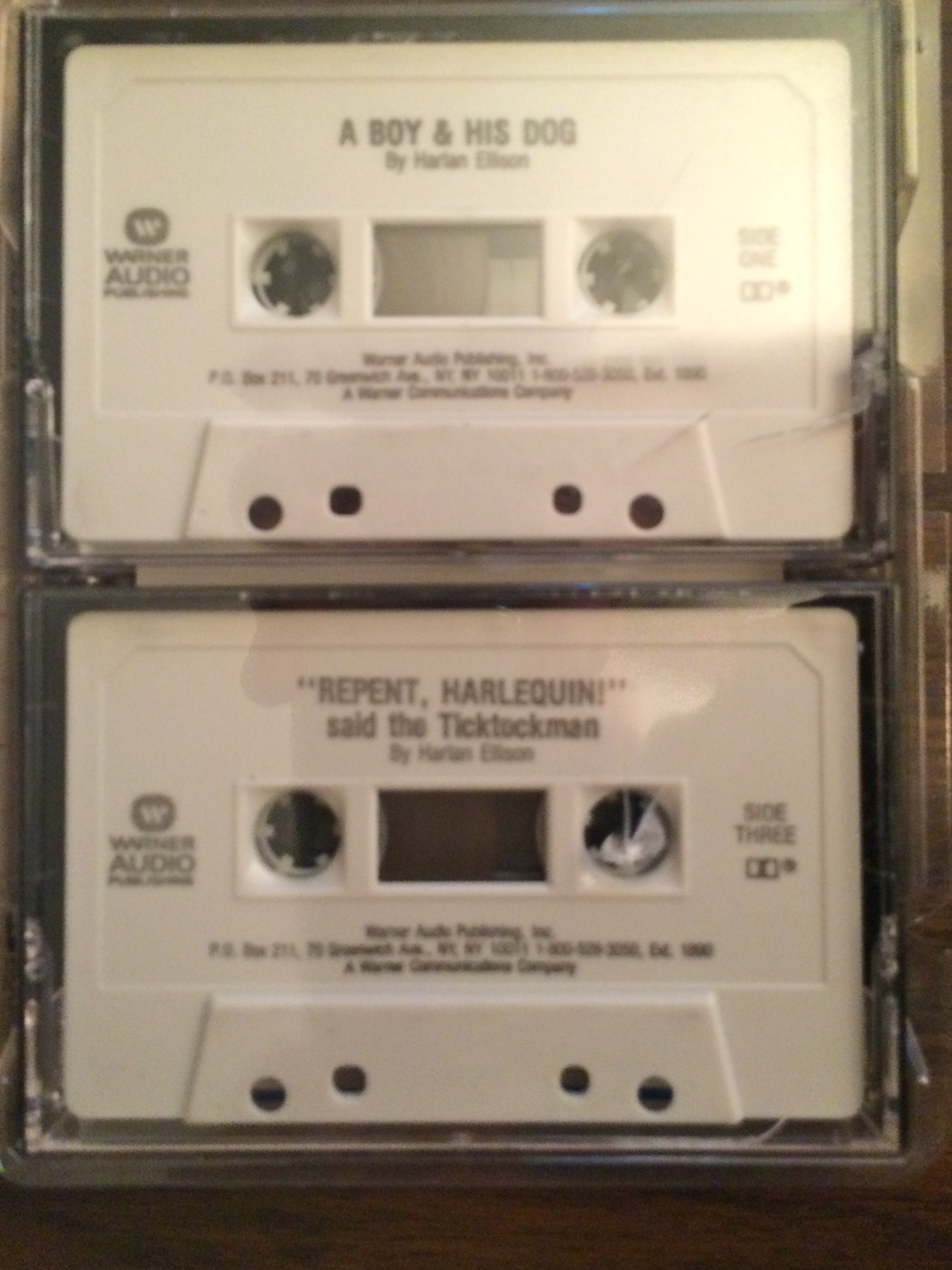
(Not having a cassette tape player it wouldn’t be a pain to hook up, I’m just assuming it still has Ellison’s stories on it, and it hasn’t been taped over with a copy of, say, Frampton Comes Alive…)
Glancing through the top 25 films in the the IMDB Top 250 list, it occurred to me that most involved crime as the central subject, and a few more peripherally:
That’s 15 of the top 25 films which involve crime as either a primary or secondary feature.
Surely crime dramas offer plenty of conflict, but so do war movies, but none of them (save the SF/F entries, and Schindler’s List) make the list, nor do any sports films. (Perpetual favorite Casablanca, which would qualify as a war film, comes in at 30, while Saving Private Ryan comes in at 31.)
Anyone care to speculate on why crime dominates the top of the list?
I’d been having a dry spell searching the local Half Price Books locations. I wasn’t find much terribly interesting in their stacks (a few signed paperbacks here and there), and I either had everything I wanted in their collectable shelves, or they were asking too much money for marginal works.
Saturday’s find made up for many, many years of dry spells, and is hands-down the best find I’ve ever made at Half Price Books:
Oliver, Chad. Shadows in the Sun. Ballantine Books, 1954. First edition hardback (Currey state A, tan cloth lettered in black, no priority), a Near Fine+ copy with slight bumping at head and heel and usual age-darkening to pages), in a Near Fine- dust jacket with a 1 1/2″ closed tear to rear dust jacket flap, slight spotting to top of white rear cover, and a few small rubs. Hall, Hal W., The Work of Chad Oliver: An Annotated Bibliography & Guide, A2. Currey (1979), page 397. Locke, Spectrum of Fantasy, page 169 (an ex-library copy; his description of the dust jacket matches (down to the H-91 code on the front flap), but his description of the book itself as “gray cloth in dark blue lettering” doesn’t match either this copy or the Currey B state (blue cloth lettered in black); Locke’s copy was possibly a library rebind or another binding variant). Barron, Anatomy of Wonder 4, 3-138. Bought for $3 from the Half Price Books in Cedar Park.
Since Google image search brings up no copies of the hardback dust jacket (only the paperback edition, which has a different cover, as they frequently did), I’ve done several scans of it.
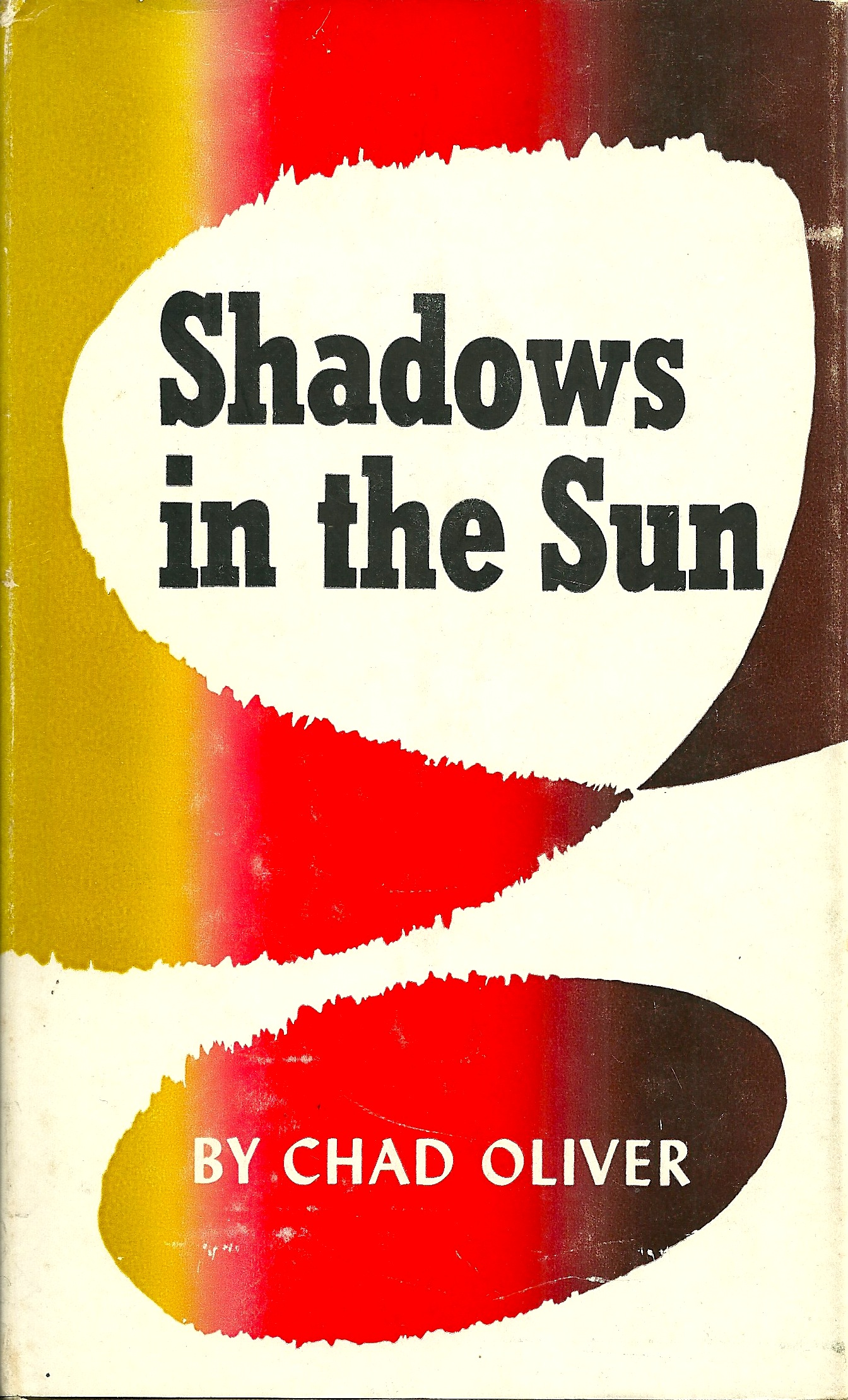

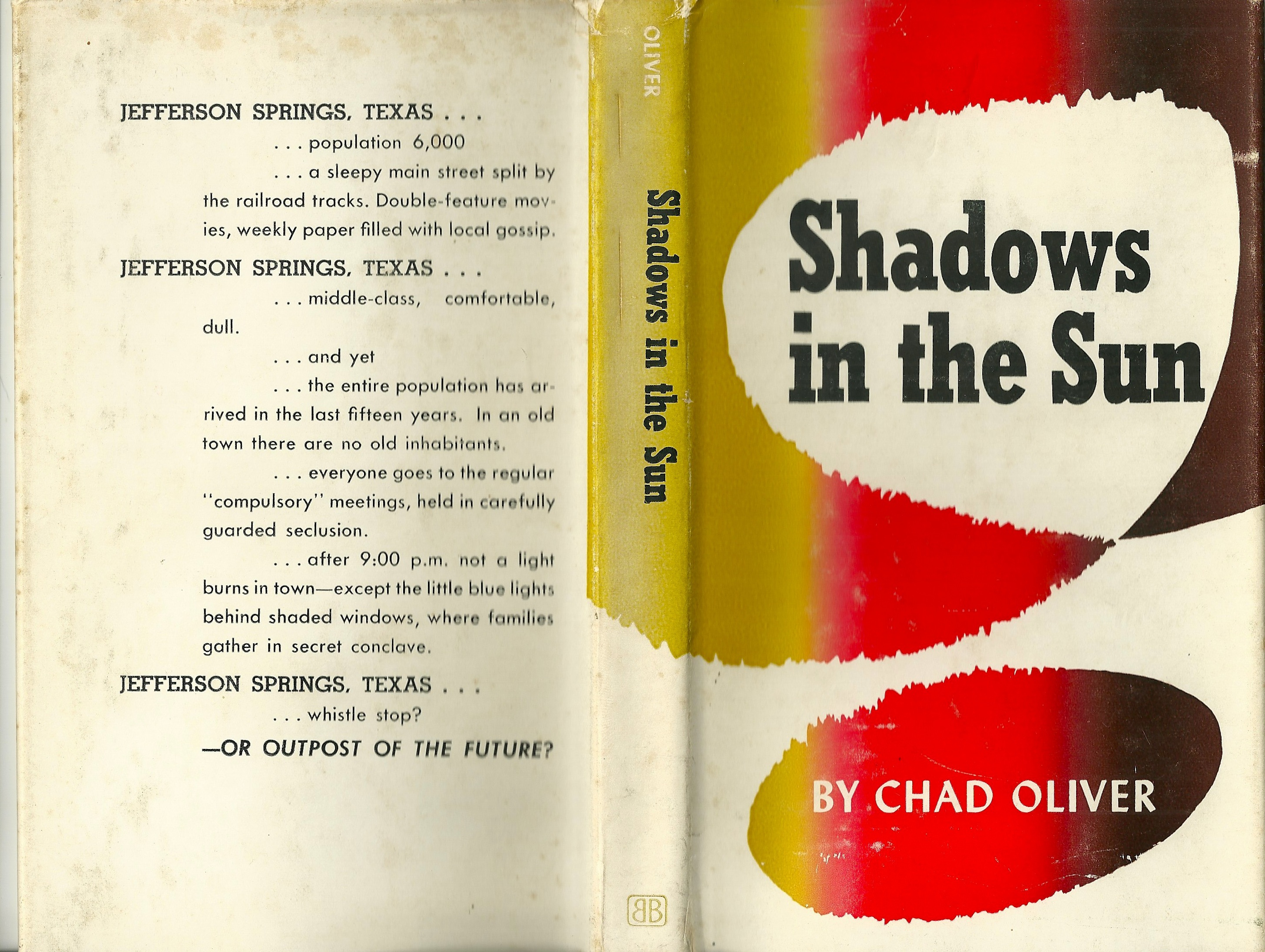
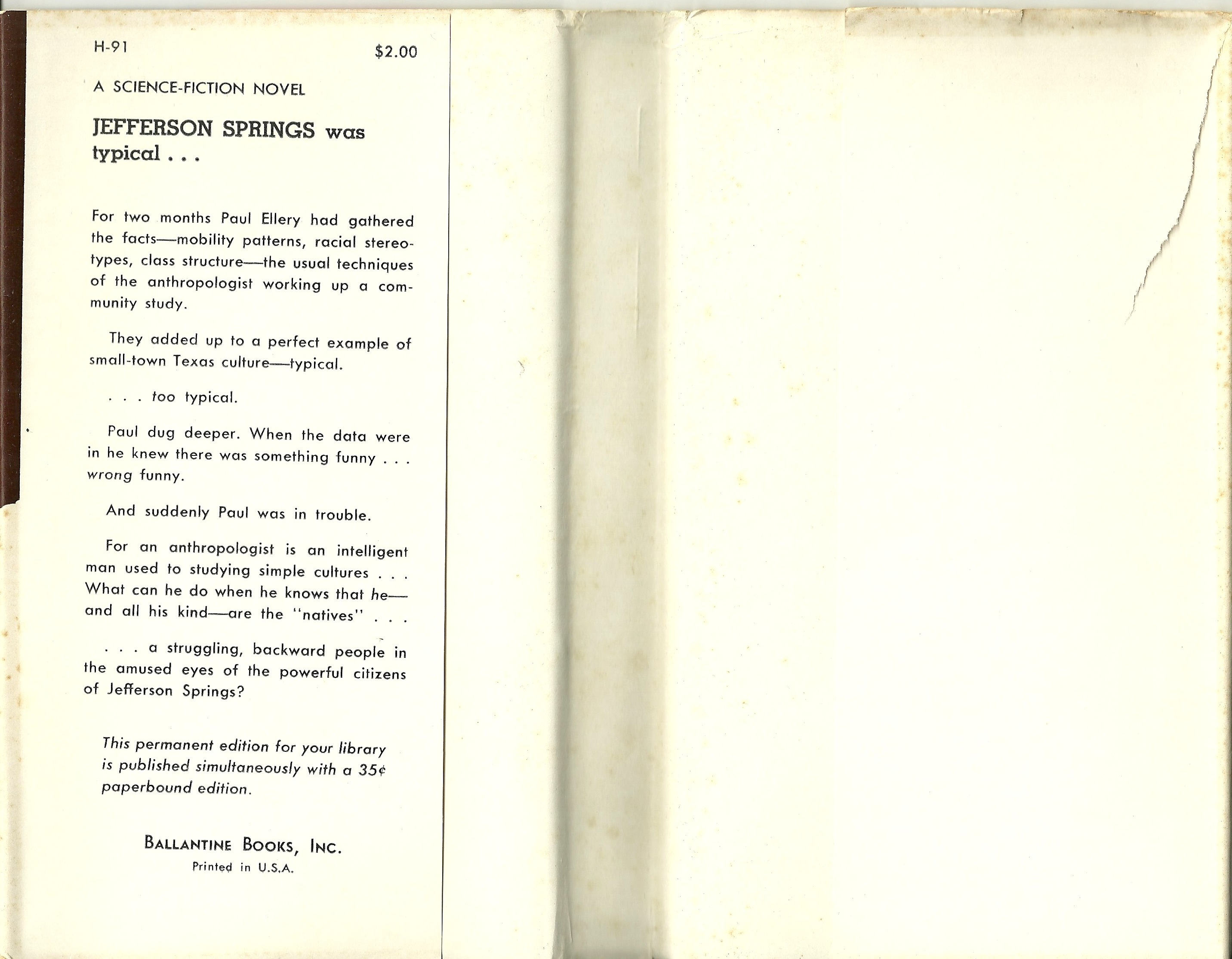

Chad Oliver was the Grand Old Man of Austin science fiction writers. In addition to writing important works of anthropological SF in the 1950s, he was Dean of the University of Texas’ anthropology school for a while, and was an all-around swell guy. I knew him, but he was really more of a mentor to my mentors (Howard Waldrop, Bruce Sterling, Lewis Shiner, etc.), and had stopped going to the Turkey City Writer’s workshop by the time I started attending. He died in 1993.
Ballantine Books was one of the first mainstream publishers to move into science fiction in the 1950s. They published a prestigious SF line that came out in two formats: A paperback edition for readers, and a hardback edition, scarcely larger than the paperbacks, primarily for the library market. The paperbacks had print runs in the hundreds of thousands, while I’ve heard 600 as a typical print run for the hardbacks. Among the most desirable titles are Fahrenheit 451 (including the asbestos-bound state, which is insanely expensive), Childhood’s End (which I have an Ex-Library of), Hal Clement’s Cycle of Fire, and Green Odyssey, Philip Jose Farmer’s first published book. I’ve seen multiple copies of all those (even the asbestos Fahrenheit 451) offered up for sale or auction, but never Shadows in the Sun (Heritage offered up a jacketless copy a few years back). I don’t think seen a jacketed copy for sale or auction anywhere in the last 20 years.
Hell, as far as I can tell, Texas A&M’s Cushing library, to which Chad donated his books and papers, doesn’t even have a copy of the hardback listed among the donated material.
A conservative estimate of value is probably $2,000…
A pleasant Shoegazey song set to someone’s video of their vacation in Japan. It’s actually pretty cool.
At some point The Kritzlers apparently became Cochlear Kill.
For your Sunday dose of Shoegaze, here’s Tennis System covering A Flock of Seagulls’ “Space Age Love Song.”
In other news, A Flock of Seagulls had songs other than “I Ran”…
Blue Bell ice cream to begin test production this week.
Hip hip, hooray! If all goes well, they expect to have product back on store shelves by Labor Day. Also, billionaire Sid Bass has made a “significant investment” in Blue Bell, which should help them survive until production is up and running again.
46 years ago today, mankind landed on the moon.
And “An Ending (Ascent)” (which you only get a little bit of above) is the greatest piece of music Brian Eno ever did…
Finally obtained a book I’ve been trying to get for over 20 years, ever since hearing about it while compiling Bruce Sterling’s bibliography for Nova Express in the early 1990s:
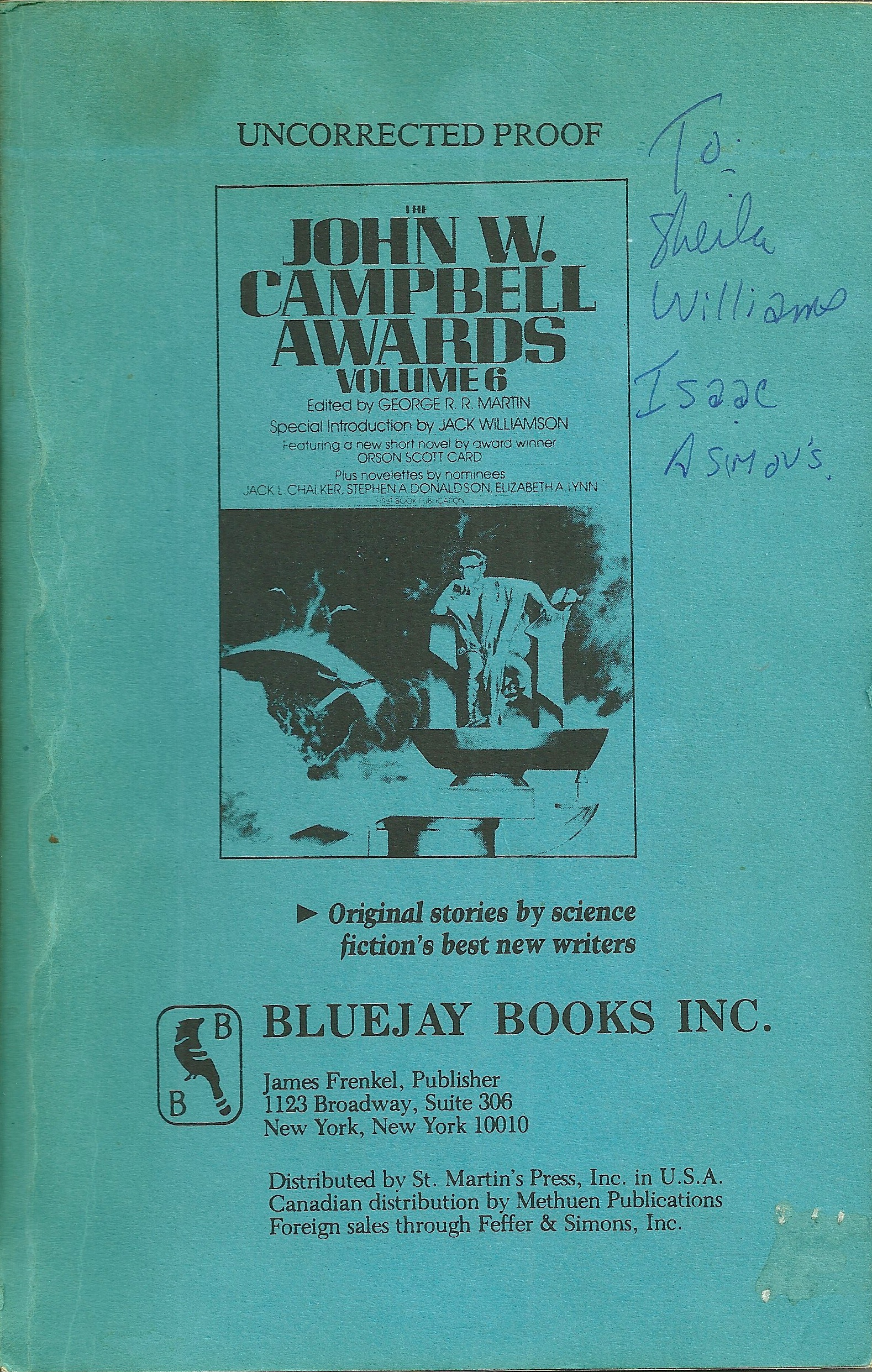
Martin, George R. R. The John W. Campbell Awards Volume 6. Bluejay Books, 1986. Uncorrected proof, trade paperback format, of the never-published hardback first edition, a Very Good- copy, being well-read with creasing along front and back spine joins, bottom of front spine join starting to split, a few spots of staining (including one to the edge of side/bottom page block), and general wear, with note on front cover stating “To/Shelia/Williams/Isaac/Asimov” and a note on the table of contents saying the Orson Scott Card story listed was going to be replaced with another Card story. Never produced because Bluejay Books went out of business in 1986. Copy on the back covers states the book was to be produced in both hardback and trade paperback formats.
The contents are as follows:
Bought for $100 from an editor who was downsizing his library as part of moving.

Here’s New York-based Soundpool with “On High.”