The End of the Ocean labels themselves post-rock, and some of their work is a bit noodly for my taste, but this one hits a nice melodic shoegaze sweet spot.
Shoegazer Sunday: The End Of The Ocean’s “Worth Everything Ever Wished For”
October 14th, 2012The Sound of Cylons
October 13th, 2012The only reason this isn’t perfect is that no one has the pure upper tenor Art Garfunkel has. But right now it’s only a 360 hits. By the end of the month I bet it’s over a million.
Halloween Horrors: Aphex’s Twin’s Creepy Video for “Come to Daddy”
October 13th, 2012With it’s decayed council estates, menaced pensioner and eerie gang of identically-faced children, Aphex Twin’s “Come To Daddy” surely has to rank among the creepiest music videos ever made.
Halloween Horrors: Self-Mummifying Japanese Monks
October 10th, 2012Next on our Halloween tour of scary and/or creepy phenomena: Mummies.
Yawn. Bad Universal monster movies. How banal.
OK. How about Japanese mummies?
Meh. Maybe worthy of a slightly-arched eyebrow.
OK. How about Japanese monks who mummified themselves while they were still alive?
!!!
I thought that would get your attention.
Meet the Sokushinbutsu:
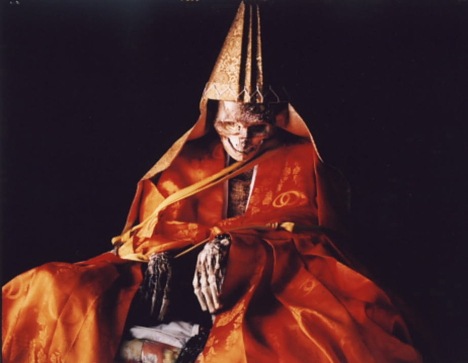
Let’s go to Wikipedia, the source of all vaguely-accurate knowledge, for the grisly details of how a monk would voluntarily turn himself into a Sokushinbutsu:
For 1,000 days the priests would eat a special diet consisting only of nuts and seeds, while taking part in a regimen of rigorous physical activity that stripped them of their body fat. They then ate only bark and roots for another thousand days and began drinking a poisonous tea made from the sap of the Urushi tree, normally used to lacquer bowls.
This caused vomiting and a rapid loss of bodily fluids, and most importantly, it made the body too poisonous to be eaten by maggots. Finally, a self-mummifying monk would lock himself in a stone tomb barely larger than his body, where he would not move from the lotus position. His only connection to the outside world was an air tube and a bell. Each day he rang a bell to let those outside know that he was still alive.
When the bell stopped ringing, the tube was removed and the tomb sealed. After the tomb was sealed, the other monks in the temple would wait another 1,000 days, and open the tomb to see if the mummification was successful.
If the monk had been successfully mummified, he or she was immediately seen as a Buddha and put in the temple for viewing. Usually, though, there was just a decomposed body. Although they were not viewed as a true Buddha if they were not mummified, they were still admired and revered for their dedication and spirit.
There are reportedly some 24 “successful” examples of monks turning themselves into mummies in northern Japan, which suggests that they were probably hundreds of unsuccessful attempts. So just imagine a starving monk, entombing himself alive, wasting away toward his inevitable demise.
That would be one hell of a time to discover you have claustrophobia…
Shoegazer Sunday: Malory’s “Falling Shine”
October 7th, 2012I picked up Malory’s album Outerbeats and I’m enjoying it quite a bit. It’s about halfway between ambient and shoegaze, with a tiny bit of lounge jazz thrown in every now and then. Great end-of-the-day music.
Here’s “Falling Shine.”
Halloween Video: Don’t Look in the Mirror
October 5th, 2012A compilation of mirror scares from various films. Starts out scary, then starts to seem a bit old…
Halloween Videos: Freaky the Scary Snowman
October 4th, 2012With the Halloween season upon us, I thought I’d start sharing some seasonal videos. Here’s one of an amusingly scary prank snowman, even though it won’t be cold enough for snow in Austin for a few months (if then).
Lawrence Person’s Library: Reference Books (Part 5: Magill’s Sets)
September 30th, 2012Back when I edited Nova Express, I tried to pick up all the important SF reference works I could afford that I could lay my hands on. Among those were two extensive Magill’s references sets: Survey of Science Fiction Literature and Survey of Modern Fantasy Literature. Each covers hundreds of key works, alphabetized by title, providing title, author, year of publication, type (novel, etc.), time, setting, key characters, a summary of the book that touches in some measure on its major themes, and a short secondary bibliography. Several notable science fiction writers, editors and critics contributed entries, including Brian Aldiss, John Clute, David Pringle, Brian Stableford and Jack Williamson.
In some ways, the material in these books have been superseded by the aggregate knowledge contained in the Internet. But it’s still a useful reference source. If i want to know, say, what Harry E. Martinson’s Aniara is about, I can read the short entry here rather than the entire book-length poem and be reasonably sure that it’s accurate.
I kept my eyes out for those sets, and picked them up off eBay when affordable copies appeared. I also picked up two more Magill’s sets at a library sale dirt cheap (I think $10 for each set) and those are on the same top shelf.
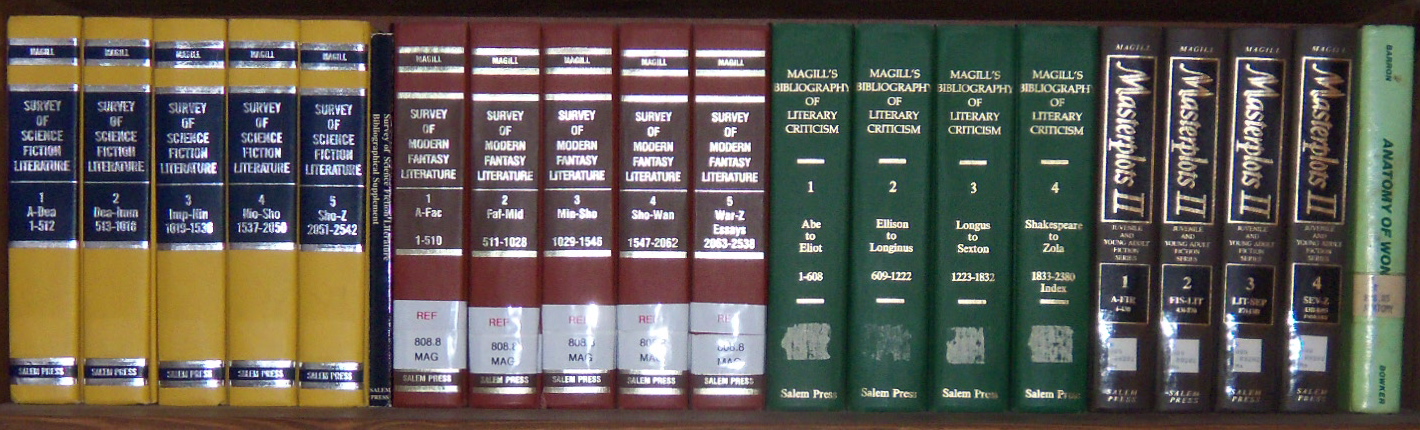
On the end of the row in the picture is an Ex-Library copy of the first edition of Neil Barron’s Anatomy of Wonder.
There are two other Magill SF/F reference sets I don’t own: Magill’s Guide to Science Fiction and Fantasy Literature from 1996, which culls and condenses the two five volume sets down to a single four volume set, and Classics of Science Fiction and Fantasy Literature from 2002, which condenses them down still further into a two volume set with still more additional material, including my own entry on Patrick O’Leary’s Door Number Three. I believe that Classics of Science Fiction and Fantasy Literature is the only thing I’m in for which I lack a contributor’s copy.
In Anatomy of Wonder 4, Neil Barron calls Survey of Science Fiction Literature “an essential tool, although its price will limit it to larger libraries.” Well, I guess mine qualifies…
Related Posts
Shoegazer Sunday: Thrushes’ “Crystal”
September 30th, 2012And the Thrushes kick continues with “Crystal”!
Lord Byron’s Autographed Copy of Frankenstein Up for Sale
September 25th, 2012I have a number of interesting association copies in my library, but a first edition of Frankenstein inscribed to Lord Byron by the author blows away anything I have by a good measure. That’s what bookseller Peter Harrington is offering up for a mere £350,000 or so (which, at this particular moment, comes out to $566,985.26). I’ll check my recliner for spare change, but I think that’s more than I’m willing to spend right now. (Plus it’s only the first volume of the three volume set, and you can’t expect me to lower my standards and buy an incomplete set, can you?)

I’ve refrained from putting up a post on it until now because I’m incredibly lazy I was waiting for the bookseller to put up a full prospectus, which he has now done. Here’s the relevant description:
[SHELLEY, Mary.] Frankenstein; or, The Modern Prometheus. London: for Lackington, Hughes, Harding, Mavor, & Jones, 1818. First edition, presentation copy to Lord Byron, with the author’s autograph inscription to the front flyleaf: “To Lord Byron from the Author”. An unsurpassable association copy of the best known fiction of the Romantic era, perhaps the most evocative presentation copy conceivable in all nineteenth-century literature.
Condition: Vol. 1 only (of 3), duodecimo (184 × 114 mm). Bound for presentation in contemporary calf, boards ruled in gilt with a double fillet enclosing a leaf-and-flower-head roll in blind with floral tools in blind at inside corners, marbled endpapers, green silk book mark. Inscribed by the author on the binder’s blank immediately preceding the half-title; complete with the half-title and final advert leaf. Spine perished (a small fragment with a single blind-tooled oriel preserved in archival paper tipped-in on the rear pastedown), inner hinges expertly repaired by James Brockman, boards rubbed and a little stained, tips just worn, a few faint spots and some light offsetting, a tall, well-margined copy.
Worth that much? Probably. Though I would really want the second and third volumes…