Archive for the ‘Science Fiction’ Category

Lots of Science Fiction Showing Up in the Public Domain

Thursday, November 11th, 2010

Take a look at this list of new science fiction put up at Project Gutenberg. Lots of familiar (and fairly recent) names there: Philip K. Dick, Mark Clifton, Leigh Brackett, Poul Anderson, Norman Spinrad, Frederik Pohl, and Jack Vance. And the last three of those are still alive.

It would be interesting to know how these slipped into the public domain. Did the original magazines where they appeared use work-for-hire contracts, or did the authors forget to file the copyright renewal?

Edited to add: Wrong link, fixed now.

Edited to add 2: Really, really fixed now. This time for sure!

Not Going to the Austin Comic Con

Thursday, November 11th, 2010

As I’m going to be busy watching Skyline (another movie Howard and I are reviewing) and they didn’t have any literary SF guests, I won’t be going to The Austin Comic Con (though I have friends who are going). But they do seem to have rounded up a surprisingly large number of 70s TV stars (plus Chewbacca, Darth Maul, Billy Dee Williams and, err, the cast of The Film I Refuse to Name). (And I’ve already met Lee Majors, for certain values of “met” that include “have your hand touched briefly as you walk past in a line with 10,000 other kids and their parents at a Toys”R”Us opening in the 1970s.” Also “met” William Shatner that way. I wonder when Toys”R”Us stopped hiring TV celebrities for store openings?)

But I must admit I’m a little bit tempted to go just to meet Oscar Goldman.

Oh, and here’s a hint for the Austin Comic Con Webmaster: if you’re going to copy text out of a Wikipedia entry, it’s usually best to take out the “[citation needed]” bit…

Howard and I Rave About Monsters

Monday, November 1st, 2010

Over at Locus Online.

Read the review, but the short version is that we really liked it. Here’s the short trailer:

The problem with that trailer is that it makers you think the movie is something from the “BOO shock” school of horror films, and it really isn’t.

And here’s an interview with director Gareth Edwards:

If it’s playing anywhere near you I would encourage you to see it.

Playboy Playmate, Star Trek Actress Charged With Murder

Thursday, October 21st, 2010

Dwight mentioned this but didn’t blog about it: Former 1968 Palyboy Playmate of the Year Angela Dorian (AKA Victoria Rathgeb, AKA Victoria Vetri) has been charged with attempted murder for shooting her boyfriend during an argument.

What he didn’t mention was that she also appeared on an episode of Star Trek, among other shows. (She even appeared in Rosemary’s Baby.)

Hat tip: Ace of Spades‘s newsfeed.

WisCon Disinvites Elizabeth Moon

Thursday, October 21st, 2010

I try to avoid political topics in this blog (and Facebook, for that matter), because, as someone once pointed out, “Telling someone their political ideas are wrong is like telling a 14-year old girl that the boy band she like sucks. She won’t believe you and she’ll instantly hate you for your efforts.”

But since WisCon’s cowardly decision to disinvite Elizabeth Moon as Guest of Honor over her very mild comments about Islam is so essentially a political story, I covered it over on my political blog BattleSwarm.

I also have some signed Elizabeth Moon books for sale through Lame Excuse Books is you’re interested.

An Amazing Jack Vance Collection

Saturday, October 16th, 2010

With pictures.

While I do have the Vance integral edition, which he doesn’t, I still don’t have a lot of the stuff shown here. Vance collectors are so fanatical that they make my bibliomania look relatively sane by comparison…

(Hat Tip: Mike Berro)

Library Curiosities: The Space Squid Cuneiform Clay Tablet

Wednesday, October 13th, 2010

You may have heard about science fiction fanzine Space Squid printing one of their issues on the ultimate form of Dead Media: inscribed in cuneiform on a baked clay tablet. Of these, I think they auctioned off five at Armadillocon.

Being one of the few people in the world with a complete collection of Space Squid issues (they actually told me that Nova Express was one of their sources of inspiration, the poor deluded fools), naturally I had to pick one up, which I did for the munificent sum of $11. (Bidding seemed more brisk for the usual cats-with-wings and dragon-related art items.)

My tablet. Let me show it to you.

Click to gallery-ize, the click again to embiggen. The first picture is of it sitting in its resting place on my mantelpiece, and the other two pics are close-ups of the front and back. (And here’s another Wired story with pics.)

In truth, the tablet (which contains the Kevin Brown story “Hunting Bigfoot”) is actually pretty hard to read, and I’m not sure how permanent the medium is; the clay has a tendency to flake off. Still, I’m sure that some 50 years hence an insane fanzine collector will be paying big bucks for one…

Here’s Matthew Bey’s step by step tutorial on how he created them.

Books Read: The Collected Stories of Phillip K. Dick, Volume 2: Second Variety

Sunday, October 10th, 2010

The Collected Stories of Phillip K. Dick, Volume 2: Second Variety
Underwood/Miller, 1987

People think I’ve read every damn SF book in the world, but this isn’t even remotely true. For example, I’m still trying to catch up to the works the previous generation of SF readers read when they were growing up. So while I’ve generally read the highlights of their work, I’m still trying to catch up on authors like Henry Kuttner, C, L. Moore, R. A. Lafferty, Fritz Leiber, Jack Vance and Philip K. Dick.

In this second volume of Dick’s collected short stories, the themes of “what is reality” and “who is human” that would dominate so many of his novels crops up again and again. The title novella (the longest here) is set during a third world war after a U.S./Soviet nuclear exchange, where U.S. forces are only able to hold off the Soviets thanks to the development of semi autonomous “claw” robots assembled in automated underground factories. A U.S. soldier goes out under truce to a small band of Soviet survivors, only to have a little boy tag along behind him, a boy that’s shot on sight approaching the bunker, as he’s one of two known “impostor” claws varieties in human form. In the bunker, our protagonist is told that there’s a “second variety” of impostor, who’s form is unknown. Paranoia ensues, especially when he returns to his own bunker to find out they’ve been overrun by claw impostors. “Human Is” and “Impostor” also question what it means to be human, and how can you tell if you’re really human?

“Adjustment Team” is another Dick story where the protagonist finds out that Reality Is Not What he Thought it Was, being given an accidental glimpse of something adjusting the world. Believe it or not, they’re making it into a romantic comedy starring Matt Damon and Emily Blunt. Because “romantic comedy” is the first thing you think of when talking about the work of Philip K. Dick. (Although “The World She Wanted,” in which absolutely everything goes exactly right for the woman the protagonist meets (because, after all, it is her world) could also be considered one.)

By this point, Dick was already a technically proficient author capable of moving a story swiftly along with a minimum of wordage. The overwhelming majority of stories in this volume come in at 10-20 pages long, and finish long before they wear out their welcome. As with all Dick’s work, none is perfect, but all have their points of interest. Amazingly, every story in this book (according to the notes at the end) was turned out between August 27, 1952 and April 20, 1953, a rate of productivity that was probably only surpassed by Robert Silverberg at the highpoint of his robotic pulpy period. I can only imagine what sort of effect these stories had on the field when they were originally published, and they’re still well worth reading today.

The Usual Idiots at Wikipedia are Trying to Delete Don Webb’s Entry

Thursday, October 7th, 2010

This entry, here. Evidently publishing some dozen-odd books doesn’t make you “notable” enough.

The deletion discussion page is here.

At this point I would rant about the deletion of my own entry from Wikipedia a year ago by some wrestling fan who objected to the review Howard Waldrop and I did of the Watchmen movie, but that would mean actually caring what the usual Wikipedia idiot zealots think. It’s simply wiser and easier to ignore them entirely.

A Quick Tour Around the Hollow Earth

Wednesday, October 6th, 2010

I can’t believe I missed this Jess Nevins piece over on No Fear of the Future talking about 19th century SF writer and astronomer Camille Flammarion (I have a couple of first English-language translations of his work) scheme to avert war by having all the armies of Europe dig a giant hole in the ground. This probably wasn’t the wackiest naive pacifist scheme to avert war in the 19th century (though it is even wackier than, say, teaching everyone to speak Esperanto; see Howard Waldrop’s story “Ninieslando” for more details on how that worked out…)

But I’m also fascinated by the Hollow Earth theories propounded by John Cleves Symmes, Jr., who in 1818 proclaimed:

I declare the earth is hollow and habitable within; containing a number of solid concentric spheres, one within the other, and that it is open at the poles 12 or 16 degrees; I pledge my life in support of this truth, and am ready to explore the hollow, if the world will support and aid me in the undertaking.
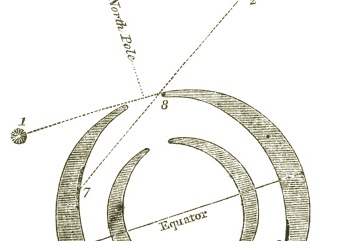
As wacky cosmological theories, this one had a lot going for it (and certainly more than, say, the theories of Immanuel Velikovsky). For one thing, given the state of exploration and geology extent in 1818, it wasn’t clearly wrong. For another, the idea of internal worlds, of delving deep into the earth, has always fascinated mankind, from the Greek and Sumerian underworlds all the way up through The Mines of Moria, Dungeons and Dragons, and even Minecraft. (Not to mention those Denver airport and Dulce base conspiracy theories.)
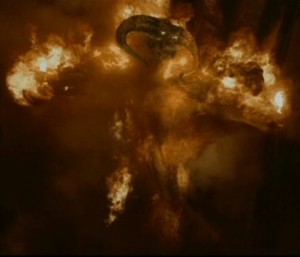
Not found in John Cleves Symmes' vision of a Hollow Earth

Symmes theories even inspired a novel. (Note: The person who put up that e-text of Symzonia says even reprints are rare, but this is no longer the case, as Amazon and Bookfinder are lousy with POD editions.) And Edgar Allen Poe would use some of Symmes’ ideas in The Narrative of Arthur Gordon Pym.

Another permutation of the Hollow Earth idea was Richard Shaver’s Shaver Mystery. Shaver claimed to hear voices in his head while using welding equipment, and claimed that “detrimental robots” (or deros) lived inside the earth and beamed mind control rays at the surface dwellers. For a while Amazing publisher Ray Palmer had every crackpot in America writing letters to add to the mystery in the late 1940s, just when when the first wave of flying saucer mania was reaching its peak.

Edgar Rice Burroughs’ Pellucidar series is set in the Hollow Earth, and an ever-growing number of science fiction writers have taken advantage of the idea, from Howard Waldrop and Steve Utley’s “Black as the Pit, from Pole to Pole” to Rudy Rucker’s The Hollow Earth, which also features Poe.

Believe it or not, there are some who still believe in the Hollow Earth theory. (Of course, there are still people who believe in a flat earth as well. And they’re looking for new believers once again!)

For more information, I would suggest looking up Walter Kafton-Minkel’s Subterranean Worlds, but since Loompanics Press went out of business (the people currently using their website just picked up the domain name when it lapsed), it’s gotten a bit pricey. I have David Standish’s Hollow Earth: The Long and Curious History of Imagining Strange Lands, Fantastical Creatures, Advanced Civilizations, and Marvelous Machines Below the Earth’s Surface, but I haven’t read it yet.