I almost missed the news that Jonathan Frid, who starred as vampire Baranabas Collins in the original Dark Shadows, died April 13 (Friday the 13th). It’s tempting to say that he died after seeing the trailer for the Tim Burton version.
I have extremely vague memories of watching the original when I was very young (including one scene where characters were trapped in a web and menaced by a giant spider that, even to my 5-year old self, looked incredibly fake), but I was never a devoted fan of the original series. Even so, it was obviously a very interesting pop culture artifact, a failing soap opera that desperately threw in a stage actor playing a vampire that turned it into a sudden cult hit.
Even so, I have to wonder why Tim Burton decided to camp it up like the movie version of The Brady Bunch. They few elements it shares with the original are so attenuated that he could have made the same “18th century vampire out of water” movie and changed a few names without calling it Dark Shadows, and since it stars the always-watchable Depp it would still have made money.
I can only imagine how real fans of the series must feel.
It’s sort of ironic that in the late 1960s, Batman was camp and Dark Shadows was melodrama, and now in 2012, Dark Shadows is camp, and The Dark Knight Rises is drama. And we all get ready for the next turn of the wheel…
But there’s no reason this idea can’t succeed in the U.S. Why not have Freddy Kruger, Leatherface, Jason or Pinhead throw out the first pitch? Granted, this still wouldn’t be enough to get me to watch baseball…
In the Before Time, the Long Long Ago (i.e., before I started this blog), I would ask The Vast Wisdom of Usenet (i.e. rec.arts.sf.written) what books I should read this year. Now that I have the blog, I’m posting the question here.
Below are 100 books (or a few more, counting multiple titles by a single author) of fiction I’m considering reading in 2012. With a few exceptions (like forthcoming books), they’re pretty much all books I already own in first editions. Most likely I’ll get to considerably less than 100. The first few are books I’ll probably get to (or are already reading), whereas the rest are a little vaguer (and in alphabetical order by author). That’s where you come in. Tell me which of the books below I should or shouldn’t read, and why. If a book’s not on the list, it’s probably because I’ve already read it, or have no interest in it, won’t get to it this year, etc., so save your electrons instead of suggesting alternates (there are plenty of other places for that). And if I list Book #2 in a linear series, rest assured I’ve already read Book #1.
I don’t promise I’ll read all the highest rated works, but those most highly praised are considerably more likely to be added to the reading stack, which is what’s happened the previous years I’ve done this.
Michael Shea: The Color Out of Time (read)
Jack Vance: The Killing Machine (read)
Stina Leicht: Of Blood & Honey (reading)
Joe R. Lansdale: Hyenas
Joe Dominici: Bringing Back the Dead
China Mieville: Embassytown
Robert Jackson Bennett: Company Man
Vernor Vinge: The Children of the Sky
Philip K. Dick: Clans of the Alphane Moon
Michael Moorcock: The War Hound and the World’s Pain
Greg Egan: Crystal Nights
Peter Ackroyd: Hawksmoor
Paolo Bacigalupi: The Windup Girl
Iain Banks: Against a Dark Background or Matter
John Barnes: Kaleidoscope Century or One for the Morning Glory
Stephen Baxter: Traces or Mayflower II
Peter S. Beagle: A Fine and Private Place
Greg Bear: The City at the End of Time or Hull Zero Three
Leigh Brackett: The Best of Leigh Brackett or The Long Tomorrow
David Brin: Dr. Pak’s Preschool
Tobias Buckell: Sly Mongoose or Tides from the New World
Octavia Butler: Fledgeling
Jack Cady: The Night We Buried Road Dog
Ramsey Campbell: Creatures of the Pool
Michael Chabon: The Amazing Adventures of Kavalier and Clay
John Christopher: No Blade of Grass
Susanna Clarke: Ladies of Grace Adieu
Hal Clement: Iceworld
Avram Davidson: The Adventures of Dr. Esterhauzy or Limekiller
L. Sprague de Camp: A Gun for Dinosaur
Bradley Denton: Laughin’ Boy
Junot Diaz: The Brief Wondrous Life of Oscar Wao
Paul Di Filippo: Lost Pages or A Princess of the Linear Jungle
George Alec Effinger: What Entropy Means to Me
Harlan Ellison: Deathbird Stories
Greg Egan: Crystals Nights or Zendegi
John M. Ford: The Dragon Waiting
Neil Gaiman: Fragile Things or The Graveyard Book
Hinko Gotleib: The Key to the Great Gate
John Gardner: Freddy’s Book or The Wreckage of Agathon
Ray Garton: Night Life or Nids
Jane Gaskell: The Serpent
Joe Haldeman: The Accidental Time Machine
Peter F. Hamilton: Mindstar Rising
Robert E. Howard: The Coming of Conan
Nalo Hopkinson: Brown Girl in the Ring or The Salt Roads
Shirley Jackson: We Have Always Lived in the Castle or The Lottery
K. W. Jeter: Noir or Dark Seeker
Ha Jin: Waiting
James Patrick Kelly: Strange But Not a Stranger
Stephen King: Dark Tower IV: Wizard and Glass or The Colorado Kid
Russell Kirk: The Surly Sullen Bell (and yes, I’ve read the 2 Arkham House collections)
Henry Kuttner and/or C. L. Moore: The Dark World or Black God’s Shadow or No Boundaries
R. A. Lafferty: Archipelago, Aurelia, or The 13th Voyage of Sinbad
Fritz Leiber: Night’s Black Agents
Jonathan Lethem: Motherless Brooklyn
Thomas Ligotti: Grimscribe, Noctuary, or The Shadow at the Bottom of the World
Ian MacLeod: Breathmoss and Other Exhalations
Ken MacLeod: Giant Lizards from Another Star or The Execution Channel
Gregory Maguire: Wicked
Barry Malzberg: Hervoit’s World
Richard Matheson: Duel
Maureen McHugh: Mothers and Other Monsters
Sean McMullen: The Miocene Arrow
Ward Moore: Bring the Jubilee
Richard Morgan: Woken Furies
Pat Murphy: The Falling Woman
John Myers Myers: Silverlock
William F. Nolan: Things Beyond Midnight or Wild Galaxy
Naomi Novik: Black Powder War
Chad Oliver: The Shores of Another Sea or The Winds of Time
Susan Palwick: The Fate of Mice
H. Beam Piper: Lord Kalvan of Otherwhen
Tim Powers: Three Days to Never or Pilot Light
Fletcher Pratt: The Well of the Unicorn
Mike Resnick: Paradise or Kilimanjaro
Alastair Reynolds: Redemption Ark
Rudy Rucker: Master of Time & Space or The Secret of Life or White Light
Matt Ruff: Fool on the Hill
Salman Rushdie: Midnight’s Children
Joanna Russ: The Female Man
John Scalzi: The Lost Colony
Karl Schroeder: Permanence or Lady of Mazes
Michael Shaara: The Herald or The Killer Angels
Lucius Shepard: Floater or Aztechs or Viator
Lewis Shiner: The Edges of Things or Black and White
Dan Simmons: The Terror or Hard as Nails
Robert Sladek: Roderick
Neal Stephenson: Zodiac or The Big U
Charles Stross: The Apocalypse Codex (forthcoming)
Theodore Sturgeon: Microcosmic God: The Complete Stories of Theodore Sturgeon Volume 2
Steph Swainston: The Year of Our War
Thomas Burnett Swann: The Day of the Minotaur
Manly Wade Wellman: The Sleuth Patrol or The Last Mammoth
Martha Wells: The Element of Fire
John Whitbourne: To Build Jerusalem or Binscomb Tales
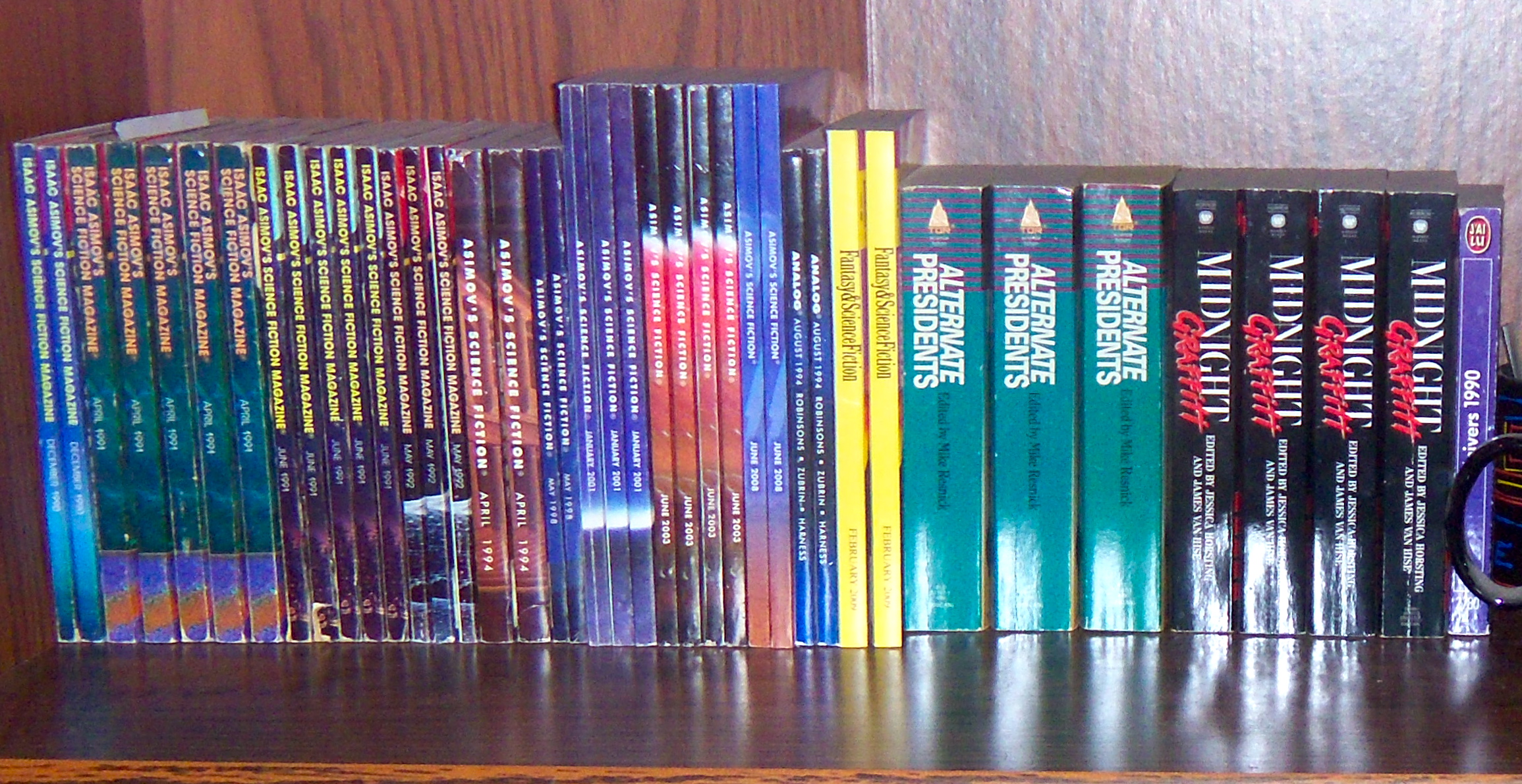
Here are some pics from the section of my reference library where I keep contributor copies of publications my work has appeared in. Before the contributor copies, there are several book auction catalogs (including from the auctions I covered here), as well as some old S. M. Mossberg and L. W. Currey book catalogs of interest. After that the actual contributor copies start. You should be able to figure out what these are from my bibliography. The exception is the black tape-bound volume on the first shelf, which is a compilation of materials handed out for a Danish class on science fiction which includes my review of Donnie Darko. I have so many copies of Jim Baen’s Universe because FACT had boxes to give away at the 2008 Nebula Awards here in Austin and I snagged some leftovers.
As usual, click to embiggen.
I have a few of these available for sale through Lame Excuse Books as well.
Previous entries on my reference library can be found here and here.
I have all my fiction shelved in alphabetical order by author within three form-factors (hardbacks, trade paperbacks, and mass market paperbacks). I leave “expansion joint,” i.e., empty slots in which to insert new acquisitions, on every shelf, but eventually they fill up and it’s time to add a new bookcase. Since they are shelved alphabetically by author, I can’t just stick the books randomly onto the new bookcase if I want to find them.
When I started out collecting books, I got the regular crappy 5-high, assemble-them-yourself particle board bookcases they sold at Target, just like every other college student. (Back then, anyway. I wonder if today’s college students use bookshelves at all.) Later, when I was a little less broke, I had some real 5-high wooden bookcases made for me (one fixed shelf in the middle, three adjustable shelves plus the base) to match the existing particle board shelves. later, when I started running out of room, I started getting 8-high bookcases (one fixed shelf, six adjustable shelves plus the base) to maximize the amount of storage space. in fact, when I moved into my new house, I immediately had three more 8-high built for me (along with a custom paperback shelf) to store books I hadn’t had room to put out in my apartment.
Because of the way the room is laid out, I’ve been replacing the five-high bookcases in my living room/library with the eight-high bookcases, and moving the five-highs back into a sort of den (with a fireplace, a futon, a coffee table, an old sofa for my dog, and the rest of the fiction bookshelves). But to do everything the “proper” way is a fairly labor intensive process:
Order the bookshelf
Take delivery
Stain the bookshelf (and this step and the next one might take several months, depending on whether I think it’s too hot to mess with, since I do it out in my garage)
Varnish the bookshelf (actually, polyurethane)
Remove all the books off the 5-high shelf (in this case, it was in the middles of the S section)
Dust the 5-high shelf with a dust mop
Dust/polish the 5-high with lemon Pledge
Move the shelf back into the den, where it now falls in the middle of the V section
Move about two and a half shelves of books over from the V-W section. This is how much I need to move to incorporate all the proofs I’ve added to the library after clearing out the Nova Express review pile.
Stock the remaining shelves from the V section in the living room.
Now move books over from the next shelf.
Repeat until you reach the books removed from the 5-high and stacked on the table, at which point you incorporate those.
Keep in mind that every time I clear a shelf of books, I:
Take a dust mop to the shelf
Dust the shelf with lemon Pledge
Flip the adjustable shelf over to prevent bowing
Let the shelf dry at least an hour or two; and
Add expansion joints (i.e., empty spots) when you move books back onto the shelves. There are also a few odd cases, where I leave additional spots if I think I’ll be adding be adding more than a book or two to that shelf, such as books I’ve already ordered, very prolific writers I pick up everything by (Joe R. Lansdale and Charles Stross both come to mind), or series gaps I know I want to fill (I’m missing some of the Datlow/Windling Year’s Best volumes).
Continue the book-moving process over a course of weeks until all the shelves have been cleaned and stocked.
This is not a difficult process, but it is time-consuming (and by now I’m mostly done). But it prevents heartache in the long-run, because my collection remains alphabetized, the shelves clean and in good shape. And I can always lay my hands on a book when I need to. (There was another bookseller/collector who packed up his library willy-nilly, depending on what fitted in the box, and it was very frustrating experience trying to pull things from those myriad boxes when he wanted to sell something to me…)
Humper Monkey’s Ghost Story has just about everything you could ask for in a haunted building story. Inexplicable occurrences, dead bodies, a Nazi past, and lots of general creepiness. Oh, and it’s theoretically true. It seems to have originally been posted on Something Awful.
Be forewarned that it’s really long; plan to set aside an hour or two if you want to read the whole thing, as it’s easily novella length.
And, if that weren’t enough, there seems to be more to the story here. It gets a bit less subtle.
I also hope Humper-Monkey gets a cut of this, and it’s not just somebody ripping him off.
The story, which I have not been able to confirm, is that black goat farmer Oscar Washburn and his family near Denton, Texas were killed by the Klan in August of 1938. (Some set the date even earlier, which does suggest a certain lack of historical evidence.) From there you get the usual hauntings, abandoned cars, etc.
Here’s a mercifully brief video:
Of course, the Denton, Texas Goatman is not to be confused with the Maryland Goatman, who seems to be a Satyr-like half goat/half man creature carrying an axe.
“Hey, that sounds pretty unbelievable,” you say, “but is there a cheesy reality TV video with ominous music, various clip art, some BS theorizing, and random morons walking around in a forest at night to make the story more convincing?”