Posts Tagged ‘Science Fiction’
Sunday, March 4th, 2012
Philip K. Dick died 30 years ago, on March 2, 1982.
Dick was already a major science fiction writer before he died, but since his death he has come to loom over popular culture in a way that other near contemporary SF writers of similar stature (say, Roger Zelazny, Samuel R. Delany, Harlan Ellison, and John Brunner) have not. Dick’s themes of paranoia and unreality continue to resonate in a world where almost every human action is permanently recorded, an where so many of us live lives half in a world of unreality (said a man typing in his blog).
Dick’s prose may often have been workman-like, but his vision and voice were unique, and his sheer productivity was staggering not only for its quality, but also it quantity. Between 1961 and 1966, Dick wrote:
The Man in the High Castle
We Can Build You
Martian Time-Slip
Dr. Bloodmoney, or How We Got Along After the Bomb
The Game-Players of Titan
The Simulacra
The Crack in Space
Now Wait for Last Year
Clans of the Alphane Moon
The Three Stigmata of Palmer Eldritch
The Zap Gun
The Penultimate Truth
His portion of Deus Irae (later finished by Roger Zelazny)
The Unteleported Man
The Ganymede Takeover (with Ray Nelson)
Counter-Clock World
Do Androids Dream of Electric Sheep?
Nick and the Glimmung
Ubik
That’s in order of composition. Some of those are minor works, and many were only published later or after his death, but five or six are considered classics. Had an otherwise unknown SF writer written just one Dr. Bloodmoney or Ubik, they would still be remembered today as the one-hit wonder of a minor classic. To think that Dick cranked them out in six years (and was just as productive writing short stories earlier in his career) is pretty mind-boggling.
I recently read Clans of the Alphane Moon on the way back from Stavanger, and I hope to have a review up in the not so distant future.
(Also, I have a few Dick firsts and paperback reprints available through Lame Excuse Books.)
Tags:Books, Philip K. Dick, Science Fiction
Posted in Books, Movies, Science Fiction | 1 Comment »
Wednesday, February 15th, 2012
Those of you who have been reading my Locus Online reviews for a while know that I’m a fan of the Japanese anime series Ghost in the Shell: Stand Alone Complex. One of the many interesting features of that series is a super-hacker known as “Laughing Man” who is so proficient he’s able to hack streaming video in real time, plastering his logo over the faces of various people in the video:

I’ve always admired the compelling, iconic simplicity of that logo, and how well it fit into the overall arc of the show’s first season. Which is why I found this piece on just how it was designed interesting.
Tags:Anime, design, Ghost in the Shell: Stand Alone Complex, postcyberpunk, Science Fiction, TV
Posted in pics, Science Fiction, TV | No Comments »
Saturday, February 4th, 2012
Better late than never!
In the Before Time, the Long Long Ago (i.e., before I started this blog), I would ask The Vast Wisdom of Usenet (i.e. rec.arts.sf.written) what books I should read this year. Now that I have the blog, I’m posting the question here.
Below are 100 books (or a few more, counting multiple titles by a single author) of fiction I’m considering reading in 2012. With a few exceptions (like forthcoming books), they’re pretty much all books I already own in first editions. Most likely I’ll get to considerably less than 100. The first few are books I’ll probably get to (or are already reading), whereas the rest are a little vaguer (and in alphabetical order by author). That’s where you come in. Tell me which of the books below I should or shouldn’t read, and why. If a book’s not on the list, it’s probably because I’ve already read it, or have no interest in it, won’t get to it this year, etc., so save your electrons instead of suggesting alternates (there are plenty of other places for that). And if I list Book #2 in a linear series, rest assured I’ve already read Book #1.
I don’t promise I’ll read all the highest rated works, but those most highly praised are considerably more likely to be added to the reading stack, which is what’s happened the previous years I’ve done this.
Michael Shea: The Color Out of Time (read)
Jack Vance: The Killing Machine (read)
Stina Leicht: Of Blood & Honey (reading)
Joe R. Lansdale: Hyenas
Joe Dominici: Bringing Back the Dead
China Mieville: Embassytown
Robert Jackson Bennett: Company Man
Vernor Vinge: The Children of the Sky
Philip K. Dick: Clans of the Alphane Moon
Michael Moorcock: The War Hound and the World’s Pain
Greg Egan: Crystal Nights
Peter Ackroyd: Hawksmoor
Paolo Bacigalupi: The Windup Girl
Iain Banks: Against a Dark Background or Matter
John Barnes: Kaleidoscope Century or One for the Morning Glory
Stephen Baxter: Traces or Mayflower II
Peter S. Beagle: A Fine and Private Place
Greg Bear: The City at the End of Time or Hull Zero Three
Leigh Brackett: The Best of Leigh Brackett or The Long Tomorrow
David Brin: Dr. Pak’s Preschool
Tobias Buckell: Sly Mongoose or Tides from the New World
Octavia Butler: Fledgeling
Jack Cady: The Night We Buried Road Dog
Ramsey Campbell: Creatures of the Pool
Michael Chabon: The Amazing Adventures of Kavalier and Clay
John Christopher: No Blade of Grass
Susanna Clarke: Ladies of Grace Adieu
Hal Clement: Iceworld
Avram Davidson: The Adventures of Dr. Esterhauzy or Limekiller
L. Sprague de Camp: A Gun for Dinosaur
Bradley Denton: Laughin’ Boy
Junot Diaz: The Brief Wondrous Life of Oscar Wao
Paul Di Filippo: Lost Pages or A Princess of the Linear Jungle
George Alec Effinger: What Entropy Means to Me
Harlan Ellison: Deathbird Stories
Greg Egan: Crystals Nights or Zendegi
John M. Ford: The Dragon Waiting
Neil Gaiman: Fragile Things or The Graveyard Book
Hinko Gotleib: The Key to the Great Gate
John Gardner: Freddy’s Book or The Wreckage of Agathon
Ray Garton: Night Life or Nids
Jane Gaskell: The Serpent
Joe Haldeman: The Accidental Time Machine
Peter F. Hamilton: Mindstar Rising
Robert E. Howard: The Coming of Conan
Nalo Hopkinson: Brown Girl in the Ring or The Salt Roads
Shirley Jackson: We Have Always Lived in the Castle or The Lottery
K. W. Jeter: Noir or Dark Seeker
Ha Jin: Waiting
James Patrick Kelly: Strange But Not a Stranger
Stephen King: Dark Tower IV: Wizard and Glass or The Colorado Kid
Russell Kirk: The Surly Sullen Bell (and yes, I’ve read the 2 Arkham House collections)
Henry Kuttner and/or C. L. Moore: The Dark World or Black God’s Shadow or No Boundaries
R. A. Lafferty: Archipelago, Aurelia, or The 13th Voyage of Sinbad
Fritz Leiber: Night’s Black Agents
Jonathan Lethem: Motherless Brooklyn
Thomas Ligotti: Grimscribe, Noctuary, or The Shadow at the Bottom of the World
Ian MacLeod: Breathmoss and Other Exhalations
Ken MacLeod: Giant Lizards from Another Star or The Execution Channel
Gregory Maguire: Wicked
Barry Malzberg: Hervoit’s World
Richard Matheson: Duel
Maureen McHugh: Mothers and Other Monsters
Sean McMullen: The Miocene Arrow
Ward Moore: Bring the Jubilee
Richard Morgan: Woken Furies
Pat Murphy: The Falling Woman
John Myers Myers: Silverlock
William F. Nolan: Things Beyond Midnight or Wild Galaxy
Naomi Novik: Black Powder War
Chad Oliver: The Shores of Another Sea or The Winds of Time
Susan Palwick: The Fate of Mice
H. Beam Piper: Lord Kalvan of Otherwhen
Tim Powers: Three Days to Never or Pilot Light
Fletcher Pratt: The Well of the Unicorn
Mike Resnick: Paradise or Kilimanjaro
Alastair Reynolds: Redemption Ark
Rudy Rucker: Master of Time & Space or The Secret of Life or White Light
Matt Ruff: Fool on the Hill
Salman Rushdie: Midnight’s Children
Joanna Russ: The Female Man
John Scalzi: The Lost Colony
Karl Schroeder: Permanence or Lady of Mazes
Michael Shaara: The Herald or The Killer Angels
Lucius Shepard: Floater or Aztechs or Viator
Lewis Shiner: The Edges of Things or Black and White
Dan Simmons: The Terror or Hard as Nails
Robert Sladek: Roderick
Neal Stephenson: Zodiac or The Big U
Charles Stross: The Apocalypse Codex (forthcoming)
Theodore Sturgeon: Microcosmic God: The Complete Stories of Theodore Sturgeon Volume 2
Steph Swainston: The Year of Our War
Thomas Burnett Swann: The Day of the Minotaur
Manly Wade Wellman: The Sleuth Patrol or The Last Mammoth
Martha Wells: The Element of Fire
John Whitbourne: To Build Jerusalem or Binscomb Tales
Jack Williamson and James E. Gunn: Star Bridge
Connie Willis: To Say Nothing of the Dog
Gene Wolfe: The Land Across (forthcoming)
Tags:Fantasy, Gene Wolfe, Horror, Jack Vance, Joe Domenici, Joe R. Lansdale, Manly Wade Wellman, Paolo Bacigalupi, Philip K. Dick, Robert Jackson Bennett, Science Fiction, Stina Leicht
Posted in Books, Fantasy, Horror, Science Fiction | 5 Comments »
Thursday, January 26th, 2012
I don’t have a love/hate relationship with The New York Review of Science Fiction, but I do have a “Love/Meh” relationship with it. I’ve been a subscriber lo these many years, and have contributed the occasional piece. But frequently much of it will either strike me as the sort of close-reading, semiotic, postmodern academic grab fanny (“The Anvil of Dissonance: Contextualizing the Other in the Early Work of Joanna Russ”) that I tried to stay away from back when I was publishing Nova Express, or subjects that, while theoretically worthy of study, I would get so little out of that I see no point in spending the time to read (“The Evolution of the French Vampire Novel: 1867—1894”).
But every now and then they publish something absolutely vital to my interests.

This month it was Andrew Ferguson’s piece on unpublished R. A. Lafferty works, which is much more extensive than either the list in The SF Book of Lists or anywhere online. I knew about the unpublished In a Green Tree volumes and a few others, but there’s lots of stuff I’ve never heard of, including the novels:
Loup Garou, a werewolf mystery
Civil Blood, an anti-communist novel
Antonio Vescovo, a very early novel described as “a cross between Rabelais and The Lives of the Saints” (!)
Dark Shines, about gifted children and an evil protagonist, and
When All the World Was Young, a plague novel in which everyone over the age of 10 is killed.
And there’s a huge list of unpublished stories, poems and essays as well. All of which I’ll no doubt end up buying when it comes out.
If you’re a Lafferty fan, it’s well worth your $4 to pick up a copy of this issue.
Tags:Books, Fantasy, New York Review of Science Fiction, R. A. Lafferty, Science Fiction, unpublished works
Posted in Books, Fantasy, Science Fiction | 10 Comments »
Wednesday, January 25th, 2012
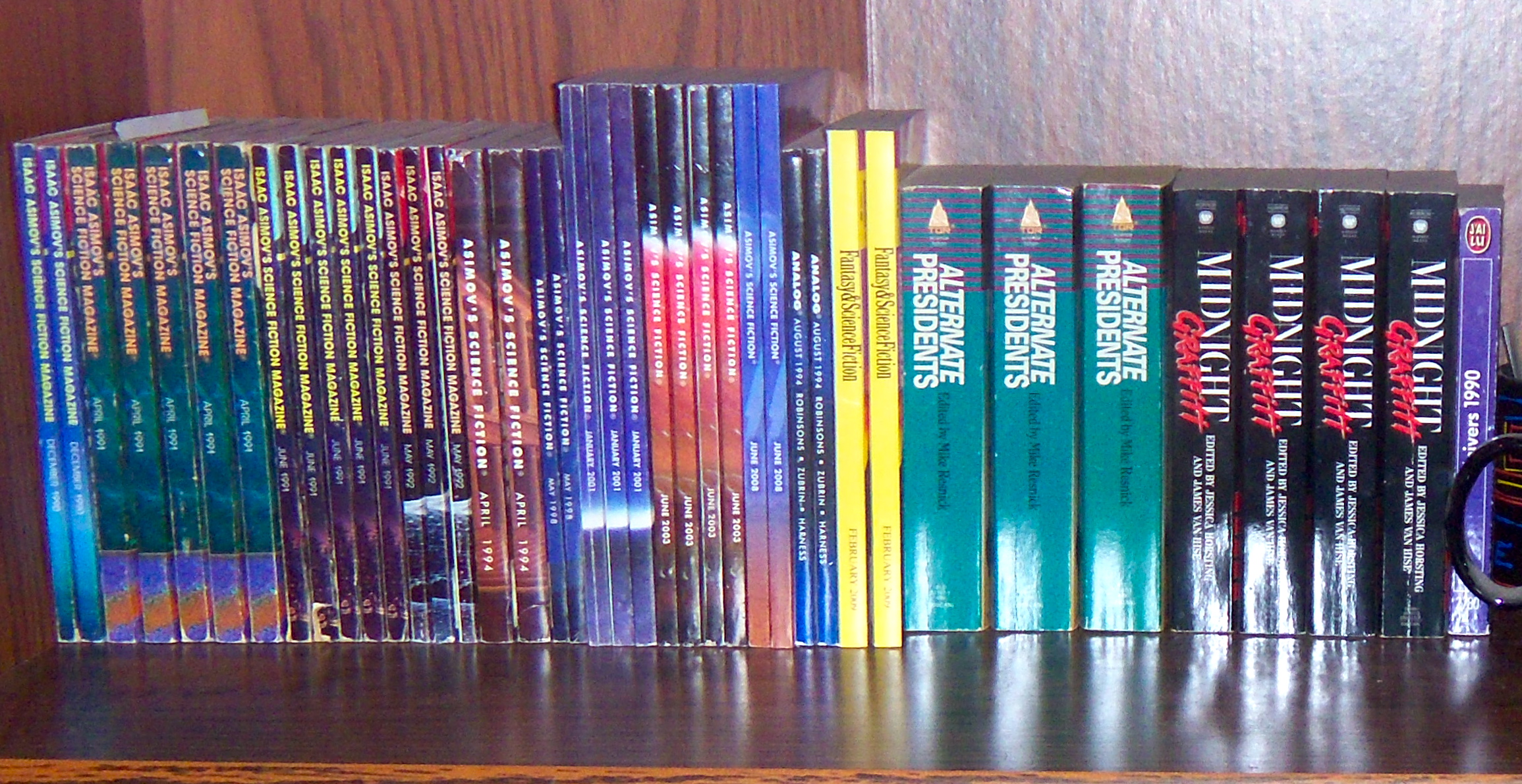
Here are some pics from the section of my reference library where I keep contributor copies of publications my work has appeared in. Before the contributor copies, there are several book auction catalogs (including from the auctions I covered here), as well as some old S. M. Mossberg and L. W. Currey book catalogs of interest. After that the actual contributor copies start. You should be able to figure out what these are from my bibliography. The exception is the black tape-bound volume on the first shelf, which is a compilation of materials handed out for a Danish class on science fiction which includes my review of Donnie Darko. I have so many copies of Jim Baen’s Universe because FACT had boxes to give away at the 2008 Nebula Awards here in Austin and I snagged some leftovers.
As usual, click to embiggen.
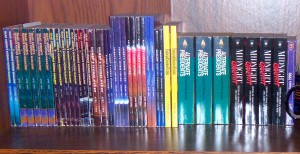
I have a few of these available for sale through Lame Excuse Books as well.
Previous entries on my reference library can be found here and here.
Tags:auction, book auction, Books, Fantasy, First Edition, Heritage Auctions, Horror, Library, pics, Professional Library, reference works, Science Fiction
Posted in Books, Fantasy, Horror, pics, Science Fiction | 1 Comment »
Monday, January 2nd, 2012
One more for 2011:
This article in The Economist points out that Hugo Gernsback’s Ralph 124C41+ (one to foresee for one) was published 100 years ago. The article calls it “arguably the first major work of American science fiction.” Well, no. There were a lots of examples of American SF before that, as both the late Everett Bleiler and the very much alive Jess Nevins could point to no end of antecedent examples. But Ralph 124C41+ is probably the first novel overwhelmingly concerned with the idea that technology will change almost every aspect of the quotidian lives of ordinary people. In weird way it’s sort of a cyberpunk precursor. That’s why, for all the clumsy prose, the “As you know Bob” infodumps, the hackneyed romance-and-rescue plot, and the paper thin characters, the work remains a cornerstone of American science fiction.
That said, it’s not for everyone. It isn’t quite unreadable (I like it a bit better than Horace Walpole’s The Castle of Otranto), but it’s close. Today its importance is entirely historical, and only real students of the field should give it a try. (I was quite surprised when Charlie Brown admitted he hadn’t read it on a panel we were on at the 2006 Worldcon in Anaheim.)
(Hat tip: Locus Online.)
Tags:Books, cyberpunk, Hugo Gernsback, Science Fiction
Posted in Books, Science Fiction | No Comments »
Wednesday, December 14th, 2011
The book buying continues apace here at Stately Person Manor. I plan to have a comprehensive roundup of every damn thing I bought toward the end of the year (which is nigh), but here are a few particularly interesting, obscure, and/or lustworthy books I’ve picked up since Worldcon (a;; pics enbiggenable):
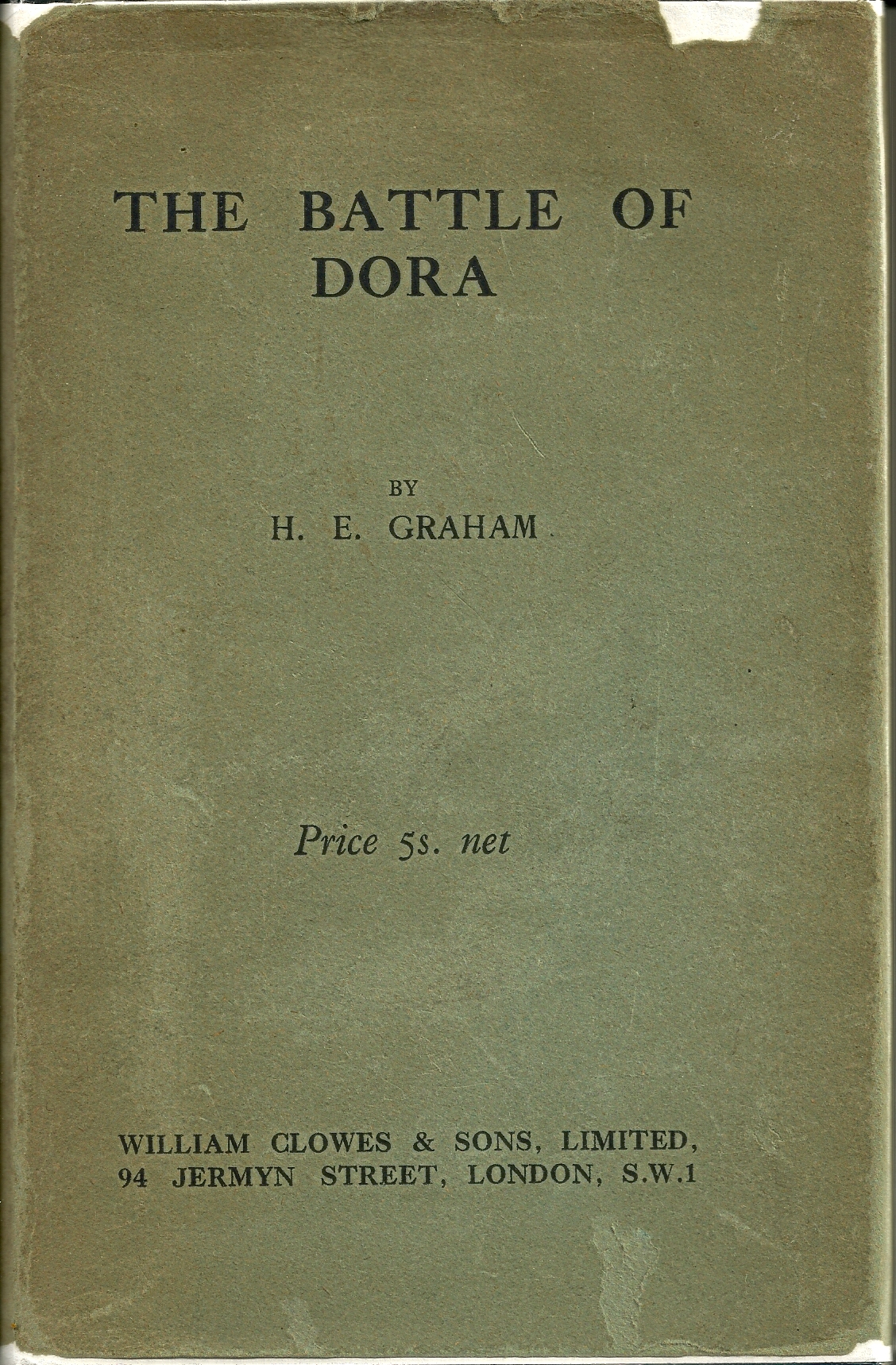
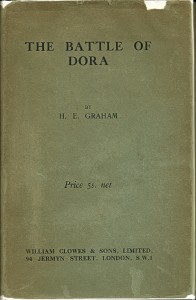
Graham, H. E. The Battle of Dora. William Clowes & Sons, Ltd. 1931. First edition hardback, a Very Good copy in a Good+ dust jacket with three 1/4″ chips at edges. Future war book set in an imaginary European country concerned with primarily with the evolving tactics of mechanized warfare. With fold-out maps!
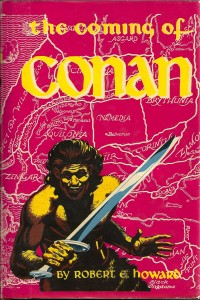
Howard, Robert E. The Coming of Conan. Gnome Press, 1953. First edition hardback, a Near Fine+ copy with slight bends at head and heel and slight foxing to strip along front and back gutters, in a Near Fine dust jacket with slight dust staining to white rear cover and a few touches of rubbing to spine panel (but no spine fading). This completes my Robert E. Howard Gnome Press Conan collection. (At some point I suppose I’ll pick up the De Camp and Nyburg volume but, eh. what’s the rush?)
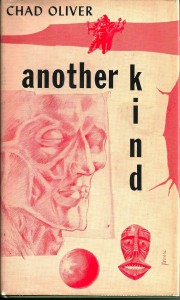
Oliver, Chad. Another Kind. Ballantine Books, no date (1955). First edition hardback (an unrecorded variant binding of green boards with red lettering), a Near Fine copy with slight age-darkening to page (most noticeable in one signature) and slight bending at head and heel in a Near Fine dust jacket with slight age darkening and touches of wear at extremities. Actually quite nice. All of the Ballantine SF hardbacks if this era are hard to find.
Tags:Chad Oliver, Fantasy, First Edition, Robert E. Howard, Science Fiction, tanks
Posted in Books, Fantasy, Science Fiction | No Comments »