John Belushi’s 30th on March 5.
H. P. Lovecraft’s 75th on March 15.
I think it’s safe to say that the names of those two have seldom been linked together…
John Belushi’s 30th on March 5.
H. P. Lovecraft’s 75th on March 15.
I think it’s safe to say that the names of those two have seldom been linked together…
Henry Kuttner’s The Dark World
Ace, 1965.
At his best, Henry Kuttner was one of top SF/F writers of the Golden Age.
The Dark World is not Henry Kuttner at his best.
Essentially I only picked this up because it had been a while since I read any Kuttner, and this paperback original fit nicely in my bag on my trip to Stavanger. Even though this shows up on the Cawthorn and Moorcock Fantasy 100 list, and Roger Zelazny cites it as an influence on the Amber books, it’s a very uneven (and sometimes overwritten) parallel world fantasy. Protagonist Edward Bond has returned home after a plane crash and long period of jungle convalescence in World War II. He finds himself drawn from his house to a “need fire” by people claiming to need his help in another world. Traveling to the world with them, he discovers he’s actually Ganelon, one of the leaders of The Coven, who ruled the dark world of the title, and who has been bonded to Llyr, a powerful being who demands sacrifice. Ganelon had been exchanged for Bond (his doppelganger on earth) by the magic of his enemies, but whose memories of the dark world are still incomplete. After his fellow Coven members secretly dress him in the robes of sacrifice, he decides that some adjustment of loyalties is in order…
Despite it’s brevity (The Dark World clocks in at 126 pages), modern readers are likely to have problems with this. For one thing, the prose occasionally takes florid flights that betray its pulp-era origins. (“Medea and Edeyrn and Matholoch! The names of the three beat like muffled drums in my brain.”) Exclamation points are freely dispensed, frequently in one-word sentences. (“Llyr! the though of it-of him-crystallized that decision in my mind.”) In the world of post-Lord of the Rings fantasy, the Dark World seems both underdeveloped and under-populated, and the semi-scientific mutant explanation is unconvincing.
It’s not awful; the story moves along at a steady clip. There are also a few points of formal novelty. It was probably rare to have a novel told from the viewpoint of the bad guy, and who remained the bad guy, pretty much all of the novel. Also, the scene where Edward Bond and Ganelon face off against each other in some sort of nether corridor between the worlds makes you wonder if Don Ingalls, the screenwriter for the Star Trek episode “The Alternative Factor,” read The Dark World, given the obvious parallels.
if you haven’t read any Kuttner, this is not the one to start with.
From The New Yorker comes this tale of an old fashioned book scout beating the scanner guys at their own game.
Philip K. Dick died 30 years ago, on March 2, 1982.
Dick was already a major science fiction writer before he died, but since his death he has come to loom over popular culture in a way that other near contemporary SF writers of similar stature (say, Roger Zelazny, Samuel R. Delany, Harlan Ellison, and John Brunner) have not. Dick’s themes of paranoia and unreality continue to resonate in a world where almost every human action is permanently recorded, an where so many of us live lives half in a world of unreality (said a man typing in his blog).
Dick’s prose may often have been workman-like, but his vision and voice were unique, and his sheer productivity was staggering not only for its quality, but also it quantity. Between 1961 and 1966, Dick wrote:
That’s in order of composition. Some of those are minor works, and many were only published later or after his death, but five or six are considered classics. Had an otherwise unknown SF writer written just one Dr. Bloodmoney or Ubik, they would still be remembered today as the one-hit wonder of a minor classic. To think that Dick cranked them out in six years (and was just as productive writing short stories earlier in his career) is pretty mind-boggling.
I recently read Clans of the Alphane Moon on the way back from Stavanger, and I hope to have a review up in the not so distant future.
(Also, I have a few Dick firsts and paperback reprints available through Lame Excuse Books.)
First up, from the world of auctioning, comes the offering of the exceedingly rare issue of June 1926 Zeppelin Stories pulp containing Gil Brewer’s “The Gorilla of the Gas Bags,” a holy grail for gorilla and zeppelin fans everywhere.

This issue formerly belonged to SF writer and pulp collector Frank M. Robinson. Bidding is currently up to $2,000, which does rather take it out of the impulse purchase range for me. Assuming, of course, that Rick Klaw, Jess Nevins and Mark Finn didn’t all chip in together to purchase it. But really, it’s a comparative bargain right now, since one just sold for $6,572.50…
Second, as seen on Fark, a giant mechanical gorilla was found abandoned in Witchford, Cambridgeshire, UK.

Insert your own gorilla in the mist joke here…
I attended a signing at BookPeople for Three Messages and a Warning: Contemporary Mexican Short Stories of the Fantastic, co-edited by Turkey City’s own Chris Brown (formerly Chris Nakashima-Brown, now renamed after a long and painful de-Japanization process).

The event was fairly well attended, with about 40-50 people showing up.
Two of the authors flew up for the event: Pepe Rojo of Tijuana:

And Bernardo Fernandez of Mexico City (who also works as a graphics artist and teacher, as well as a crime writer):

(I’m not sure if you can tell, but Bernardo’s shirt features a robot (or possibly an android) and an electric sheep.) I believe he mentioned that he was working on a graphic novel about William S. Burrough’s time in Mexico. I bet it ends with a bang.
I also found it interesting that both of their fathers were engineers.
In attendance were also many members of the Austin SF community, including a few that my pictures of weren’t completely awful:

Stina Leicht and Sara Felix.

Jessica Reisman, a few moments before the police arrested her for the Hollywood scriptwriter they found dead facedown in her pool.
On Saturday, there was a party at Chris Brown’s newly opened East Austin hipster-pad-cum-1970s-science-fiction-movie-set. Sadly, none of my photos of the house (taken at dusk) came out well. But I did get a few pics of the party attendees:

Don Webb, who co-edited one of the most influential Spanish-language anthologies of speculative fiction, for which he was paid $50 and three bottles of Tequila.

Stina and Jessica redux.
The rest of my pictures were various degrees of crappy. (Hopefully Jayme Blaschke, who was there with a bigger, better camera, will put some up.) Sadly, one picture that didn’t come out was that of Bernardo wearing a t-shirt depicting Mexico’s most famous science fiction character: Bender Bending Rodriguez.
Finally, no expects the Spanish Steampunk Zeppelin!

I don’t have a love/hate relationship with The New York Review of Science Fiction, but I do have a “Love/Meh” relationship with it. I’ve been a subscriber lo these many years, and have contributed the occasional piece. But frequently much of it will either strike me as the sort of close-reading, semiotic, postmodern academic grab fanny (“The Anvil of Dissonance: Contextualizing the Other in the Early Work of Joanna Russ”) that I tried to stay away from back when I was publishing Nova Express, or subjects that, while theoretically worthy of study, I would get so little out of that I see no point in spending the time to read (“The Evolution of the French Vampire Novel: 1867—1894”).
But every now and then they publish something absolutely vital to my interests.

This month it was Andrew Ferguson’s piece on unpublished R. A. Lafferty works, which is much more extensive than either the list in The SF Book of Lists or anywhere online. I knew about the unpublished In a Green Tree volumes and a few others, but there’s lots of stuff I’ve never heard of, including the novels:
And there’s a huge list of unpublished stories, poems and essays as well. All of which I’ll no doubt end up buying when it comes out.
If you’re a Lafferty fan, it’s well worth your $4 to pick up a copy of this issue.
Here are some pics from the section of my reference library where I keep contributor copies of publications my work has appeared in. Before the contributor copies, there are several book auction catalogs (including from the auctions I covered here), as well as some old S. M. Mossberg and L. W. Currey book catalogs of interest. After that the actual contributor copies start. You should be able to figure out what these are from my bibliography. The exception is the black tape-bound volume on the first shelf, which is a compilation of materials handed out for a Danish class on science fiction which includes my review of Donnie Darko. I have so many copies of Jim Baen’s Universe because FACT had boxes to give away at the 2008 Nebula Awards here in Austin and I snagged some leftovers.
As usual, click to embiggen.


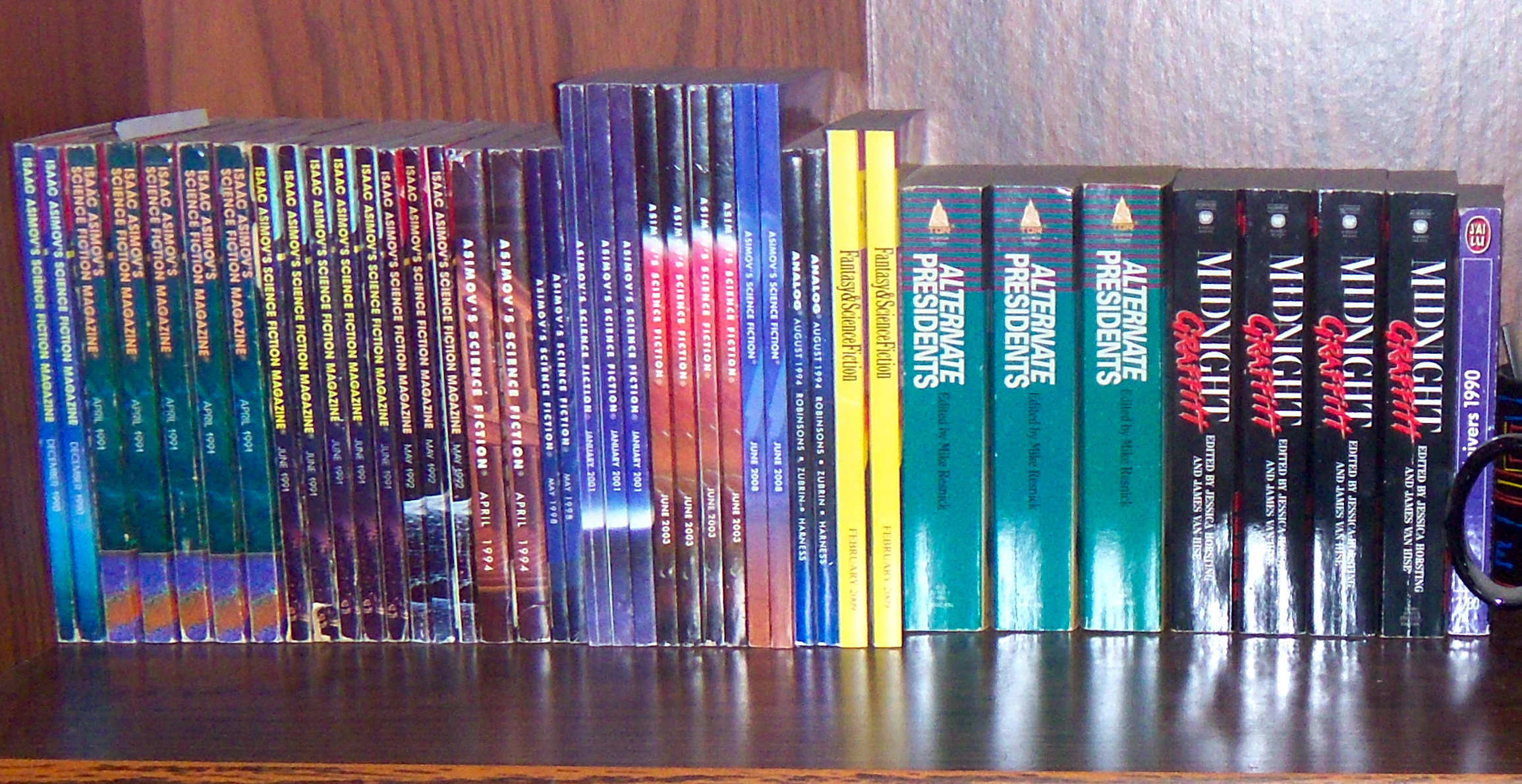
I have a few of these available for sale through Lame Excuse Books as well.
Previous entries on my reference library can be found here and here.
William Gibson has a new book out, Distrust That Particular Flavor, collecting his non-fiction output. Gibson’s essays are usually interesting and thought-provoking.
Paul Di Filippo offers a review, as does The New York Times.
The list of the top 500 books (or related paper items) to sell at auction for 2011 is now available. Beyond a first edition of Gulliver’s Travels, there was no SF I could spot, but a number of interesting items, including Action Comics #1, the founding documents for Apple Computer, the original manuscript for an unfinished Jane Austen novel, and the usual assortment of illuminated manuscripts. Also, a copy of Raymond Chandler’s The Big Sleep inscribed to his wife; at $254,500, that may be the most I’ve ever seen a work of 20th century American fiction go for.
And here are all 500 books in a handy spreadsheet format.